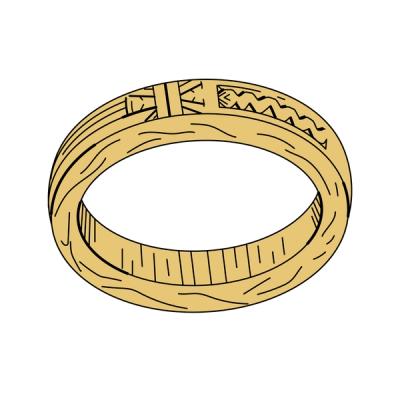
Ẹgba
Ẹgba (bracelets) are worn as part of ceremonial costumes and could be made of brass, bronze, iron, ivory or wood. The material determines the status of the individual wearing it, as the Ọba controls the use and production of brass, bronze and ivory. Ẹgba is the designation used to describe bracelets worn around the upper arm that could potentially become amulets by putting charms or medicine in them.
Based on the information available today, it is not possible to know whether the Ẹgba were worn around the upper arm or the wrist, therefore it has been decided to group together all objects variously described as ‘bracelets’, ‘arm rings’, ‘armlets’ and ‘bangles’ are here as Ẹgba. Some bracelets may have been worn as a symbol or reflection of an individual’s political and/or social status – for example, brass bracelets with horse heads were worn only by the Ọba and certain powerful chiefs to show ‘dignity and achievement’ (Curnow in Plankensteiner, 2007, p.351 ).
Meanwhile, others contain or may have been ‘cooked’ in medicine to serve specific functions, such as protection. According to Curnow (in Plankensteiner 2007, p.351 ), ‘visible medicine’ would also have acted as a visual message declaring the ritual powers of the wearer.
Educational Material
Digital Benin collates digital material from institutions, and some of this material is inherently colonial and contains words, terms and phrases that are inaccurate, derogatory and harmful towards African and African diasporic communities. Catalogue transcriptions, book titles, exhibition titles and museum titles may contain harmful terms. We recognise the potential for the material to cause physical and mental distress as well as evoke strong emotions. Owing to the scale of the collection’s data, a process to implement sensitive-content warnings in the displayed data is still incomplete. The material within the catalogue does not represent Digital Benin’s views. Digital Benin maintains a strong anti-colonial, anti-racist position and affirms its support for centring the humanity of historically marginalised and disenfranchised communities. Read more about the background of this statement here