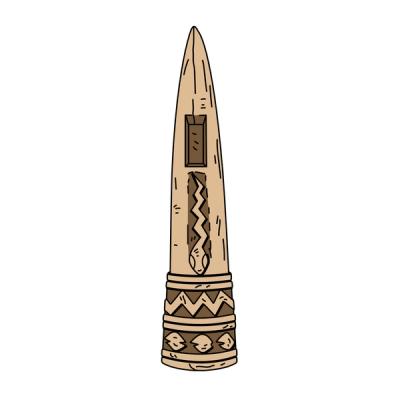
Akohẹn/Oko
Oko are side-blown horns and Akohẹn are flutes, however since the instruments look very similar they are grouped together here. Oko are frequently used by priests to evoke spirits and by traditional doctors to drive away witches when attending to a patient that may have been afflicted by a witch. Oko can also serve as an object of commemoration; when a new Ọba sends an ivory Oko to be kept at the Olokun Shrine in Ughoton, it is to commemorate his accession to the throne. Akohen, on the other hand, is a flute. Egharevba (1968:40 ) dates the Akohen to the era of Ọba Eresoyen.
Side-blown wind instruments, sometimes referred to as trumpets, horns or flutes in English, were used in Edo ritual to ‘call the ancestors’. Although typically carved from ivory, there are also a number which are cast in bronze – whether these were also usable for sound-making purposes is not clear. Trumpets are depicted on relief plaques, providing an insight into how they were worn as part of ceremonial attire. Furthermore, there are also some horn-blower or flute-player figures depicting court musicians playing these objects.
Educational Material
Digital Benin collates digital material from institutions, and some of this material is inherently colonial and contains words, terms and phrases that are inaccurate, derogatory and harmful towards African and African diasporic communities. Catalogue transcriptions, book titles, exhibition titles and museum titles may contain harmful terms. We recognise the potential for the material to cause physical and mental distress as well as evoke strong emotions. Owing to the scale of the collection’s data, a process to implement sensitive-content warnings in the displayed data is still incomplete. The material within the catalogue does not represent Digital Benin’s views. Digital Benin maintains a strong anti-colonial, anti-racist position and affirms its support for centring the humanity of historically marginalised and disenfranchised communities. Read more about the background of this statement here