About About
Digital Benin was developed between 2020 and 2026 through an international and interdisciplinary collaboration, bringing together researchers, developers, designers and Edo scholars and knowledge holders across Nigeria, Europe, the US and beyond. Hosted by MARKK and supported by the Ernst von Siemens Kunststiftung, Gerda Henkel Foundation and Mellon Foundation, the project connected diverse forms of knowledge and perspectives to shape research, documentation, data, design and technical infrastructure, deepening understanding of histories and continuing cultural lives of Benin heritage.
The fieldwork undertaken in Nigeria between 2020 and 2026 formed an important foundation for Digital Benin’s engagement with oral history, local knowledge and Edo perspectives on the history of the Benin Kingdom. The work combined the collection and digitisation of object data from Nigerian institutions with field research, oral history interviews, documentation of cultural practices and the development of Itan Edo and the Benin Kingdom map.
This process was designed by Osaisonor Godfrey Ekhator-Obogie and Eiloghosa Obobaifo, members of the Digital Benin research team from Benin City, to establish an Edo-centred approach to creating a digital platform documenting historical Benin objects that are now dispersed globally or held in Nigerian institutions. Rather than treating local knowledge as supplementary to institutional records, the fieldwork sought to establish relationships between objects, people, places, historical traditions and contemporary cultural knowledge.
Fieldwork and the digitisation of Nigerian collections
The first stage of documentation in Nigeria was to identify stations of the National Commission for Museums and Monuments (NCMM) across the country that held historical Benin objects within the scope of the project.
Three stations were identified and visited by Osaisonor Godfrey Ekhator-Obogie and Eiloghosa Obobaifo. At the National Museum Benin, catalogue cards for collections that had not previously been digitised were photographed, and the curator made an inventory of the collection available to the research team. The process took approximately one week with the support of museum staff.
The National Museum Owo was also visited. The research team found relatively few objects within the scope of Digital Benin, although the museum's logbook and inventory records contained objects relating to the historical social relations between Benin and Owo, including female body ornaments such as ivory bracelets.
At the National Museum Lagos, more than forty thousand catalogue cards had to be sorted to identify records relating to historical Benin objects. This involved the museum's storekeepers and the cooperation of the curator. Finding the relevant catalogue cards and photographing each card required substantial work, but was significant because the NCMM had not previously digitised these cards or created a digital database for its collections. Digital Benin therefore created a digital record of this information and connected it with other museum data on the platform.
The NCMM acted as a collaborator throughout this process, providing access to collections, materials and staff. The digitisation of these records provided an important basis for connecting Nigerian institutional collections with the dispersed collections documented through Digital Benin.
Fieldwork, oral traditions and local knowledge
Alongside the collection of institutional records, the fieldwork in Benin City and its environs was devoted to documenting a multiplicity of voices and perspectives. The research sought contributors with established knowledge in particular areas, including chiefs and elders, cultural practitioners, artists, guild members and other knowledge holders.
Collecting oral histories among the Benin people required extensive preparation and planning. Potential contributors were identified according to their background, experience, titles and designations, location and areas of knowledge. Some were invited to narrate historical accounts of particular subjects, while others contributed songs and oral traditions that were considered culturally and historically significant.
Some prospective contributors declined to participate. The oral histories and traditions passed down between generations were documented through multiple forms of media. Storytelling through song and narration, as well as other forms of artistic expression embedded in everyday rituals and cultural practices, formed part of the research.
The fieldwork was conducted as qualitative research, including participant observation, interviews, field-note journaling and written consent procedures. Open-ended interviews enabled contributors to narrate historical accounts and describe cultural traditions without being restricted by a predetermined structure. Questions were introduced in response to contributors' accounts, while in most cases conversations were allowed to develop freely.
Participant observation was also an important component of the research. For example, the research team visited a bronze-casting foundry every day for more than two weeks in order to document, learn from and speak with practitioners. The processes of bronze casting were filmed continuously to document the different stages of the lost-wax process, or cire perdue.
Other guilds contributed knowledge that was not widely represented in existing scholarship. At the same time, some guilds could not be contacted or interviewed because the research team was unable to secure the required collaboration of the royal court. Many guilds directly serve the Ọba, and an official directive from the monarch would have been required to make interviews possible. Existing literature and oral traditions from non-guild members were therefore used to address gaps in the documentation.
The research team also encountered difficulties accessing government archives. The Edo State Government was contacted but did not provide a letter of intent, and bureaucratic obstacles made access to relevant archival documents difficult.
The fieldwork also documented accounts of historical events represented in art and re-enacted through cultural ceremonies. These accounts were collected to understand the cultural significance of Benin objects from the perspective of Benin people. The research therefore included both historical traditions and descriptions of living cultural practices.
Some cultural activities and ritual practices could be documented directly, while others involved restrictions based on principles of secrecy. Where such restrictions existed, the researcher navigated them with attention to the appropriate cultural and ritual practices. The researcher's background knowledge and familiarity with contributors and the wider community were important in establishing these relationships.
Contacting contributors could itself require repeated visits and conversations. Proposed contributors were contacted in person and by telephone, often on several occasions, to introduce the project, explain its purpose and establish the conditions for participation. Contributors completed consent forms giving Digital Benin permission to use and include the resulting fieldwork material on the digital platform. Some elderly contributors chose not to participate in video interviews but permitted their voices to be recorded and made available.
Expanding the oral history collection
The oral history work continued beyond the initial fieldwork period. Between 2022 and 2026, Godfrey continued to conduct and record interviews, expanding the collection of oral histories already established through the earlier research. A significant addition to this material was created through his work with a videographer in Benin City to document further oral histories.
These recordings substantially expanded the audiovisual documentation of Edo knowledge developed through the project. The resulting collection brings together contributions from chiefs, elders, scholars, artists and other knowledge holders who contextualise Benin objects within living cultural practices, rituals and ceremonies. The recordings preserve indigenous knowledge, cultural memory and historical interpretation through spoken word and provide a resource for future research, education and the safeguarding of Edo culture.
The current Oral History collection contains 110 videos. The material can be explored through multiple filters, including contributor, object ID, object group, Edo iconography, themes and kings. This allows users to approach the recordings through different forms of cultural, historical and material context.
The recordings cover a wide range of subjects. They include accounts of chiefs and palace societies, historical kings, guilds and craft practices, songs and oral traditions, objects and their uses, and historical events such as the consequences of the 1897 invasion. The collection also documents processes of making and learning, including wood carving and bronze-related knowledge, alongside songs, prayers, eulogies and historical narratives.
The oral histories are now integrated more extensively into the wider Digital Benin platform. Recordings can be connected directly to individual objects and object groups, allowing spoken accounts to be encountered alongside the material heritage to which they relate. They can also be explored in relation to Edo terminology, iconography, themes and historical figures.
This development is important because oral history is not treated simply as additional information attached to museum records. The recordings constitute a body of primary source material in their own right, while their connections to objects and other areas of the platform allow different forms of knowledge to be considered together.
Developing Itan Edo
The development of Itan Edo began during the initial fieldwork as an effort to create a historical and cultural account of the Benin people. The first version was developed through a literature review and in reference to organograms published by Plankensteiner ( 2007 p.92), Eweka ( 1992, p.25) and Igbafe ( 1979, p.32). These were reworked into a single model that could provide a structure for the hierarchical presentation of historical and cultural information on the platform.
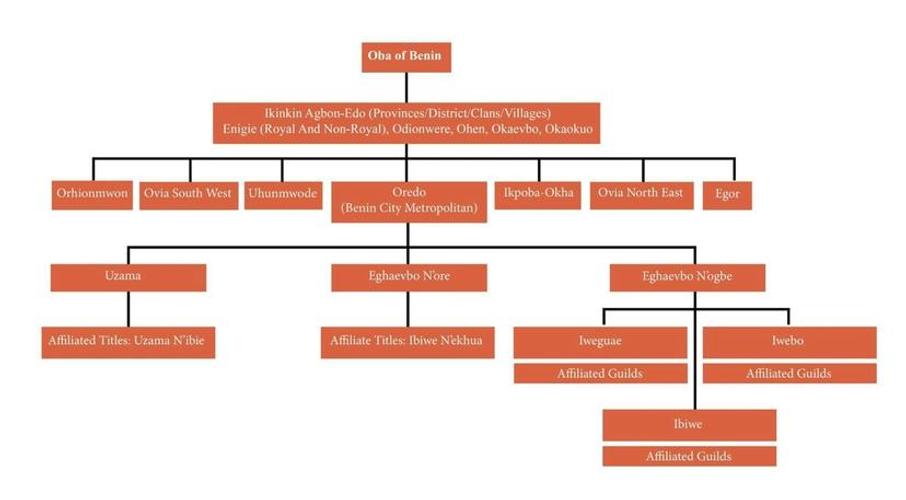
The organogram provided an initial way of communicating the relationships between different entities to the technical development team. However, the research quickly demonstrated that contextualising the Kingdom of Benin involved considerably more complexity than could be represented through a single hierarchy.
The research therefore developed beyond the initial organogram into a second iteration combining an anthology, glossary and map. The material was brought into a software environment that allowed entities described in Itan Edo to be directly linked. Nested navigation provided a flexible way to represent the research content while maintaining relationships between people, places, institutions and other entities.
An important principle throughout this development was the inclusion of texts by Benin writers and scholars. The aim was to create an interactive structure that would allow users to encounter the history and culture of the Benin Kingdom through an Edo perspective rather than relying primarily on European or US American scholarship.
The first draft of the Itan Edo research was reviewed by African and European scholars, including Prof. Dr. Kokunre A. Agbontaen-Eghafona, Prof. Dr. Barbara Plankensteiner, Dr. Felicity Bodenstein and Dr. Uyilawa Usuanlele. One outcome of the review process was the decision to distinguish three groupings for prominent women in the Kingdom of Benin according to their different roles, histories and influence: queens, Queen Mothers (Iy’Ọba) and prominent women.
The content was organised with digital publication in mind and developed as an interactive website in which historical content could be connected through links and nested structures. Mabel O. Oviahon contributed as a research assistant. The first draft was reviewed by Dr. Uyilawa Usuanlele and Prof. Victor Osaro Edo, and the comments and suggestions were incorporated into the research. The Edo language used in the text was reviewed by Aiko Obobaifo and Prof. Dr. Esohe Omoregbe, including its orthography.
The development of Itan Edo was significant not only as a historical overview but also because it provided a framework for connecting oral traditions and geographical locations to the map and for situating objects within the cultural perspectives of the Benin people. The content was designed to establish connections between people and places and between these entities and individual objects, including their material characteristics and uses.
Itan Edo in 2026
The current Itan Edo has developed substantially beyond the initial organogram and hierarchical model. Itan Edo, meaning “the story of Benin Kingdom,” presents the history of Benin from an indigenous perspective using exclusively Benin-authored sources. It covers the period from the Ogiso dynasty to the twentieth century and brings together origin stories, political developments, oral traditions and cultural practices.
The current structure connects historical events, places, rulers and institutions through multiple access points. It includes sections on the origins of the people, kings, queens, Queen Mothers and prominent women, chiefs, guilds, sites, palace societies, ancient and historical towns and villages, festivals and ceremonies, family salutations and proverbs.
The section on Kings traces the development of the Benin monarchy from the Ogiso dynasty through the Ọba dynasty. The section on Queens, Queen Mothers and Prominent Women documents the establishment of the Iy’Ọba title under Ọba Ẹsigie and presents the histories of Queen Mothers and prominent Benin women. Other sections document the hierarchy of chiefs, palace societies and guilds, as well as the historical places and settlements connected to the Kingdom.
The section on Sites includes historical places in Benin City and beyond, including altars and shrines, sites associated with historical events and sacred places connected to deities and the collective spirit of the dead. The sections on Palace Societies and Guilds document the specialised functions and organisational structures through which services to the Ọba and the court were organised.
Itan Edo also documents festivals and ceremonies, including Ugie-Ọyẹmwẹ, Ugie-oro, Igue and Irorimwin. The section on Family Salutations documents traditions of greeting and the relationships through which family groups are identified. The Proverbs section brings together object-related proverbs, idioms, sayings and expressions in Edo alongside English-language translations, highlighting the cultural and historical meanings that depend on their interpretation in context.
These different sections make it possible to approach Benin history through more than a single chronological narrative. Historical events, political structures, people, places, cultural practices, language and material heritage can be encountered through different points of entry and connected to one another across the platform.
Connecting Itan Edo, oral history and objects
One of the major developments between the initial fieldwork and the current platform has been the integration of Itan Edo and Oral History with the other research environments of Digital Benin.
The Itan Edo material is now connected to the narratives and the map, allowing historical and cultural information to be explored in relation to geographical locations, people and objects. Individual sections and entries can also be accessed and shared through specific links. This makes it possible to direct users to particular pieces of historical or cultural information while retaining their relationship to the wider Itan Edo resource.
The oral histories are similarly connected to individual object pages and to Ẹyo Otọ. This allows a recorded account to be encountered alongside the object to which it relates and in relation to Edo designations and terminology. These connections create relationships between recorded voices, material objects and the ways in which those objects are described and understood.
The map provides another point of connection by relating historical information and oral knowledge to geographical locations. Together, these links allow users to move between historical accounts, recorded voices, Edo terminology, places and individual objects rather than encountering each form of information as an isolated resource.
The result is an interconnected research environment in which different forms of knowledge are brought into relation. Itan Edo provides historical and cultural context; Oral History preserves recorded voices and spoken knowledge; Ẹyo Otọ provides Edo terminology and designations; the map connects information to geographical locations; and the object records provide points of connection to the dispersed material heritage documented by Digital Benin.
From fieldwork to an interconnected research environment
The development of Itan Edo and Oral History reflects a broader shift in Digital Benin from documenting and assembling information towards creating relationships between different forms of knowledge.
The original fieldwork established the methods, relationships and source materials through which oral traditions and local knowledge could be documented. The subsequent development of the platform created ways for this knowledge to remain connected to objects, places, people, terminology and historical narratives.
Oral histories, Itan Edo, Ẹyo Otọ, the map and the object records are therefore not presented as separate bodies of material. They form an interconnected research environment in which historical scholarship, oral accounts, cultural knowledge, geographical information and material culture can be explored together.
This approach also changes the role of oral history within a digital heritage platform. Oral accounts are not simply added as supplementary information to existing museum records. They provide perspectives through which objects and their histories can be interpreted, while the connections between recordings, objects, people and places make the relationships between different forms of knowledge visible.
The work undertaken between 2020 and 2026 has therefore transformed the initial fieldwork and documentation process into an interconnected body of research. What began with the digitisation of institutional records, the documentation of oral traditions and the development of an initial historical structure has developed into a platform in which oral accounts, historical scholarship, Edo-authored knowledge, cultural practices, geographical information and material culture can be connected.
The resulting Itan Edo and Oral History collections preserve a record of the research undertaken with contributors and knowledge holders in Benin City and make this material accessible through the wider Digital Benin platform. Together with the map, Ẹyo Otọ, object records and narratives, they create a lasting research environment for exploring the history, cultural knowledge and material heritage of the Benin Kingdom.
Sensitive Content Digital Benin includes colonial material that may contain inaccurate, derogatory or harmful language relating to African and African diasporic communities. Such language may appear in catalogue records, transcriptions, and book, exhibition or museum titles. We recognize that this material may cause distress. Sensitive-content warnings are being implemented across the collection, but this process is ongoing. The language does not reflect Digital Benin’s views; we take an anti-colonial and anti-racist position and are committed to centring the humanity of historically marginalised communities.