About About
Digital Benin was developed between 2020 and 2026 through an international and interdisciplinary collaboration, bringing together researchers, developers, designers and Edo scholars and knowledge holders across Nigeria, Europe, the US and beyond. Hosted by MARKK and supported by the Ernst von Siemens Kunststiftung, Gerda Henkel Foundation and Mellon Foundation, the project connected diverse forms of knowledge and perspectives to shape research, documentation, data, design and technical infrastructure, deepening understanding of histories and continuing cultural lives of Benin heritage.
Digital Humanities projects, and historical research in general, are increasingly defined by the technologies and formats adopted to structure, manage, enrich and visualize large quantities of information. In a long-term project like Digital Benin, design and technology were part of the conversation from the earliest phases, which allowed the design and development team to take part in every discussion from the very beginning.
Rather than waiting for the researchers to define what they wanted to publish on the website, the design and development team was asked to co-design the most suitable approaches together with them: first to reassemble and preserve data coming from hundreds of institutions, and then to create new layers of situated knowledge that had previously been impossible to build because the historic Benin artefacts are scattered in institutions around the world.
The design process usually started with a general research question formulated by the team. Through discussion, testing, iteration and a review of the available tools and standards, we then defined how the research question could be translated into a design problem and how it could connect with the research carried out by our team members. The general research question was then turned into a more specific, actionable workflow. This was not always a linear process. After a first overview of the content, the research team sometimes found more interesting aspects to study that had not been considered at the beginning, or exceptions that needed to be preserved and that forced us to revise the initial approach.
For each problem, we analysed the available technologies and tools, and then decided whether to adapt existing tools or build new ones from scratch. In both cases, the aim was to preserve the heterogeneity of the data sources, the uncertainty of historical data and the multiplicity of ways in which we can look at cultural artefacts.
In the last phase of the project, we had the opportunity to look back and reflect on which tools we would have liked to have had at the beginning, and which could also benefit other researchers working on similar projects.. This is why we are releasing two open-source tools: Ọkpan and Loupe.
Below, we describe the main tools we developed, adopted or adapted during the project.
Open-source tools developed by the Digital Benin team
Ọkpan - Origin Knowledge Platform for Assembled Narratives
One of the most challenging parts of the project was building a catalogue from the data of hundreds of institutions and museums, preserving the original metadata while making it searchable across institutions. This challenge was the starting point for Ọkpan, a software application we conceived, designed and developed to help other research teams build catalogues of dispersed objects. Users can import artefact records from any source, enrich them with situated knowledge (indigenous designations, oral histories, cultural context) and publish the result as a unified, public catalogue, bringing a scattered collection back together.
Designed to be usable without advanced technical expertise, Ọkpan gives communities and researchers a practical foundation for projects like Digital Benin.
Key features:
· Import museum data in any format (CSV, JSON, LIDO, etc)
· Create and manage institutions
· Add new layers of knowledge (connections)
· Build a structured and searchable catalogue
· Publish it as a website
· Offline-first, built for collaboration
· Publish enriched, open datasets
SOON AVAILABLE
Loupe - Life of Objects, Uncovering Provenance Event
During the project, we worked extensively on ways to define and structure provenance data in order to explore the movements and biographies of artefacts. Starting from this experience, and given the lack of specific tools designed to easily structure and explore provenance data, we conceived and designed Loupe, a platform that helps users structure, analyse and visualize provenance research.
Users can build an artefacts's movement history event by event, link each step to its supporting evidence, and turn scattered archival research into a clear, shareable timeline, from its first known record to today.
Key features:
· EDTF (Extended Date/Time Format) standardized dates, to record uncertain and approximate dates
· Trace object histories event by event
· Visualize provenance timelines
· Source and evidence linking
· Structured data export
· Generate reports
· Works online, with data stored locally
Research tools developed by the Digital Benin team
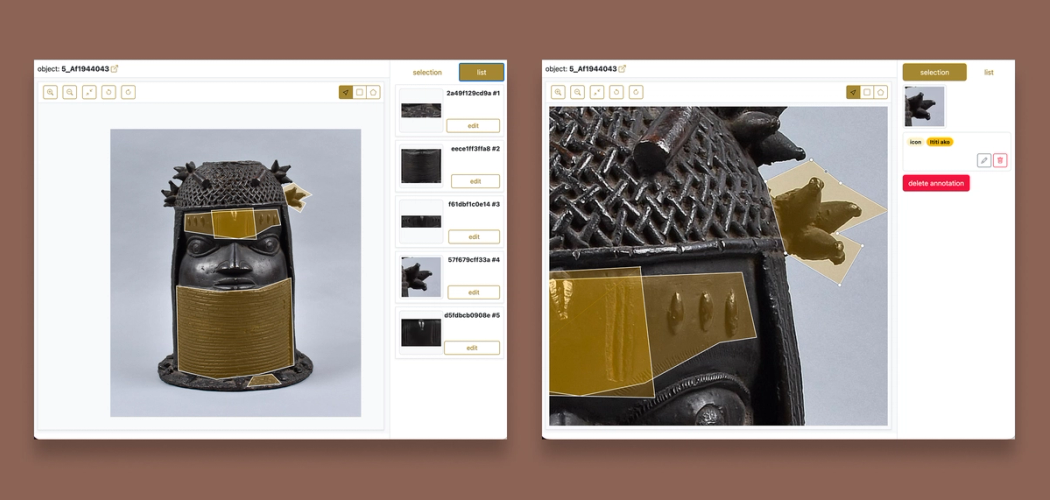
DB Iconography tool
Images, motifs and symbols on the historic Benin artefacts serve as sources of historic and cultural knowledge, reflecting the Kingdom’s institutions, traditions, and the relationships between people, ancestors and the spiritual world. To add this layer of knowledge to the objects reassembled in Digital Benin, we needed to give our researchers a visual tool to annotate and classify iconography and interpretations directly on the images of the artefacts. We therefore built a custom application in which researchers can browse the catalogue, select portions of images and link them to iconographic concepts and interpretations.
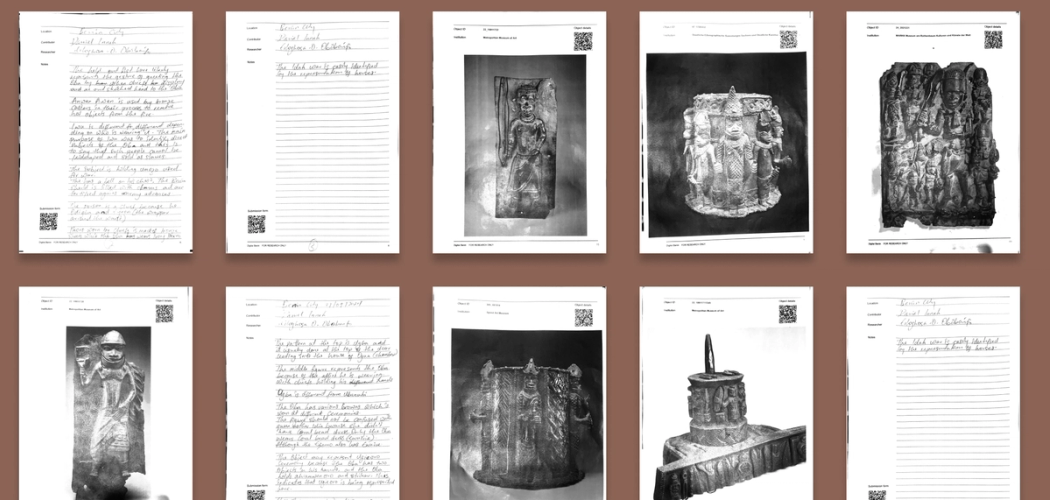
DB Printing tool
To involve the community in Benin City in annotating, discussing and telling stories about the Edo objects, the research team had to find ways to bring the catalogue and its data into a physical, offline format. While a digital interface makes it possible to explore vast quantities of data and digital objects, printed images invite exchange and annotation. This was key when the team wanted to ask the community how to interpret certain motifs and iconography on objects dispersed around the world. For this reason, we created a tool that allowed researchers to easily select objects from the catalogue and generate printable PDFs specifically conceived for these activities. A similar tool was also used to print the photographic archive during the “Approaching Colonial Photographs with Care” workshops.
Tools to explore Digital Benin data
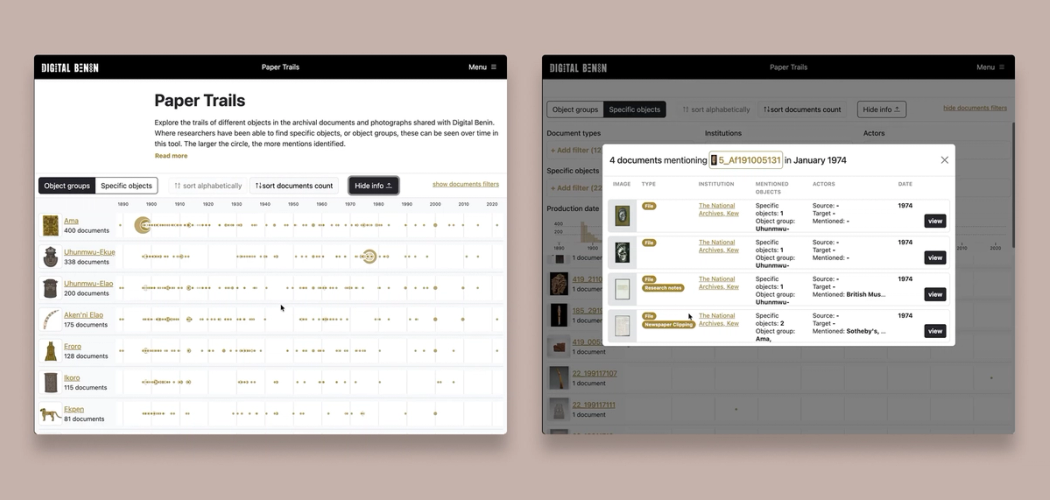
Paper trails
To reconstruct the biographies and movements of Edo objects, the research team needed a tool to visualize the chronology of the archival documents mentioning specific objects or Edo designations. The idea was to create a tool to forensically explore documents dispersed across institutions and to materialize the paper trails that trace the lives of the objects during and after the 1897 looting. The visualization helps users structure and reference provenance research and see common patterns across the corpus.
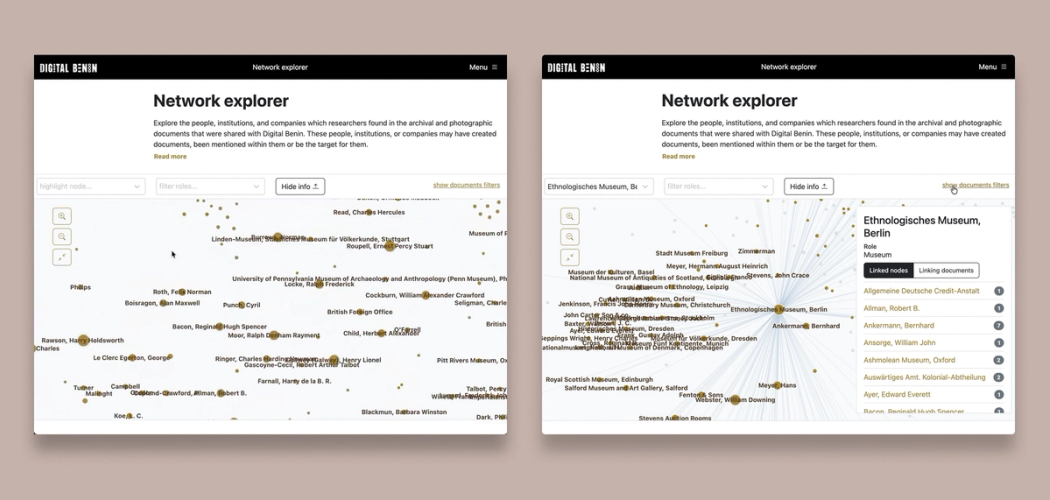
Network explorer
After collecting thousands of archival documents related to the historic Benin artefacts from over 150 institutions, the team went through all of them and, using the original metadata and close reading, manually tagged the names of thousands of people who authored, received or were mentioned in these documents. Once this task was completed, we realized how difficult it was to explore the connections between these actors without visualizing the data. This was the starting point for the Digital Benin Network Explorer, an interactive network visualization that allows users to explore the connections between actors linked shared documents about the historic Edo artefacts.
External tools and services used by Digital Benin
Tropy
Tropy is free, open-source software that allows you to organize and describe photographs of research material. We used Tropy to explore, organize and classify a large corpora of images and documents.
IMMARKUS
IMMARKUS is a semantic image annotation service that allows you to assemble and organize image collections and their metadata, identify specific image regions, create custom data models to annotate images, and add relationships between elements in and across images. We used it to develop the Iconography tool.
Zotero
Zotero is a free tool to help you collect, organize, annotate, cite, and share research. The team used it to organize references and bibliography.
Directus
Directus is a collaborative backend and self-hostable headless CMS over any database. We used to develop tools to tag or edit metadata of objects or documents before importing them in the back end of Digital Benin.
Airtable
Airtable is a cloud-based platform that combines the simplicity of a spreadsheet with the structure and functionality of a relational database. We used Airtable as an accessible entry point for working with data in Digital Benin. The tool enabled researchers with little or no prior experience in data management to create their own relational databases and connect their research data with museum collection data. It also introduced them to the fundamentals of data structures, relationships, and relational database design, allowing them to organise and explore their research independently.
Back-end and data management
Sanity
Sanity is an headless CMS that allows for modeling complex relational data structures and offers a powerful query engine, which we used extensively to manage the entire catalogue as well as research-oriented content such as objects annotations and provenance data. We also developed custom components tailored to Digital Benin. The CMS’s intuitive editing environment allowed every member of the team to easily update and maintain content.
Sensitive Content Digital Benin includes colonial material that may contain inaccurate, derogatory or harmful language relating to African and African diasporic communities. Such language may appear in catalogue records, transcriptions, and book, exhibition or museum titles. We recognize that this material may cause distress. Sensitive-content warnings are being implemented across the collection, but this process is ongoing. The language does not reflect Digital Benin’s views; we take an anti-colonial and anti-racist position and are committed to centring the humanity of historically marginalised communities.