About About
Digital Benin was developed between 2020 and 2026 through an international and interdisciplinary collaboration, bringing together researchers, developers, designers and Edo scholars and knowledge holders across Nigeria, Europe, the US and beyond. Hosted by MARKK and supported by the Ernst von Siemens Kunststiftung, Gerda Henkel Foundation and Mellon Foundation, the project connected diverse forms of knowledge and perspectives to shape research, documentation, data, design and technical infrastructure, deepening understanding of histories and continuing cultural lives of Benin heritage.
The royal artefacts of the Kingdom of Benin — the Emwin Arre, have histories that extend across centuries. Long before many of these objects entered European museums and collections, they were embedded within the social, political, religious, artistic, and economic life of the Kingdom of Benin. They were commissioned, produced, used, exchanged, displayed, inherited, cared for, and interpreted within particular Edo systems of knowledge and practice. Their histories are connected to the Ọba and Iy’Ọba, chiefs and title holders, guilds and artists, families and communities, ceremonies and rituals, places and institutions, songs and oral traditions. They belong to a cultural world that did not end with the British Colonial Military Campaign on Benin in 1897 and that is not confined to the historical moment of their production. For Edo people today, these objects remain part of a living heritage through which histories, identities, cultural practices, and knowledge continue to be remembered and transmitted.
The British Colonial Military Campaign on Benin in 1897 constituted a profound rupture within these histories. The destruction of the Royal Palace and the looting of its contents initiated the large-scale removal of royal treasures from Benin City and their subsequent circulation through military, colonial, commercial, and collecting networks. Many of the objects were subsequently acquired by museums and private collectors across Europe, North America, and elsewhere. Their physical separation from Benin was accompanied by a separation of documentation, interpretation, language, and cultural context. Yet the history of these objects cannot be reduced to the circumstances of their dispersal. Their removal represents one episode within much longer object histories, while their subsequent museum lives constitute further episodes within histories that continue into the present.
Digital Benin begins from this distinction. Its purpose is not simply to document where Benin objects are now, but to reconnect them with the histories, relationships, knowledge systems, and cultural practices through which they can be understood. The project is therefore more than a catalogue of objects removed from Benin or a digital interface that reproduces existing museum documentation. It is a research infrastructure that brings together dispersed collections while creating relationships between institutional records and forms of knowledge that have often remained outside museum documentation. Its catalogue brings together object records from institutions around the world and places them alongside Edo terminology, oral histories, historical narratives, maps, archival documents, photographs, provenance research, iconographic studies, and contemporary research undertaken with people in Benin City and across the Edo community. The platform also publishes authored research narratives that draw on these materials and develop particular historical, cultural, and material questions in sustained form.
The narratives do not simply reproduce the information assembled on Digital Benin, nor are they extended catalogues of the objects represented on the platform. They develop questions that become possible to investigate through the relationships established by Digital Benin. The platform provides the means to bring dispersed objects and records into relation; the research undertaken through it develops those relationships through investigation, interpretation, and historical writing. The narratives therefore offer a different form through which research generated through the platform can be encountered.
Digital Benin initially had to establish an overview of a dispersed corpus: institutions had to be identified and contacted, relationships developed, datasets transferred and inspected, images matched to objects, and different metadata structures mapped. This process also involved creating new documentation for collections in Nigeria that was not available through existing digital records. In 2023, in collaboration with the National Commission for Museums and Monuments (NCMM), the project documented objects in the National Museum Benin and the National Museum Lagos directly from the physical collections in storage. The team photographed the objects, transcribed information from catalogue cards and inventory books, and remeasured and described the objects. Tolulope Sanusi undertook the photography with assistance from Olanrewaju Ali. This work expanded both the visual and documentary representation of Nigerian-held collections within the platform and provided a richer basis for comparison with records from museums elsewhere.
Once this corpus had been established, however, the research questions became more complex. The team began asking how objects could be understood through Edo knowledge and cultural traditions; how oral histories and archival evidence could become part of object histories; how provenance could encompass the lives of objects before and after their incorporation into museums; how the material transformations of objects in museums could be documented; and how digital tools could be developed not only for Digital Benin but for other researchers, communities, and collections seeking to reconnect and recontextualize translocated heritage.
Reassembling a Dispersed Heritage
Digital Benin is not, of course, the first attempt to reassemble what 1897 had dispersed. The effort to see these objects together began almost as soon as they entered the market, and it has been pursued in very different registers ever since and with very different interests in mind. The earliest assemblages were made by those who held or sold the works: the British Museum’s catalogue of the material that reached London ( Read and Dalton, 1899), the volume Augustus Pitt Rivers had printed privately for his own holdings at Farnham ( Pitt-Rivers, 1900), and the illustrated stock catalogues of dealers such as William Downing Webster, which circulated photographs of hundreds of objects shortly before sale dispersed them a second time ( Webster, 1899). These publications were instruments of commerce and of institutional prestige, but they also constitute the first photographic corpus of Benin material and remain a primary source for provenance research today.
The first properly comparative corpus was Felix von Luschan’s Die Alterthümer von Benin ( 1919), two volumes assembled from Berlin that brought together photographs of objects held across German and other European collections. Half a century later Philip Dark attempted something more systematic: an illustrated catalogue of Benin art compiled from visits to and correspondence with institutions and private owners across Europe and North America (Dark, 1973, 1982). Dark interestingly developed an early computational approach, documenting the artefacts across hundreds of punch cards that are held in the archives of the British Museum and that are a kind of pre-history to our Digital approach here.
Reassembly has also been attempted physically and politically. The exhibition Benin: Kings and Rituals brought over 300 artefacts into one exhibition space for the first time, and its catalogue remains a standard reference ( Plankensteiner, 2007). From Nigeria, the effort has taken the form of claim and inventory rather than exhibition: the restitution requests made by Oba Akenzua II from the 1930s onwards ( Peraldi, 2017), the purchases made on the international art market to build the national collections ( Bodenstein, 2022).
Each of these undertakings was limited by the technology and the politics of its moment. They were assembled by single authors or single institutions; they depended on the willingness of owners to be catalogued; they reproduced the descriptive categories of the collections they drew on; and once printed they could not be corrected or extended. They also circulated where the objects were rather than where they had come from, so that the corpus was legible from Berlin, London or New York and largely inaccessible in Benin City.
Comparable undertakings elsewhere have confronted the same structural problem, that the record of a dispersed heritage is held where the objects are rather than where they came from. But they have used a very different method to answering them. The International Inventories Programme (2018–2022), led from the National Museums of Kenya inventoried more than 32,000 Kenyan artefacts held in thirty institutions abroad and set that database alongside exhibitions and public Object Movement Dialogues that made the absence of those objects visible in Nairobi itself however the data was not visualized in a catalogue; Digital Pasifik, currently still in a beta version, was developed by the National Library of New Zealand with the National Library of Australia in 2020, and brings digitised Pacific heritage held in collections around the world into one place to make access easier but it doesn't consistently comment the metadata. Other initiatives, including the Global Egyptian Museum, Mapping Philippine Material Culture, the Haḍḍa Archaeological Database, and the Colonial Collections Datahub, have likewise sought to reconnect dispersed objects digitally, but differ in their geographic scope, data structures, and approaches to linking collection records.
Digital Benin developed a pragmatic approach to data that is also somewhat at odds with what is currently being called for in the field of digital provenance: large-scale digitisation, shared standards for describing collections, and the publication of museum data as open and linked data that should make it possible to work across institutional records rather than one collection at a time ( van Hooland and Verborgh, 2014; Rother, Koss and Mariani, 2022). However, the data that museums could provide in 2020 did not conform to this ideal. Receiving more than 400 datasets from participating institutions and comparing them made clear that, while some institutions used established metadata schemas or standards, these were often applied only to fragments of the data, and no two datasets shared the same underlying structure. Indeed, one institution asked us to standardise all of the data according to its own institutional standard, illustrating the difficulty of treating any single museum’s structure as a universal model. This variation was not simply a technical problem that could be resolved by agreeing on a common schema. Museum databases are shaped by the institutional histories, working practices and purposes that produce them, and should not be understood simply as neutral repositories of information (Luther, 2022). Digital Benin therefore met the data where it was, rather than requiring institutions to reconstruct their databases according to a single external standard. This approach recognises, following Loukissas’s argument that ‘all data are local’, that datasets are produced within particular institutional, technical and historical settings and carry the traces of those settings ( Loukissas, 2019). It also acknowledges what Groys describes as the ‘logic of the collection’: collections are not neutral aggregations of objects but are constituted through the particular criteria and histories by which institutions select, organise and give meaning to what they hold (Groys, 2021). Rather than attempting to erase these differences, Digital Benin built a connection layer across them, operating at both the metadata and research-content levels. This made it possible to search across institutions while retaining the internal logic and particularities of each collection. The aim was therefore not to create one universal database in which institutional differences disappeared, but to establish connections between collections while allowing each institution’s data history and locality to remain visible.
A second body of work proved more directly formative for Digital Benin. Research on Indigenous data sovereignty and community-controlled archives established that access is not a single setting but a set of relationships, and that digital infrastructures can reproduce the extractive logic of the collections they describe ( Christen, 2009; Christen and Anderson, 2019; Walter, Kukutai and Carroll, 2020). Work on the digitisation of colonial archives similarly demonstrated that placing a colonial image online does not neutralise it, but may extend its circulation ( Odumosu, 2020; Krabbe Meyer and Odumosu, 2020). Critical scholarship on museum documentation has shown that catalogue categories are historical artefacts rather than neutral containers (Turner, 2015, 2020), while postcolonial digital humanities has insisted that digital projects can reproduce the geographies of the archives on which they are built unless they are deliberately designed against them ( Risam, 2019). Debates around digital surrogates and restitution have further made clear that digital access cannot be offered as a substitute for physical return ( Pavis and Wallace, 2019; Open Restitution Africa, 2022). Together, this work shifted the question from how dispersed objects might be made digitally accessible to how the infrastructures through which they are described, connected and accessed might reproduce or challenge the histories of their dispersal. The vocabulary of relation and relationships used throughout this introduction is therefore not ours alone. It belongs to a wider argument about how heritage taken under colonial rule might be reconnected to the people and places from which it came: formulated as a ‘new relational ethics’ by Felwine Sarr and Bénédicte Savoy (2018) and given practical form in principles of Indigenous data governance, which hold that what must be maintained is a set of relationships rather than a set of records ( Research Data Alliance, 2019).
Digital Benin emerged at a moment when three conditions held at once: museum data could be shared digitally yet in myriad formats and there was a general sense that a technique was necessary to find a way to connect that data without deforming it (see more on this below); the categories structuring that data have recently become more visible as objects of critique (von Oswald, 2022, pp. 155-180); and a body of practice existed for building digital environments that recognise different regimes of knowledge and different conditions of access. The project drew on all three, and tried to develop responses that are tailored to our subject.
The history of the project is consequently also a history of changing understandings of what a digital heritage platform can be. Digital Benin began with the need to establish visibility and connection across dispersed collections. It developed into an environment for research, contextualization, interpretation, knowledge exchange, and digital experimentation. The catalogue remains fundamental, but it operates within a larger ecology of research spaces, relationships, and tools. The project moved from the question of how to bring records together toward the more difficult question of how to reconnect the histories and Indigenous forms of knowledge that those records only partially represent.
An International Project with an Institutional Home
Digital Benin grew out of several contexts that met in 2017-18 as research and the political question of restitution reached a tipping point in Germany: the Benin Dialogue Group, convened by Barbara Plankensteiner since 2010 in the wake of the exhibition Benin: Kings and Rituals, and a research project in Berlin, translocations where post-doctoral researchers, Anne Luther and Felicity Bodenstein, realized that they were grappling with a dispersed corpus that clearly exceeded what any single researcher could hold. Meanwhile, at the Humboldt Forum, Jonathan Fine was responsible for the African collections and their presentation as part of the Ethnologisches Museum and was redefining its position as the role that the artefacts would have in the new museum set to open under growing controversy. International meetings brought academics from Benin City such as Kokunre Agbontaen-Eghafona to Germany, who placed emphasis on the idea that she and her colleagues had no practical means of finding out where the objects were. What began as a proposal to aggregate existing museum data became a different project at a workshop held at MARKK in October 2019, where some thirty participants, many of them from the Benin Dialogue Group, agreed that the platform should be intuitive enough to be used on a phone rather than built primarily for academic users, and that a research team in Benin City had to be at its centre. The contrast with the German approach was already instructive. In June 2021, the German Contact Point for Cultural Property and Human Remains from Colonial Contexts published a central database of Benin artefacts held in German museums, bringing together object information from participating institutions through a common interface and a defined set of searchable categories. Digital Benin began from a different premise. Rather than asking how the holdings of institutions could be brought into a single national inventory, the project asked how dispersed records could be connected across institutions and countries without requiring the collections themselves to conform to a single institutional structure. This distinction became fundamental as the project developed: the task was not simply to aggregate Benin objects, but to build a research infrastructure capable of working across the different systems through which those objects had been documented, while placing researchers and communities in Benin City at the centre of the resulting platform. Digital Benin began in 2020 as a fully funded international research project based at the Museum am Rothenbaum – MARKK in Hamburg. Its initial development was supported by the Ernst von Siemens Kunststiftung, which provided more than €1.5 million for the first two years, with an additional year of funding in 2023. Digitization activities in Nigeria received additional support from the Gerda Henkel Foundation, and from December 2023 the project entered a further three-year phase supported by the Mellon Foundation through a grant of €2.6 million. MARKK has remained the project’s institutional host, providing administrative infrastructure including administration, accounting, press relations, and reporting to funders.
The location of the project within a German museum was significant. When its collections are taken together, Germany, of any European country, including Great Britain, holds the largest number of the Emwin Arre removed from Benin in 1897, while, of course, much of the cultural knowledge associated with those objects remains rooted in Nigeria and within Edo communities. Digital Benin was therefore conceived from the outset as an international collaboration rather than as a digital initiative undertaken by a single museum. Its founding team brought together expertise in museum collections, heritage studies, digital humanities, Design and development, African art history, provenance, and restitution, working across Nigeria, Europe, and the United States. The project was developed in the context of the Benin Dialogue Group, bringing together the Royal Court of Benin, Nigerian heritage authorities, and European museums holding significant Benin collections. The Institute for Benin Studies (IBS) in Benin City was an important institutional partner in this context. As an organisation dedicated to the study and documentation of Benin history and culture, IBS connected the project to an established body of scholarship and to researchers working within the cultural and historical context of the Benin Kingdom. This relationship provided an important Nigerian institutional context for the project and supported connections with researchers and knowledge holders in Benin City. The project team has worked across Benin City, Lagos, Hamburg, Paris, Amsterdam, Cambridge, Milan, Philadelphia, and Tbilisi, developing a remote model of collaboration from the beginning.
This international structure was important not only because the objects themselves are dispersed, but because knowledge about them is dispersed as well. Museum records, archival documentation, provenance evidence, oral traditions, linguistic knowledge, historical scholarship, and contemporary interpretations exist in different institutions and communities and are produced according to different systems of knowledge. A digital project that simply assembled museum records would therefore reproduce only one part of this fragmented landscape. The project instead sought to bring different forms of evidence into relation while retaining their distinct contexts and origins.
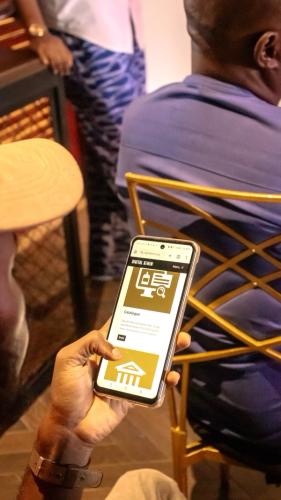
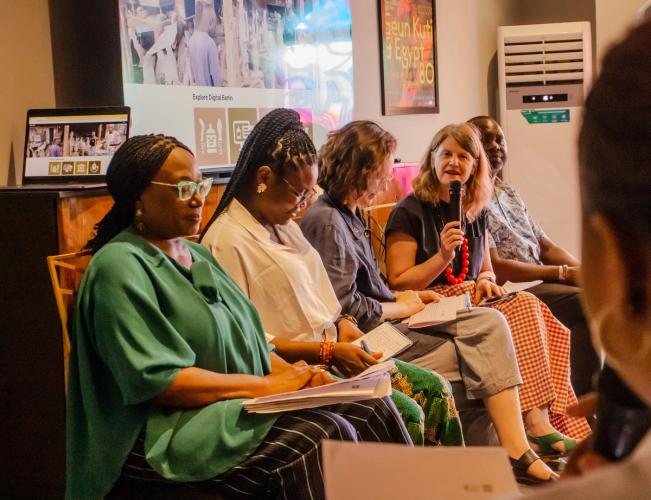
From its earliest conception, access was understood as extending beyond the ability to retrieve an object record. Restricted access to predominantly European and American museum and archival resources presented a particular disadvantage to Nigerian researchers. Digital Benin was consequently intended to make dispersed materials more accessible to Nigerian scholars and researchers while also serving wider audiences. The project employed an outreach coordinator, Iwinosa Oyakhire, to develop this engagement in Nigeria and internationally. From the earliest stages of the project, this work was accompanied by lectures, workshops, conferences, seminars, and public conversations in Nigeria, Europe, and the United States, through which the team presented its methods and findings and discussed questions of museum data, oral history, provenance, digitization, restitution, and digital infrastructure with researchers, museum professionals, students, cultural practitioners, and wider publics. The breadth of all public engagements cannot be described here in full; two examples illustrate the range and character of these engagements. In January 2026, the Conversation Forum “Digital Benin and Community-Centered Approaches to the Restitution of Historic Benin Collections in East Coast Museums” in Philadelphia brought together Edo community representatives, museum professionals, and scholars to examine community-centred approaches to the interpretation, stewardship, provenance, and restitution of historic Benin collections in U.S. museums. In August 2025, a two-day workshop with the National Commission for Museums and Monuments (NCMM) focused on how the knowledge assembled through Digital Benin could be incorporated into museum practice, including Edo designations, oral histories, metadata, photographs, and research. It was clear that meaningful access requires the ability to encounter institutional documentation alongside knowledge produced within Edo communities, and it requires digital structures capable of accommodating forms of knowledge that do not originate within museum systems.
This principle also shaped the organization of the research. Rather than separating research conducted in Nigeria from technical and institutional work undertaken in Europe and elsewhere, the project developed shared workflows in which these activities informed one another. The platform was consequently not designed first and populated later. Research questions, data structures, technical architecture, interfaces, vocabularies, and forms of data representation developed together. The resulting infrastructure reflects not only the research undertaken through the project, but the collaborative process through which research and technical development became an integrated practice.
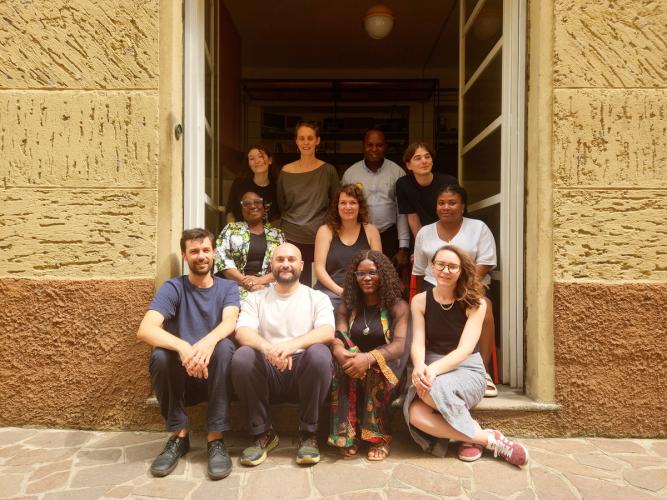
The international and interdisciplinary structure of Digital Benin presented significant organizational and methodological challenges, but working through these challenges also became an important part of building the collaborative model that ultimately sustained the project. The project began shortly after the COVID-19 pandemic had started, at a moment when international travel, institutional access, and conventional forms of collaboration were severely disrupted. Bringing the team together in person at least once a year therefore required substantial coordination across institutions, countries, funding structures, and visa regimes. Meetings were intended to rotate between Hamburg, the project’s institutional home; Milan, where the technical team was based; Vienna, where partner institutions were located; and Benin City, where much of the research and community engagement took place. In practice, international mobility could not always be taken for granted. Nigerian colleagues faced difficulties securing visas for meetings in Europe, while Italian colleagues were unable to obtain visas for a workshop in Nigeria. These experiences made visible the uneven conditions under which an international collaboration operates, but they also required the team to develop alternative ways of maintaining continuity and working together across distances.
The same was true of the relationships with the museums whose collections formed the basis of the platform. The team spoke with more than 600 people across participating institutions, including directors, curators, collection-management staff, registrars, data specialists, and technical teams, to negotiate participation and data access. Institutions were asked to provide published, open, and internal collection data, together with available object images in the highest resolution possible. At the beginning of the project, some institutions had little or no experience of treating their collection information as data for use in a digital research environment, making the development of trust around data access, ownership, and representation an important part of the process. Through these negotiations, Digital Benin developed agreements that allowed institutional data to be displayed on the website without time restrictions while ownership of the underlying data remained with the contributing institutions. The project did not alter or claim ownership of museum records and worked through media agreements with participating institutions that were authored by the project itself and not the institutions. Because of the sensitivity of the subject and the potential implications that the publication of collection data could have for restitution claims, some institutions were only providing their data shortly before the planned launch in 2022, requiring the research and technical teams to adapt their workflows as the material became available.
The project also brought together people with substantially different levels of expertise in digital technologies, museum data, provenance research, oral history, Edo cultural knowledge, art history, and other fields. Establishing a shared language across these areas required time and sustained exchange, particularly because technical and research questions were often unfamiliar to colleagues working in other disciplines. The project therefore benefited from a catalytic role that could connect these different areas of expertise and translate between technical, institutional, and research perspectives. As Project Catalyst, Anne Luther worked across these areas to create the conditions for collaboration, ensuring that technical development remained connected to research questions and that research could be translated into forms that could inform the technical architecture. Cultural backgrounds, as well as the different forms of knowledge, experience, and emotional investment that team members brought to the history of Benin and to museum collections shaped by colonial histories, also formed an important part of the collaboration. These differences sometimes required difficult conversations, but they also created opportunities to approach the project from perspectives that would not have been available within a more homogeneous team. Developing trust and a shared sense of purpose was therefore an ongoing process rather than an assumption at the outset.
Despite these logistical, institutional, disciplinary, cultural, and technological challenges, the project developed a strong collaborative practice. The difficulties of bringing people together, establishing shared vocabularies, negotiating access to collections, and working across different forms of expertise did not remain external obstacles to the research; they became part of the process through which the team learned how to work together. Digital Benin was consequently built not only through datasets, software, and research methods, but through relationships of trust, sustained communication, institutional negotiation, and a willingness to learn from different forms of knowledge and experience. The resulting collaboration was itself an important part of the project’s infrastructure, enabling researchers, museum professionals, community knowledge holders, designers, and technical specialists to contribute to a shared environment despite the considerable differences in their institutional positions, disciplinary backgrounds, and geographical locations.
Research and Technical Development as a Shared Practice
The relationship between research and technical development has been central to Digital Benin from the beginning. An important condition for the project was that its funding made it possible to employ research, data, and technical expertise together from the outset, rather than treating technical development as a service to be commissioned after the research had been defined. This approach reflects a role-based model of digital humanities collaboration in which humanists, technologists, and data stewards contribute distinct but interdependent forms of expertise, with a catalyst helping to connect these areas throughout the project ( Berg-Fulton et al. 2018). Digital Benin adopted this integrated approach from the outset. Researchers, data specialists, designers, developers, and museum professionals worked together, meeting as a team twice weekly and in further online work sessions, rather than treating technology as a service commissioned after research questions had been established. The technical architecture developed in response to research problems, while technical possibilities in turn created new opportunities for research.
The interdisciplinary structure was reflected in the composition of the project’s leadership. Prof. Dr. Kokunre Agbontaen-Eghafona brought expertise in Benin culture, oral literature, Indigenous knowledge systems, and the curation and exhibition of cultural materials, providing an important foundation for the project’s engagement with Edo knowledge and cultural practices. Dr. Felicity Bodenstein contributed specialist knowledge of the histories and trajectories of Benin objects, provenance research, archival sources, market histories, and restitution debates. Dr. Jonathan Fine contributed expertise in museum collections, colonial collecting histories, and the institutional and legal contexts in which Benin objects are held and interpreted. Prof. Dr. Barbara Plankensteiner, director of MARKK and a specialist in African art and material culture, contributed institutional oversight and extensive knowledge of Benin collections internationally, drawing on her professional networks to establish connections with museums and scholars. Dr. Anne Luther, as Project Catalyst, provided the digital and operational framework through which these areas of expertise could be brought together, coordinating research, design, technical development, institutional partnerships, data acquisition, and the project’s operational and infrastructural requirements.
Their work was complemented by researchers, data specialists, developers, designers, and external scholars working across Nigeria, Europe, the United States, and Kenya. In Benin City, Osaisonor Godfrey Ekhator-Obogie developed methodologies for working with local knowledge, oral traditions, and stakeholders and established the Itan Edo, Oral History, and historic photography spaces. This work was supported by Mabel Osaruemwinnomwan Oviahon who contributed her own research into Benin history, cultural practices, and oral traditions, while Iwinosa Oyakhire extended the work into community engagement, outreach, and iconographic research. Eiloghosa Obobaifo worked with Nigerian museum collections, transcribed analogue catalogue information, developed an initial controlled vocabulary for Edo designations, and worked with linguists and researchers on terminology for the Ẹyo Otọ and Iconography spaces. She collaborated closely with Imogen Coulson, who worked across teams in Benin and Europe to ensure an ongoing dialogue. After the first phase where she liaised with the institutions to bring in the data, she worked on controlled vocabularies, the architecture and development of the archive as well as on keeping data up to-date with regards to the restitution process. Ermeline de la Croix developed the provenance research space with Imogen and Felicity, structuring the entire data set in order to create object biographies and connect it to research across the platform.
The core team was complemented by external specialists whose expertise was brought into the project as particular research questions emerged. Their contributions ranged from Edo linguistics and historical scholarship to photographic practice, accessibility, and the ethical treatment of colonial documentation. These forms of expertise were not conceived as separate from the research process but became part of the iterative development through which the platform and its research evolved.
The technical architecture developed alongside this research. The first-phase technical team comprised Alex Horak and Krystelle Denis, who led the platform’s design, technical architecture, data structuring and development, working with Gwenlyn Tiedemann, the data engineer responsible for processing the datasets received from institutions, developing data pipelines, and preparing the data and images for integration into the platform. In the second phase of the project, following the launch in 2022, we worked with a technical and design team comprising Dimitri Müller, who worked on data transfer, management, modelling and processing and Osaze Amadasun, an illustrator, artist and designer based in Lagos, who developed the platform’s visual language, drawing on his Edo heritage to translate Edo visual and cultural references into the platform’s illustrations and icons. In the second phase of the project, Calibro, led by Giorgio Uboldi and Matteo Azzi, played a central role in rethinking and redesigning the Digital Benin platform in its full complexity. Working directly with researchers throughout the research process, the studio contributed to the platform’s front- and back-end architecture, interaction design, wireframes, and prototypes, while also developing internal research tools that enabled the team to investigate, structure, and connect the growing body of data. Their role extended beyond the implementation of defined technical requirements: Calibro consulted continuously on research design, data structures, and possibilities for digital integration, translating emerging research needs into technical and interface solutions and, in turn, using the possibilities of the platform to shape new forms of research. Calibro also developed the software tools that emerged from this process, making technical development an integral part of the project’s research practice rather than a separate implementation phase.
The importance of this structure becomes particularly apparent in the relationship between technical decisions and research questions. The need to bring different object designations together led to controlled vocabularies and new filtering structures. The absence of Edo terminology in museum datasets led to field research rather than simply translation. Provenance research generated relationships between people, roles, institutions, and objects. Archival research required new ways of linking documents to objects and people. Oral history required interfaces capable of presenting spoken knowledge rather than reducing it to written metadata. Iconographic research required tools for annotating motifs and relating them to objects, histories, and interpretations. Research into material interventions likewise required ways of connecting physical changes to museum histories, conservation practices, and documentation.
The process also worked in the opposite direction. Once object records could be searched across institutions, researchers could identify patterns that were difficult to perceive within individual museum databases. Once provenance names were normalized and linked to objects, relationships among collectors, dealers, military actors, colonial officials, and institutions could be examined at a larger scale. Once archival documents and photographs could be connected to objects, different forms of evidence could be considered together. Once museum records could be compared across institutions, gaps and inconsistencies themselves became objects of research. The technical environment therefore did not simply reproduce research that had already taken place; it altered the scale and possibilities of that research.
This reciprocal relationship became one of the defining characteristics of the project. Researchers participated in defining categories, relationships, vocabularies, data structures, visualizations, and interfaces, making technical development part of the research methodology itself. The 2024 workshop at Calibro Studio in Milan marked an important point in this development. Researchers and technical specialists reviewed the first three years of work and discussed a transition toward deeper research and contextualization through an Edo-centric approach, including provenance, research documentation, tool development, and authored research.
This transition should not be understood as a movement from a technical phase to a research phase. Research has always been integral to Digital Benin. Rather, the change involved a shift in scale and form: from establishing a corpus and connecting institutional records toward using that corpus to produce deeper interpretations, identify patterns, develop new narratives, and create reusable research infrastructure.
Weaving Dispersed Knowledge
The platform brings together forms of knowledge that are distributed across collections, archives, communities, languages, and places. Its 5,304 objects from 139 institutions across 21 countries form the central corpus, but the information associated with them extends well beyond institutional catalogue records. Edo terminology, oral histories, iconography, archival documents, photographs, geographical information, provenance research, and historical interpretation provide different forms of evidence and knowledge. The platform connects these materials without collapsing them into a single system of description.
The Catalogue provides the principal point of entry. Institutional records remain identifiable in their original context, while shared metadata allows objects to be searched and compared across collections. The individual object page now brings together the research connected to each object across the platform. An object may therefore be accompanied by its Edo designation from Ẹyo Otọ, iconographic research, references in archival documents and photographs, oral histories, and provenance research. Where provenance has been established, its relationships to people, institutions, places, and events can also be explored through a visualisation. The object page thus provides a consolidated view of the different forms of evidence and research associated with an individual Emwin Arre.
The Institutions section provides a complementary view of the dispersed collections. Museums and institutions can be explored by name, country, or number of objects, including collections containing objects that have been restituted or are currently subject to return. Individual collection pages retain institutional information, datasets, and overviews of objects held. This makes visible not only where objects are located, but also how different institutions have documented and contextualised them within their own collection histories.
The Map and Itan Edo establish geographical and historical contexts for the objects. The Map connects people, places, and objects across Edo South and traces relationships between places of origin and institutions holding objects today. Itan Edo, drawing exclusively on Benin-authored sources, presents the history of the Kingdom from the Ogiso dynasty to the twentieth century, connecting historical events, rulers, institutions, places, oral traditions, and cultural practices. Together, they allow objects to be situated within the landscapes and histories of the Kingdom rather than encountered only through their later museum histories.
Ẹyo Otọ presents objects through their Edo designations and groups them according to Edo knowledge systems rather than classifications developed by institutions outside Nigeria. Designations are provided through visual, written, and spoken forms, with contextual information about use, function, production, and interpretation. This establishes relationships between objects that may not be visible through museum classifications and foregrounds Edo language as a means of organising and interpreting material heritage. Where a designation is associated with an object, it becomes part of the object's wider digital record rather than remaining a separate linguistic resource.
The Iconography section approaches the objects themselves as sources of historical and cultural knowledge. Motifs and visual elements found across the dispersed collections are identified and annotated and then interpreted through Edo language, historical sources, cultural practices, and living knowledge. The imagery of Benin objects can communicate information about histories, beliefs, ceremonies, social structures, institutions, traditions, and relationships between people, ancestors, and the spiritual world. Bringing motifs together across dispersed collections makes comparison possible, while interpretation requires forms of knowledge that extend beyond visual similarity. The connection between Iconography and the Catalogue therefore allows an object to be understood both as an individual artefact and as part of a broader visual and cultural system.
The Oral History section connects objects to knowledge transmitted through spoken word and across generations. Chiefs, elders, scholars, artists, and other contributors contextualise objects through cultural practices, rituals, ceremonies, and historical memory. These accounts are treated as primary sources rather than supplementary commentary. Their connections to objects, people, events, and other research allow forms of knowledge that are rarely represented in museum databases to become part of the object's digital record.
The Archival Documents section brings together more than 5,000 documents shared by 51 institutions, including correspondence, research notes, invoices, and other records. Searchable metadata, OCR, and links to actors, institutions, locations, and objects allow these dispersed records to be considered alongside the Catalogue. The Photographs section similarly expands the documentary record: more than 30,000 photographs were received from institutions worldwide, with more than 5,015 relating to the Benin Kingdom represented in the archive. Of these, 900 were selected for review with elders, chiefs, scholars, and other knowledge holders in Benin City. Their input informed how photographs are described, contextualised, and accessed.
This consultation also established that digital access cannot be treated as a uniform condition. Digital Benin developed ten photographic access categories, ranging from public access to highly restricted or no public access, reflecting Edo cultural protocols as well as the historical and colonial circumstances of image production. The photographic archive can therefore function simultaneously as historical evidence and as a site requiring decisions about cultural authority, context, and access.
Questions of harmful and derogatory language in institutional documentation also required external expertise. Digital Benin consulted Chao Tayiana Maina, a Kenyan historian and digital-heritage specialist working at the intersection of culture and technology, on derogatory, racist, and otherwise harmful language contained in institutional data and documentation. Her work addressed the responsibility of reproducing terminology originating in museum catalogues and other institutional sources, including its potential effects on communities and the ways in which a digital platform might mitigate these harms. Her recommendations contributed to the use of trigger warnings and a framework for responding to different forms of harmful wording. The consultation also identified a broader challenge: archival and institutional language requires continuing review and contextualisation, particularly where the historical circumstances in which terms were produced remain part of the material being presented.
The Provenance section connects objects to the people, institutions, transactions, and events through which their histories unfolded. It traces movements from production and use in the Benin Kingdom through the looting of 1897, subsequent sales, gifts, acquisitions, and restitution, distinguishing documented evidence from inference. The Actors section makes these relationships more visible by connecting more than 2,000 names associated with the ownership, collection, sale, and transfer of Benin objects. Provenance thus becomes a network of relationships rather than simply a chronological list of owners.
The Narratives draw these different forms of evidence together through sustained historical interpretation. They bring together fieldwork, archival and provenance research, oral histories, and collaboration with Edo knowledge holders to examine the history of the Kingdom, the 1897 invasion, the dispersal of Emwin Arre, and their continuing cultural and material lives. Unlike the structured records of the Catalogue, the narratives provide space for argument, synthesis, and interpretation.
The Digital Research Tools developed alongside this work support the processes through which these relationships are established. They include tools for managing catalogue data, annotating iconography, structuring provenance research, visualising networks of actors, and connecting documents to objects. Ọkpan and LoUPE extend this approach beyond the platform: Ọkpan supports the reconnection and enrichment of dispersed museum datasets, while LoUPE structures and visualises provenance research by connecting object histories to sources and evidence.
The different sections therefore function less as separate repositories than as interconnected ways of encountering the same dispersed heritage. An object can lead to an Edo designation, an iconographic motif, an oral history, an archival document, a photograph, a place, an actor, or a provenance history, while those materials can in turn lead back to other objects. The platform does not resolve these different forms of knowledge into a single authoritative account. Instead, it makes their relationships visible, allowing the histories of Emwin Arre to be encountered through multiple forms of evidence and interpretation.
From Research Spaces to Narratives
The development of the platform is also reflected in the evolution of its research spaces. The first years were necessarily dominated by building the corpus: establishing institutional relationships, acquiring datasets and images, mapping metadata structures, and creating the architecture through which the material could be connected. At the same time, spaces for oral history, Edo terminology, provenance, iconography, archival materials, and photographs were conceived as part of the platform.
By the end of 2023, however, the project had accumulated sufficient material to shift toward more sustained interpretation. The question was no longer primarily how to add information, but what could be learned from the relationships among the information already assembled. Iconography expanded from motif identification toward questions of meaning and significance. Provenance expanded from known ownership histories toward the broader lives and movements of objects. Photographs became not simply illustrations or documentary sources but objects of historical and ethical research in their own right. Oral histories, Ẹyo Otọ, and Itan Edo similarly developed from contextual spaces into environments for sustained research. Research into material interventions demonstrated how physical changes to objects could reveal aspects of their institutional histories that were not immediately visible in catalogue records.
The narratives published through Digital Benin emerged from this development. They are not a separate publication that sits beside the platform. They arise from the research questions, evidence, methods, and collaborations that Digital Benin helped bring together, while taking forms that a database cannot: extended argument, interpretation, historical synthesis, and authored narrative.
The platform and the narratives therefore perform different but connected functions. Digital Benin allows users to move across objects, institutions, people, places, and sources, while the narratives develop particular in-depth arguments and histories. The platform keeps relationships open and searchable; the narratives provide sustained interpretation. Neither replaces the other, and neither is intended to provide a final account of Benin heritage.
The research undertaken through Digital Benin extends beyond the assembly and connection of museum records. As the platform developed, the relationships between objects, people, places, collections, archives, photographs, oral histories, languages, and historical sources generated new questions and areas of investigation. The narratives presented through the platform emerged from this research process. They do not simply reproduce information contained in museum records; rather, they bring together different forms of evidence and knowledge to examine aspects of the histories of the Emwin Arre that cannot be understood from individual institutional records alone.
The narratives also provide the foundation for the accompanying publication, Digital Benin: Archives of Dispersed Heritage and the History of the Benin Kingdom. The book brings together the research developed through the project in a sustained scholarly form, while the digital platform makes the underlying corpus, sources, connections, and research materials available for further exploration. The two formats therefore serve different but complementary purposes: the platform provides an environment for connecting and investigating dispersed knowledge, while the book develops selected questions and interpretations through extended scholarly essays and contributions.
The research areas that follow emerged from this process. They are not discrete subjects imposed on the corpus from the outset, but developed in response to questions raised through the research and to gaps, relationships, and possibilities revealed by working across the dispersed collections. Together, they demonstrate how the platform enabled the project to move from the reconstruction of a corpus toward a broader investigation of the histories, meanings, and continuing lives of the Emwin Arre.
The first two chapters might appear to be far removed from the question of the artefacts themselves but they actually establish the historical and cultural frameworks necessary for understanding Benin heritage on its own terms. Chapter 1, “Brief History of the Kingdom of Benin,” provides a historical foundation for the objects and practices discussed throughout the volume. It places the royal objects within the political and social structures of the Kingdom rather than beginning with their removal in 1897. Chapter 2, “History, Memory, and Myth: Exploring the Traditions of Origins and Oral History of Benin,” extends this history into oral traditions and forms of historical memory. These chapters establish that the history of Benin cannot be reconstructed through European archival records alone and that oral knowledge is not supplementary to written history but an important source through which the past has been transmitted and interpreted. The historical content presented through Itan Edo and the associated map was also subject to peer review by Prof. Victor Osaro Edo, Professor of African History in the Department of History at the University of Ibadan, and Dr. Uyilawa Usuanlele. Their review provided an additional scholarly assessment of the historical interpretations presented through these components of the platform.
This principle was central to Digital Benin’s oral-history research. Contributors included palace chiefs and title holders, elders, scholars, artists, bronze casters, cultural ambassadors, and others with knowledge of particular aspects of Benin history and culture. Fieldwork used open-ended interviews, participant observation, field notes, and documentation of songs and other oral traditions. Rather than imposing a fixed questionnaire, researchers allowed conversations to develop according to the knowledge and experience of contributors. The resulting material includes historical accounts, descriptions of cultural practices, personal perspectives, and interpretations that are not readily available in museum records.
The oral histories also demonstrate a profoundly different approach to documenting the past in Benin where historical knowledge continues to be remembered, interpreted, performed, and transmitted beyond textual formats. Songs can recount historical events and the achievements of rulers; accounts of titles and institutions can connect contemporary structures to earlier histories; and descriptions of rituals and practices can provide context for artifacts whose museum records contain little information about their original use or significance. The inclusion of oral history within Digital Benin therefore extends the platform beyond the documentary conventions of museum cataloguing and creates relationships between the objects and the living contexts in which knowledge about them continues to be transmitted.
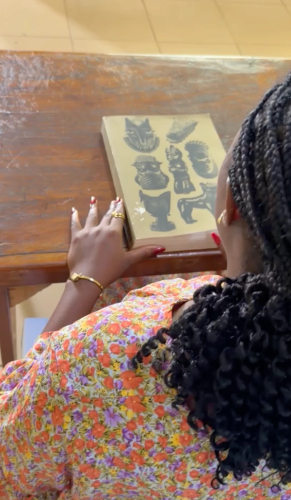
Chapter 3, “Objects as Archives: Knowledge, Memory, and the Visual Language of the Emwin Arre,” examines the iconography of Benin objects as a source of historical and cultural knowledge. The research began with the identification and annotation of motifs represented across the dispersed collections, drawing on existing scholarship and developing a digital image-annotation tool to compare and document them across objects. As the research progressed, however, it moved beyond the identification of visual motifs toward questions of their meaning, significance, and interpretation within Edo cultural contexts. The team worked with members of Edo society, including guild members, bronze casters, and members of the Royal Family, whose perspectives challenged and expanded established art-historical interpretations. The chapter demonstrates how the objects themselves can serve as archives of knowledge, while also showing that interpreting their imagery requires bringing material evidence into dialogue with Edo language, history, cultural practices, and living knowledge.
The research represented in this chapter illustrates the broader methodological relationship between the narratives and the platform. Digital Benin made it possible to locate and compare objects held in different institutions, but comparison alone did not provide an interpretation of the motifs represented on them. The research therefore moved between digital image analysis, existing scholarship, visual annotation, and conversations with people whose knowledge of Edo material culture is rooted in contemporary practice. The resulting research demonstrates how digital aggregation can become a starting point for deeper historical and cultural investigation rather than an end in itself.
Chapter 4, “Photographs as Sites of Memory and History,” extends this approach to the photographic archive. Digital Benin incorporated photographs supplied by museums as well as larger archival collections, including more than 25,000 images from the Eliot Elisofon Photographic Archive and 3,063 photographs from the Dr Robert Elwyn Bradbury Photographic Archive, alongside newly digitized diaries of Reginald Kerr Granville from 1898 and 1899. These materials document Benin City, the Royal Palace, Edo communities, sacred sites, cultural practices, British military personnel, and the aftermath of the British Colonial Military Campaign on Benin in 1897.
The photographsare themselves historical objects with histories of production, circulation, captioning, cataloguing, reproduction, digitization, and interpretation ( Odumosu 2020). They were created for different documentary, political, commercial, scientific, and propagandistic purposes. Bringing them together creates new possibilities for studying relationships among objects, people, places, and historical events, while also raising questions about the ethics of access. Some images contain human remains, sacred sites, rituals, and other culturally sensitive material. Dr. Temi Odumosu developed the initial outline for work addressing accessibility formats for more than 900 photographs selected from institutional holdings worldwide. This led to the review of the photographs and the establishment of the working group Approaching Colonial Photographs with Care, which considers the ethical and accessible presentation of historical photographs and the circumstances in which they were produced, collected, and subsequently circulated. Since August 2024, Digital Benin also worked with experts and stakeholders in Benin City to develop guidelines for archival photographs. This process introduced precaution as a methodological principle: difficult histories should not simply be suppressed, but photographs should be contextualized and accessed with attention to the circumstances of their production and the cultural significance of what they depict.
The photographic research consequently reinforces an important aspect of the project's approach to digital heritage. Bringing an image into a digital environment does not remove the history through which that image was produced. On the contrary, digitization can make the conditions of production, circulation, and interpretation more important because aggregation changes the context in which images are encountered. The photographs therefore become not simply illustrations of the historical chapters in the narratives but subjects of historical research in their own right.
The next group of chapters addresses conflict, extraction, and movement. Chapter 5, “War, Economic Exchange and Extraction – Benin and Military Conflict before 1897,” places the British Colonial Military Campaign on Benin of 1897 within a longer history of warfare and economic exchange. This is important because 1897 was not an isolated event. Understanding the political and economic conditions preceding the British Colonial Military Campaign on Benin in 1897 provides a framework for understanding the Kingdom’s relationships with neighboring states, European traders, and British colonial expansion. The chapter therefore contributes to the narratives's wider effort to place the British Colonial Military Campaign on Benin within the longer history of the Kingdom rather than allowing the event of 1897 to become the beginning and end of the historical narrative.
Chapter 6, “The Emwin Arre and 1897: From Places of Conservation and Tradition to a War of Dispossession”, joins two halves of a story that belong together but have never been told as such. The first, drawing on Kokunre Agbontaen-Eghafona’s fieldwork in Benin City, reconstructs where and how the Emwin Arre were kept, displayed and cared for in the centuries before February 1897: the Eguae Ịba N’Edo, the palace of the Iy’Oba at Uselu, the houses of chiefs and title holders, the workshops of the guilds, the shrines of traditional medicine practitioners, and the villages around the city. What emerges is not an undifferentiated collection but a distributed regime of custodianship and ownership, in which particular things belong in particular places and to particular offices.
The second half takes the looting itself and expands the received account of it in three directions. Geographically, beyond the Oba’s palace to the palace of the Iy’Oba, to other quarters of the city and to the surrounding villages. In terms of actors, beyond a handful of named naval officers to Protectorate officials, traders, journalists, and the thousands of unnamed carriers and Niger Coast Protectorate troops in whose luggage artefacts also left. And in time, from February 1897 through the continued extraction of the following years and the local market that developed in its wake.The chapter also reopens the question of scale. Of the 106 Edo designations now documented on Digital Benin, only two or three—the Ama-Ẹrọnmwọn and the Aken’ni Elao—were subject to formal processes of prize-taking accompanied by some form of documentary accountancy. The great majority of what left Benin City therefore did so without any comparable record. Against this silence, the chapter sets the work carried out by the project: 5,304 objects from 139 institutions across 21 countries, assembled, mapped, and connected through their associated histories, designations, and documentation.
Chapter 7, “The Global Movement of Benin Artefacts,” follows the objects after their removal. Their trajectories took them through military and colonial networks, auction houses, dealers, private collections, and museums. Digital Benin’s catalogue makes this global movement visible at a macro level that is unprecedented by bringing together records from institutions that ordinarily document their collections separately. But the purpose is not simply to create a map of where the objects went. The global movement of objects also transformed their identities, meanings, documentation, and relationships to institutions and communities.
This text first sets out the transactions and strategies through which museums acquired the Emwin Arre: the official prize, the private takings of members of the expedition, the dealers who gave artefacts away in order to sell more, and the exchanges and disposals of so-called duplicates through which information about origins was lost. The second follows the market itself, from the two parallel flows into Britain and Germany between 1897 and the 1920s, through the French, Swiss and Belgian network that emerged in the 1920s and 1930s, to the American dealers and collectors who dominated after 1945, alongside the founding of the Nigerian national collections in the 1950s and the attempts of Nigerian museums to buy back what had been taken. The third traces the changing status of the artefacts themselves: from trophies, curiosities and ethnographica to works of art valued for their aesthetic qualities and, in the 2020s, from commodity back to heritage through restitution. Its argument is that the artefacts have very largely followed the money - which is among other things why the Nigerian buy-back efforts of the 1950s often failed - and that the economics of the dispersal has generally been treated as a marginal concern when in fact it is a major actor in this story.
The later chapters return from dispersal and dispossession to the continuing cultural life of Benin heritage. Chapter 8, “Guilds: a Plurisecular History up until the Present-day Benin,” examines artistic production through the guild systems that have structured specialized forms of knowledge and practice over centuries. The chapter traces the history of the guild system and its relationship to the political and social organisation of the Kingdom, while also examining the specialised forms of artistic and technical knowledge associated with the production of Benin material culture. This perspective is essential to understanding objects as products of living traditions rather than anonymous examples of an art-historical category.
Digital Benin’s work on Edo terminology similarly demonstrated that the language of objects cannot be separated from the knowledge systems in which they exist. The Ẹyo Otọ space was developed as a foundational learning environment around Benin objects and their Edo designations. Existing museum datasets contained English and European-language classifications and descriptions, but Edo terminology was frequently absent, misspelled, inconsistently recorded, or detached from its cultural and linguistic context. Recovering this terminology therefore required field research rather than simple translation.
The project worked with Edo practitioners, historians, linguists, artists, bronze casters, religious practitioners, curators, and other knowledge holders. More than fifteen practitioners in Benin City contributed to research and peer review, while linguists and Edo language specialists reviewed terminology and pronunciation. Aiko Obobaifo, a historian in Benin City and former secretary of the Institute for Benin Studies, advised the project on Edo language and on the establishment of the Edo designations presented through Ẹyo Otọ, contributed to the oral-history research, and provided the vocalizations of the Edo designations. Professor Esohe Mercy Omoregbe, a linguist at the University of Benin whose scholarship focuses on Ẹdo grammar, morphology, syntax, and translation, also consulted on the designations. Her involvement helped ensure that their forms and usage were grounded in the structure of the Edo language. The resulting vocabulary is not simply a translation layer placed over an English database. It changes how objects can be named, grouped, searched, and understood, while also demonstrating that the categories through which museum collections are organised are themselves forms of historical interpretation.
This work also demonstrated that language is not only written. Edo is foremost a spoken language, and intonation contributes to meaning. Digital Benin therefore incorporated recorded vocalizations alongside written designations, allowing users to encounter terminology through visual, written, and spoken forms. The inclusion of spoken language recognizes the form in which linguistic knowledge is transmitted and restores a dimension of cultural context largely absent from conventional museum records.
Chapter 9, “The Living Museum: Rituals and Materiality Then and Now,” extends this emphasis on continuity. The objects represented in museums are not detached from the cultural practices that gave them meaning. Their histories continue through ritual, performance, artistic production, memory, and contemporary relationships between objects and communities. The oral histories collected for Digital Benin contribute directly to this understanding by documenting how historical knowledge and cultural practice continue to be transmitted within Benin society.
This approach also requires attention to cultural authority. Not all knowledge is necessarily intended for unrestricted circulation. Contributors were approached within the context of their own knowledge and relationships, the purpose of the project was explained, and consent was obtained. Some participants chose to make their voices available without being filmed, while other forms of knowledge were subject to restrictions. The question was therefore not simply what could be digitized, but what should be made accessible and under what conditions. Digital heritage must recognize that knowledge has its own conditions of transmission, and these conditions cannot always be accommodated by the assumption that digital information should be universally and permanently accessible.
Chapter 10, “Material Manipulations and Practices of Preservation of Objects Post-1897,” addresses another dimension of the continuing life of objects: what happened to them after their removal. Museum objects have not remained materially unchanged. They have been conserved, repaired, mounted, displayed, photographed, studied, published, and sometimes altered to accommodate changing institutional practices. These interventions are themselves part of the objects’ histories.
The research undertaken for this chapter developed from the traces of physical interventions that became visible as museums shared their data with Digital Benin. Plinths had been added for display, labels and accession numbers applied to surfaces, and objects had undergone a range of conservation and material interventions. These changes demonstrate that the museum history of an object is not simply a history of where it was held. It is also a history of what was done to it, how it was displayed, how it was interpreted, and how its material condition was understood at different moments.
Taken together, these chapters change what provenance can mean. The original Provenance space was designed to make visible the people, institutions, companies, dealers, collectors, soldiers and colonial officials whose names appeared across institutional records. As the research developed it became clear that provenance could not be understood simply as a chronological list of owners: for artefacts that existed in the Kingdom of Benin long before 1897, the point at which a museum record begins may coincide with a violent interruption in an already much longer history.
The Life of Object framework developed from that recognition. It considers artefacts across multiple temporalities: their production and use in Benin; their relationships to people, places, guilds and cultural practices; their extraction during or following the British Colonial Military Campaign on Benin – February 1897; their movement through military, colonial, commercial and collecting networks; and their subsequent histories of exhibition, publication, conservation, interpretation, digitization, restitution and return. It also recognises that artefacts followed different trajectories - some entered European collections before 1897, including the Benin-Portuguese ivories, while others reached the market only long after the British Colonial Military Campaign on Benin in 1897. Provenance therefore becomes not simply a question of where an artefact has been, but of what was done to it, which relationships shaped its history, and how that history has since been recorded and interpreted.
Each artefact has a history of production and use in Benin, a history of extraction and movement, a history of museum acquisition and conservation, and a contemporary history of reinterpretation and return. These histories do not replace one another; they accumulate - biographies have remained our preferred terminology over the "necrological" approach proposed by Hicks (2021) as the continued role of these artefacts for a living culture in Benin would otherwise be contradicted in particular in the case of restitutions.
Chapter 11, “The Long History and Experience of Return and Restitution,” brings these histories into the present. Restitution has become an increasingly important part of Digital Benin’s research. Responsibility for restitution rests with the institutions holding the objects and with the relevant Nigerian authorities and communities. As conceived by the Omo n'Oba n'Edo Uku Akpolokpolo, Ọba of Benin, and the National Commission for Museums and Monuments (NCMM), restitution involves both the Ọba’s intrinsic ownership and traditional custodianship and the NCMM’s responsibility for the management, maintenance, and exhibition of returned objects.
Digital Benin is a tool that can support restitution processes, but it is not a substitute for restitution itself ( Pavis and Wallace 2019, Lixinski 2020, and Open Restitution Africa'). The point is important. Digital access has repeatedly been offered as a response to claims for return, and a substantial body of work has argued that digital surrogates must not be allowed to stand in for restitution, nor to become a further site in which control over African heritage is exercised from outside the continent ( Pavis and Wallace, 2019; Lixinski, 2020; Open Restitution Africa, 2022). Since 2023, the team has documented past and ongoing returns using object and accession numbers, agreements, institutional statements, legal documents, and other evidence. This research has demonstrated that restitution is not a single event or binary status. Ownership may be transferred while an object remains abroad on long-term loan; in other cases, only some objects represented in an institution’s Digital Benin data have been transferred or physically returned. By connecting objects, institutions, provenance evidence, agreements, and histories, the platform can support research, claims, negotiations, and decision-making while leaving questions of ownership, return, and future custodianship to the relevant authorities, communities, the Ọba, and holding institutions.
Digital Benin’s role is therefore not to determine the outcome of restitution but to make the evidence and relationships surrounding it more accessible and traceable. The platform can identify where objects are held, connect them to provenance evidence, document institutional relationships and changes in ownership, and provide a shared research environment. In this sense, digital infrastructure can contribute to the evidentiary conditions within which restitution takes place.
Building Reusable Digital Infrastructure
The challenges encountered through Digital Benin have increasingly led the team toward the development of tools that can be used beyond the specific corpus of Benin objects. The need to connect heterogeneous museum data, incorporate community knowledge, and document research processes revealed structural problems that are not unique to Benin.
Ọkpan, the Origin Knowledge Platform for Assembled Narratives, emerged from this experience. It is designed as an open-source relational platform through which distributed museum datasets can be connected and enriched without altering original institutional records. Researchers and communities can add Indigenous languages, oral histories, images, recordings, research, and contextual information while retaining the institutional context of the source data. The significance of Ọkpan is therefore not simply that it provides another collection-management system. It operationalizes one of Digital Benin’s central principles: reconnection does not require replacement. An institution does not have to surrender or rewrite its existing data in order for that data to become part of a larger research environment. Different datasets can retain their institutional histories while becoming part of a broader network of relationships.
LoUPE, the Life of Object Uncovering Provenance Tool, emerged from a related problem in provenance research. The history of the information about an object is itself part of its research history. Researchers consult archives, compare records, identify people, trace institutions, evaluate conflicting evidence, and make connections between sources. Yet these processes can disappear once their conclusions are incorporated into a database. LoUPE is designed to document the sources, transformations, interventions, and decisions through which object histories are researched and assembled. It can connect archival evidence to object records, support collaborative research, and make visible how information changes over time. Provenance can consequently refer not only to the movement of the physical object but also to the movement and transformation of knowledge about that object.
Together, Ọkpan and LoUPE address two related problems: how to connect dispersed cultural heritage data and how to make the research processes through which that data is interpreted traceable. Their planned integration into a unified environment marks a shift from a project-specific platform toward reusable infrastructure. It also raises longer-term questions concerning hosting, maintenance, governance, legal responsibility, and stewardship.
This shift is an important consequence of the project’s development. The challenges encountered through Digital Benin are widespread. Cultural heritage data is distributed across institutions; museum records are structured differently; Indigenous and community knowledge often exists outside collection-management systems; provenance research is documented inconsistently; and the history of how information has been transformed can disappear. The tools developed through Digital Benin respond to these structural problems by providing ways to connect data without erasing its context and to document research without reducing it to its final conclusions.
The Continuing Life of Digital Benin
Six years of Digital Benin have demonstrated that reconnecting dispersed heritage is not a problem that can be solved simply by assembling a sufficiently large database. The creation of the catalogue made the scale of the dispersal visible, but it also exposed the limitations of the existing documentary record. Connecting museum datasets revealed differences in institutional practices. Research into Edo terminology demonstrated how much linguistic knowledge was absent from museum documentation. Oral-history fieldwork revealed forms of knowledge that cannot be represented through conventional collection-management fields. Provenance research demonstrated that object histories extend far beyond museum accession. Photographic research showed that archival images have their own complex histories and require forms of access determined through research and consultation. Research into material interventions demonstrated that objects themselves continue to change within museums, adding further layers to their histories.
Each of these discoveries changed the platform. Research generated new technical requirements, while technical development created new possibilities for research. The team therefore did not build a system once and then populate it. The infrastructure evolved alongside the questions being asked of the material. This process was neither linear nor without constraint. It depended on access to archives and collections, the availability of researchers and community members, international travel and visa processes, uneven digital infrastructure, and the resources available to sustain collaborative research across institutions and countries. These conditions shaped what could be documented, connected, and made visible, as well as the pace and scope of the work.
The result is therefore necessarily partial. New institutions may be identified, additional archival materials may emerge, and oral histories can continue to be recorded. Edo terminology will continue to develop, provenance evidence can change as archives are investigated, and objects can be transferred, returned, placed on loan, or reinterpreted. Museum records will continue to change, while new research will generate new relationships between existing records. Research into dispersed heritage can, in this sense, continue indefinitely. Digital Benin, however, reaches a defined point of completion with the end of the funded project. What follows is not the end of the research, but the point at which this particular project has to stop and leave its infrastructure, documentation, and findings available for others to build upon.
A digital heritage infrastructure must therefore be capable of change. The long-term contribution of Digital Benin may lie as much in the methodological principles developed through the project as in the catalogue itself. These include preserving the context of institutional data rather than overwriting it; connecting rather than replacing; recognizing multiple forms of knowledge; understanding objects through their relationships; documenting the processes through which research is produced; incorporating Indigenous language and knowledge into the structure of the platform; and developing technical systems that can remain open to new contributors and interpretations.
Digital Benin began with the ambition of creating an overview of the royal heritage of the Kingdom of Benin held in collections around the world. That overview remains important. But the project has demonstrated that visibility is only the beginning. Once dispersed heritage can be encountered together, new research becomes possible. Once museum data can be searched across institutions, differences and gaps become visible. Once objects can be connected to Edo language and oral histories, the limitations of institutional description become apparent. Once archival evidence can be connected to provenance, gaps and contradictions can be investigated. Once research interventions can be documented, the production of knowledge itself becomes traceable.
Digital Benin occupies several positions at once. It is a catalogue because it makes dispersed institutional records searchable. It is an archive because it preserves and connects historical documents, photographs, and other sources. It is a research environment because it enables provenance, iconographic, linguistic, and historical investigation. It is a space for knowledge exchange because it incorporates oral traditions, Edo terminology, Indigenous interpretations, and contemporary perspectives. And it is increasingly an infrastructure because the technical and methodological systems developed through the project can be adapted to other contexts.
Most importantly, Digital Benin is not a substitute for the physical artefacts. Nor is it a substitute for the communities, institutions, practitioners, scholars, and knowledge holders whose work gives them meaning. Digital access cannot undo the historical violence through which the objects were removed, and a digital platform cannot restore the relationships disrupted by colonial dispossession. It can, however, create conditions in which dispersed evidence can be encountered together and in which knowledge separated from the objects can be brought back into relation with them.
This distinction is particularly important in relation to restitution. Digital Benin cannot return an artefact. It can document its history, identify its location, connect evidence about its removal and circulation, record changes in ownership and custody, and provide a space in which contemporary research can be undertaken. In doing so, it can contribute to the evidentiary conditions within which restitutionary processes take place without claiming to be restitution itself.
The same principle applies to Indigenous knowledge. Digital Benin cannot reproduce the full complexity of Edo cultural knowledge through metadata, audio recordings, photographs, or written texts. It can nevertheless create a digital environment in which those forms of knowledge are recognized as integral to the histories of the objects rather than peripheral additions to institutional documentation.
The project has consequently moved from an initial emphasis on dispersed collections toward a broader concern with dispersed knowledge. The objects are held across institutions, but so too are the records through which their histories have been documented. Archival evidence, photographs, terminology, provenance information, scholarship, and research processes have been produced in different places and according to different systems. Knowledge about the objects is likewise distributed among museums, archives, researchers, practitioners, communities, and individuals. Digital Benin’s response has not been to collapse these differences into a single database. It has been to create relationships between them.
The structure of the narratives reflects those relationships. Its chapters move from the history of the Kingdom and traditions of memory, through objects and photographs as archives, to histories of war, extraction, and global movement. They then return to guilds, rituals, material practices, conservation, and the long history of return and restitution. Taken together, they present Benin heritage not as a collection of objects whose history is defined by dispersal, but as a body of living cultural heritage whose histories continue across different places, institutions, communities, and forms of knowledge.
The vocabulary of relation and relationships used throughout this introduction is not ours alone. It belongs to a wider argument about how heritage taken under colonial rule might be reconnected to the people and places from which it came: formulated as a ‘new relational ethics’ by Felwine Sarr and Bénédicte Savoy (2018) and given practical form in principles of Indigenous data governance. In particular, the CARE Principles – Collective Benefit, Authority to Control, Responsibility, and Ethics – challenge data practices that treat information as detached from the people, communities, and purposes to which it relates. They emphasise Indigenous peoples’ authority to determine how their data, knowledge, lands, and cultural resources are represented, governed, and used, while foregrounding collective benefit, accountability, and self-determination ( Carroll et al. 2020). Together, these approaches shift attention from the circulation of objects and information alone to the relationships, responsibilities, and forms of authority that shape their circulation. For Digital Benin, this means understanding the reconnection of dispersed heritage not simply as the aggregation of records, but as the creation of relations between objects, people, places, histories, languages, institutions, and forms of knowledge.
The result is not a definitive account of Benin heritage. It is an evolving research environment in which different histories can remain visible, different forms of knowledge can coexist, and new relationships can continue to be established. Digital Benin began as an effort to give a dispersed body of objects a connected digital presence. Its development has demonstrated that the more consequential task is to reconnect those objects with the histories, languages, people, communities, and living cultural practices from which they emerged.
The platform is not the conclusion of this research. It provides an environment in which the histories of Benin heritage can continue to be researched, interpreted, questioned, and reconnected. Its value lies not in completing a definitive record of the past, but in maintaining the relationships and infrastructures through which new knowledge can continue to emerge.
Sensitive Content Digital Benin includes colonial material that may contain inaccurate, derogatory or harmful language relating to African and African diasporic communities. Such language may appear in catalogue records, transcriptions, and book, exhibition or museum titles. We recognize that this material may cause distress. Sensitive-content warnings are being implemented across the collection, but this process is ongoing. The language does not reflect Digital Benin’s views; we take an anti-colonial and anti-racist position and are committed to centring the humanity of historically marginalised communities.