Loading...

Inventarisnummer
RV-1286-6
Institution
Omo n'Oba n'Edo Uku Akpolokpolo, Ọba of Benin & National Commission for Museums and Monuments, Nigeria Restituted
Previously owned by Wereldmuseum
Edo designations

English designations
Categories
Institution Location
1 Adesogbe (Plymouth) Road, P.M.B. 1115, Benin City , Edo State
Inventarisnummer
RV-1286-6
Institution
Omo n'Oba n'Edo Uku Akpolokpolo, Ọba of Benin & National Commission for Museums and Monuments, Nigeria Restituted
Previously owned by Wereldmuseum
Edo designations
English designations
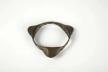
Anklet
Categories
Personal Adornment
Institution Location
1 Adesogbe (Plymouth) Road, P.M.B. 1115, Benin City , Edo State
Provenance
5
events
Institution data
Wereldmuseum
The data was transferred directly by the institution.
Last updated: 2022-07-19
Language: dutch
| Institution field | Value |
|---|---|
Inventarisnummer object id | RV-1286-6 |
Objectnaam designation object type | Armring |
Titel designation object type | Armring, enkelring, ratel |
Associatie/beschrijving (online getoond) description | Een arm- of enkelring waarin stukjes metaal zitten die geluid maken als de ring wordt bewogen. Naast de cilindervormige armbanden gebruiken de Oba en chiefs ook armringen, die bij gewone gelegenheden gedragen kunnen worden. Deze exemplaren zijn niet fe |
Materiaal en techniek (NB: ook thesaurustermen aanpassen!) material | metaal, koperlegering, brons of messing ; gegoten ('cire perdue'-techniek) |
Afmetingenlabel (H x B x D) dimensions | 14 x 14 x 2,5 cm |
Datering date made | voor 1901 |
Verzamelgeschiedenis (toelichting) provenance | 'The day book entry of 29 April 1901 acknowledges the arrival of 10 Benin objects (RV-1286-1 to -10) that were ‘Aangekocht van J.F.G. Umlauff te Hamburg. 1 besneden olifantstand, 1 houten en geelkoperen beslagen fetishkop, 1 executiezwaard, twee ivoren en vijf bronzen voorwerpen uit Benin’ (DB-L: NL-LdnRMV-A3-8-5).' 'The first (available) correspondence from J.F.G. Umlauff dates from 15 April 1898 where he encourages Schmeltz to come and visit his Hamburg collections in May. The museum register lists the objects with a short description (MR-L: NL-LdnRMV_A03_047_0067). The TMS catalogue card states that the carved ivory arm (RV-1286-9) was ‘Excavated in Benin 1897.’ A 21 March 1901 letter states that Umlauff offers an elephant tusk (RV-1286-10) – a ‘Beninzahn’, Benin tooth – to Schmeltz for 1500 Mark. In earlier letters, it was listed as No. 401 and offered for 1600 Mark (NL-LdnRMV-A1-32-484/485, -486, -487/488 to -491/492). This sale is confirmed in later letters (NL-LdnRMV-A1-32-350/351, -352, -353/354 to -356/357).' 'As with the acquisition of the Webster collection, Schmeltz again needed to secure funds. He first accepted the objects as a loan before acquiring them officially. The annual report documents the acquired series in detail and includes the names of all the donors for the acquisition (AR-L 1900-1901: 15). The annual report of the following year confirms the earlier statement saying that ‘The collections from the Kingdom of Benin were expanded in the much-desired way, first of all through a gift, for which we owe thanks to an anonymous benefactor, for objects that were up till now on loan to the Museum.’ The objects range across the three Umlauff series (RV-1286, RV-1310, RV-1355).' (Excerpt from Provenance no. 2 'The Benin Collection at the National Museum of World Cultures' written by Rosalie Hans with Annette Schmidt, 12-01-2021) |
Cultuur (NB: ook thesaurusterm aanpassen!) ethnic attribution | Bini |
Deelcollectie department and institution | Materiële cultuurcollectie |
Verwervingsdatum accession date | 1901-04-01 |
Wijze van verwerving accession method | Aankoop |
Literatuur bibliography | |
Publicaties over het object bibliography | For more information about the provenance, see <a href="https://issuu.com/tropenmuseum/docs/2021_provenance_2__benin__e-book" target="_blank"> Provenance #2 – the Benin collections at the National Museum of World Cultures </a> (NB: Issuu uses cookies). |
Objectstatus legal status | Eigendom |
Met dank aan (online getoond) | |
Periode (NB: ook thesaurusterm aanpassen!) | Benin |
Verkorte naam | AFRIK |
Sections
About
Other
Sensitive content
Sensitive Content Digital Benin includes colonial material that may contain inaccurate, derogatory or harmful language relating to African and African diasporic communities. Such language may appear in catalogue records, transcriptions, and book, exhibition or museum titles. We recognize that this material may cause distress. Sensitive-content warnings are being implemented across the collection, but this process is ongoing. The language does not reflect Digital Benin’s views; we take an anti-colonial and anti-racist position and are committed to centring the humanity of historically marginalised communities.