Loading...
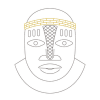
Pendant Mask
Pendant Mask
Reg No.
RAF 605
Edo designations
English designations
Categories
Institution Location
1 Adesogbe (Plymouth) Road, P.M.B. 1115, Benin City , Edo State
Reg No.
RAF 605
Edo designations
English designations
Pendant Mask
Categories
Ceremonial Regalia
Institution Location
1 Adesogbe (Plymouth) Road, P.M.B. 1115, Benin City , Edo State

Iconographies

2 annotations
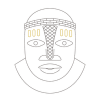
Forehead markings
Ikharo
Forehead markings

Ikharo are linear keloid markings depicted on the forehead of Uhunmwu-Elao (commemorative heads) in groups of three or four above each eye. The exact meaning of Ikharo is debated; some have argued that they relate to the gender or tribal identification of the person on whom they are depicted. For example, Gabriel Ọbazee has argued that they were worn only by men; however, their use in depictions is not consistent with this, and the Iy’Ọba are also shown wearing them. Flora Kaplan argued that they are instead a stylistic feature employed by artists that varied over time.

The naming of these markings differs between publications. For example, Ekhaguosa Aisien and Joseph Nevadomsky describe these markings as “agbaguda n'ehae”, which they write translates literally as “blades of the forehead”. However, Aisien later went on to call these “ikharo”, as used here. Kate Ezra referred to these forehead markings as ikharo, meaning “tribal mark [of eye]”.

1 annotation
Ikharo
Iconography image
Udahae
Beaded forehead band

The Udahae is a forehead band made from coral beads and worn by chiefs. Sometimes a white Igan (feather) from the Oɛɣohɔ (vulturine fish eagle) is tucked into the left side of the Udahae. According to Benin oral tradition, the Udahae was introduced by Ọba Ezoti, the first son of Ọba Ewuare I. During his coronation, Ezoti was shot in the forehead with a poisoned arrow. To stop the bleeding, a band of red beads was wrapped around his forehead while he made public appearances. Fourteen days later, he died from his wound. Since then, Benin chiefs have worn the red-beaded Udahae around their foreheads to commemorate the cap used by Ezoti to stop the bleeding (Egharevba 1968, p. 21).

1 annotation
Udahae

Provenance

9 events
Production
unknown to February 22, 1897 (day approximate)
Production of Uhunmwu-Ẹkuẹ by the Igun-Ẹrọnmwọn guild in Benin City
Loot
February 19, 1897 (day approximate) to June 1899 (month approximate)
Looting of the Emwin Arre - Inalienable Cultural Artefacts - during the Invasion of the Benin Kingdom in February 1897 and until the end of overt military activity in June 1899
Unknown
1928 (approximate)
The object is known to have come into contact with Paul Guillaume.
Unknown
1928 (approximate) to 1931
The object is known to have come into contact with Han Coray.
Transfer
1931
Bankruptcy and seizure of the Han Coray collection by the Schweizerische Volksbank, 1931
Transfer
1940
The object was transferred from Zürich Schweizerische Volksbank to the Völkerkundemuseum der Universität Zürich.
Transfer
1940
The object was transferred to Kunstgewerbemuseum.
Transfer
1982
The object was transferred from Kunstgewerbemuseum to the Museum Rietberg Zürich.
Restitution
March 20, 2026
Transfer of ownership of 11 Emwin Arre from the Museum Rietberg Zürich to Omo n'Oba n'Edo Uku Akpolokpolo, Ọba of Benin, and the National Commission for Museums and Monuments, 20 March 2026

Related archival documents

2 documents
See all
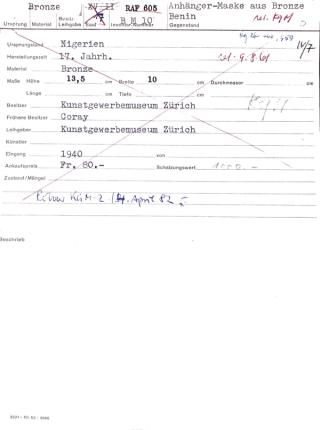
An archival document representing a Catalogue Cards of 1 page(s)
Catalogue Card
Museum Rietberg Zürich
File Cards - Museum Rietberg Zürich
Date
January 1, 1940
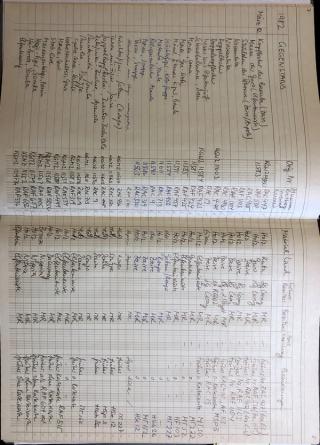
An archival document representing a Inventories of 1 page(s)
Inventory
Museum Rietberg Zürich
Written Archive - Museum Rietberg Zürich
Date
January 1, 1982

Institution data

Museum Rietberg Zürich
The data was transferred directly through the Swiss Benin Initiative.
Last updated: 2022-07-04
Language: english
Institution fieldValue
Reg No.
object id
RAF 605
Object name and materials
designation
Hip ornament
Material
material
brass
Dimension/s
dimensions
H. 13.5 cm W. 11.1 cm D. 5 cm
Provisional dating
date made
19th century
Creditline
prior source
Transfer from; the Kunstgewerbemuseum Zürich
Provenances
provenance
19th century, possibly commissioned from the Royal Bronze-casting Guild (Igun Eronmwon) by the Royal Palace of Benin; possibly by descent to Oba Ovonramwen (Ovonramwen Nogbaisi, b. about 1857 - d. about 1914; r. 1888 - 1897); 1897, probably looted from the Royal Palace during the British military occupation of Benin; [...]; ca. 1928, Paul Guillaume (collector, dealer, Paris); until 1931 Han Coray (collector, Agnuzzo) (Reg.No.: BM10); 1931-1940, Schweizerische Volksbank; 1940, Völkerkundemuseum der Universität Zürich; 1940 -1982 Kunstgewerbemuseum Zürich (Reg.No.: 11567); 1982, transfered to the Museum Rietberg Zürich
Institution
department and institution
MRZ Museum Rietberg Zürich
Institution acquisition date
accession date
April 1982
Additional IDs
object id
BM 10 (Coray-Nummer) 11567 (Kunstgewerbemuseum Zürich)
Sensitive content

Sensitive Content Digital Benin includes colonial material that may contain inaccurate, derogatory or harmful language relating to African and African diasporic communities. Such language may appear in catalogue records, transcriptions, and book, exhibition or museum titles. We recognize that this material may cause distress. Sensitive-content warnings are being implemented across the collection, but this process is ongoing. The language does not reflect Digital Benin’s views; we take an anti-colonial and anti-racist position and are committed to centring the humanity of historically marginalised communities.

Read more about our approach