Loading...


Id. Object
MEB CF 6355
Institution
Museu Etnològic i de Cultures del Món, Barcelona Edo designations

English designations
Categories
Institution Location
C/ de Montcada, 12, Via 14, 08003 Barcelona, Spain
Id. Object
MEB CF 6355
Institution
Museu Etnològic i de Cultures del Món, Barcelona Edo designations
English designations
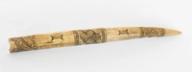
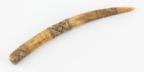
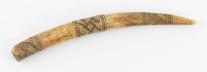
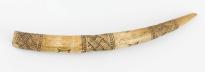
Altar Tusk
Categories
Altar & Shrine Objects
Institution Location
C/ de Montcada, 12, Via 14, 08003 Barcelona, Spain
Iconographies
2
annotations

Ubanu'hi
Inifinity Symbol
1 annotation


King's Mark
King's Mark
1 annotation

Provenance
5
events
Institution data
Museu Etnològic i de Cultures del Món, Barcelona
The data was transferred directly by the institution.
Last updated: 2025-08-18
Language: english
| Institution field | Value |
|---|---|
Nom de l_objecte | ullal |
Material Tecnica | Material / Tècnica: vori, esculpit, ivori tallat |
Dimensions | Dimensions: 57 x 5 cm |
Prec_ geogra | Antic regne de Benín; Ancient kingdom of Benin; Antiguo reino de Benín |
Autors | Regne de Benín |
Datació | segle XIX |
Object story | Acquired by Estrella Folch at Christie's in London. On 12/1991. Source: CF files. |
Id. Object object id | MEB CF 6355 |
Museu Etnològic i de Cultures del Món, Barcelona
The data was transferred directly by the institution.
Last updated: 2023-10-17
Language: catalan; valencian
| Institution field | Value |
|---|---|
Col·lecció | no domain |
Número de registre object id | MEB CF 6355 |
Nombre d'exemplars | |
Altres números d'identificació | |
Forma d'ingrés | comodat |
Data d'ingrés | 23/02/2011 |
Font d'ingrés | Estrella Folch-Rusiñol Corachán, Barcelona |
Precisions a l’ingrés | Museu de Cultures del Món. Col·lecció Folch |
Causa de baixa | |
Data de baixa | |
Valoració econòmica | nu |
Mides màximes de l'objecte | Dimensions: 56.5 x 5.0 x 0.0 cm |
Lloc de procedència/jaciment | Nigèria |
Objectes relacionats | |
Descripció de l'objecte | Ullal de grans dimensions sense l'habitual profusió decorativa amb escenes històriques relacionades amb la vida de la cort. Presenta en el seu lloc tres senefes amb un línies incises trenades i, en els espais intemitjos, un motiu format per un rectangle incís amb prolongacions corbes en els angles i ressalt en la part central. Aquesta decoració podria servir per identificar els ullals propietat del rei |
Història de l’objecte | Adquirida a la casa Christie's de Londres, l'any 1991 |
Estat de conservació | regular 150 |
Restauracions | |
Exposicions | |
Reproduccions | |
Bibliografia | Llistat d'obres. Informe de valoració de les col·leccions d'art d'Àfrica, Oceania, Filipines i Indonèsia de la Fundació Folch de Barcelona. Document complementari |
Autor de la fitxa | |
Data de la fitxa | |
Classificació genèrica | |
Nom de l'objecte | ullal |
Material | vori esculpit |
Tècnica | |
Autor | Regne de Benín |
Títol | Ullal decorat |
Iconografia | |
Estil/cultura | Regne de Benín |
Datació | 1800 1899 siglo XIX |
Justificació de la datació | |
Ús/context d’ús | els ullals esculpits es trobaven als altars dedicats a la memòria del rei, o oba, insertats en diferents suports: caps en metall, cilindres en metall, etc. Els exemplars amb aquest tipus de decoració s'han trobat preferentment en els altars dedicats a la reina mare |
Lloc d'execució/fabricació | |
Inscripcions |
Sections
About
Other
Sensitive content
Sensitive Content Digital Benin includes colonial material that may contain inaccurate, derogatory or harmful language relating to African and African diasporic communities. Such language may appear in catalogue records, transcriptions, and book, exhibition or museum titles. We recognize that this material may cause distress. Sensitive-content warnings are being implemented across the collection, but this process is ongoing. The language does not reflect Digital Benin’s views; we take an anti-colonial and anti-racist position and are committed to centring the humanity of historically marginalised communities.