Loading...


Id. Object
MEB CF 3496
Institution
Museu Etnològic i de Cultures del Món, Barcelona Edo designations

English designations
Categories
Institution Location
C/ de Montcada, 12, Via 14, 08003 Barcelona, Spain
Id. Object
MEB CF 3496
Institution
Museu Etnològic i de Cultures del Món, Barcelona Edo designations
English designations
Esieku Figure
Categories
Figures
Institution Location
C/ de Montcada, 12, Via 14, 08003 Barcelona, Spain
Iconographies
2
annotations
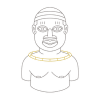
Ikele
Coral bead circlet
1 annotation


Ikharo
Forehead markings
1 annotation

Provenance
5
events
Institution data
Museu Etnològic i de Cultures del Món, Barcelona
The data was transferred directly by the institution.
Last updated: 2025-08-18
Language: english
| Institution field | Value |
|---|---|
Nom de l_objecte | figura |
Material Tecnica | Material / Tècnica: llautó, fosa a la cera perduda |
Dimensions | Dimensions: 42 x 14 x 13,5 cm |
Prec_ geogra | Antic regne de Benín; Ancient kingdom of Benin; Antiguo reino de Benín |
Autors | Regne de Benín, poble edo |
Datació | 1550 - 1700 |
Object story | Seller and date of sale according to Estela Folch purchase documents: Spink & Son LTD - Sotheby's - 6/20/1973 |
Id. Object object id | MEB CF 3496 |
Object Name | figura |
Object story | Seller and date of sale according to Estela Folch purchase documents: Spink & Son LTD - Sotheby's - 6/20/1973 |
Museu Etnològic i de Cultures del Món, Barcelona
The data was transferred directly by the institution.
Last updated: 2023-10-17
Language: catalan; valencian
| Institution field | Value |
|---|---|
Col·lecció | no domain |
Número de registre object id | MEB CF 3496 |
Nombre d'exemplars | |
Altres números d'identificació | |
Forma d'ingrés | comodat |
Data d'ingrés | 23/02/2011 |
Font d'ingrés | Estrella Folch-Rusiñol Corachán, Barcelona |
Precisions a l’ingrés | préstec en comodat de la Col·lecció Folch, 23/02/2011 |
Causa de baixa | |
Data de baixa | |
Valoració econòmica | nu |
Mides màximes de l'objecte | Dimensions: 42.5 x 14.2 x 13.5 cm |
Lloc de procedència/jaciment | Nigèria |
Objectes relacionats | |
Descripció de l'objecte | |
Història de l’objecte | |
Estat de conservació | bo <300 |
Restauracions | |
Exposicions | 7947 Permanent nou projecte MCM 2015, Museu Etnològic i de Cultures del Món – Montcada, 07/02/2015 |
Reproduccions | |
Bibliografia | Llistat d'obres. Informe de valoració de les col·leccions d'art d'Àfrica, Oceania, Filipines i Indonèsia de la Fundació Folch de Barcelona. Document complementari |
Autor de la fitxa | |
Data de la fitxa | |
Classificació genèrica | |
Nom de l'objecte | figura |
Material | llautó fosa a la cera perduda |
Tècnica | |
Autor | Regne de Benín |
Títol | Figura amb els palmells de la mà aixecats |
Iconografia | |
Estil/cultura | Regne de Benín |
Datació | 1550 1700 Período medio, 1550-1700 |
Justificació de la datació | |
Ús/context d’ús | |
Lloc d'execució/fabricació | |
Inscripcions |
Sections
About
Other
Sensitive content
Sensitive Content Digital Benin includes colonial material that may contain inaccurate, derogatory or harmful language relating to African and African diasporic communities. Such language may appear in catalogue records, transcriptions, and book, exhibition or museum titles. We recognize that this material may cause distress. Sensitive-content warnings are being implemented across the collection, but this process is ongoing. The language does not reflect Digital Benin’s views; we take an anti-colonial and anti-racist position and are committed to centring the humanity of historically marginalised communities.