Loading...
Pendant Plaque
Pendant Plaque
Inventory number
LG2001.RTV.26
English designations
Categories
Institution Location
1 Adesogbe (Plymouth) Road, P.M.B. 1115, Benin City , Edo State
Inventory number
LG2001.RTV.26
English designations
Pendant Plaque
Categories
Ceremonial Regalia
Institution Location
1 Adesogbe (Plymouth) Road, P.M.B. 1115, Benin City , Edo State

Iconographies

6 annotations

Colar Bead
Odigba
Coral beaded collar

Odigba (beaded collar) is a rigid neck collar made of beads, worn as part of ceremonial attire only by senior princes who have been made Enigie. Although Ibafe (2007, p. 43) argued that the Odigba was introduced during the Ogiso period (c. 900–c. 1170 AD) by Ogiso Ere, along with other symbolically important Emwin Arre, such as the Ada (ceremonial sword) and the Ebẹn (ceremonial sword). The Odigba was initially made of beads, while coral was incorporated only later, following its introduction through trade with Portuguese merchants in the late fifteenth century.

1 annotation
Odigba
Beaded Crown
Ẹde
Beaded Crown

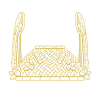
Although many other members of the Benin royal court wore a variety of hats and forms of headwear, only the Ọba may wear the Ẹde (beaded crown). The Ọba must never be seen bare-headed, and successive Ọba introduced different styles and types of crowns.

Across different media and objects, Ọba are depicted wearing various types of crowns, all elaborately crafted from coral beads. Some feature tall projections rising from the crown, known as Oro, while others have curved projections extending from either side of the head, known as the winged cap. The latter was introduced only in the 19th century, most likely by Ọba Osẹmwẹndẹ. Depictions of Ọba Ẹsigie on Ama-Ẹrọnmwọn (bronze relief plaques) show him wearing an elaborate crown decorated with large jasper or coral beads.

1 annotation
Ẹde
Headdress/crown with single projection
Oro
Headdress/crown with single projection

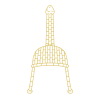
Figures wearing a headdress with a single protrusion from the crown of the head, known as the Oro, are found only among the Ọba and a select category of palace dignitaries whose ancestors originated in ancient Ile Ife. Only the Osa and Osuan, custodians of the Uwen and Ora deities, as well as members of the Emuru, who are responsible for the care of Iru vessels, may wear a headdress with the Oro. The identification of different figures is therefore interpreted based on the combination of the Oro with other items of regalia. Artists in the Igun-Ẹrọnmwọn and Igbesamwan depicted figures with the Oro on Ama-Ẹrọnmwọn (bronze relief plaques) and Aken'ni Elao (carved tusks), respectively. The Oro would either be made of coral beads as part of the crown or headdress, or be woven from itoto fibre.

1 annotation
Oro
Mudfish
Ewi
Mudfish

Depictions of Ewi (mudfish) are among the most frequent motifs in the Emwin Arre (royal treasures). Mudfish hold an important place in Edo belief, both as representations of the god Olokun and as symbols of royalty, as well as of “prosperity, peace, well-being and fertility”. Mudfish are also particularly common animals for sacrifice, and mudfish-shaped Orhiẹvbẹ (kola-nut boxes) were used to make offerings or store kola nuts.

Yet, the appearance of Ewi across the Emwin Arhe is not consistent, and it has been argued that different species of mudfish were depicted by Edo artists, each with different qualities and capabilities. For example, the electric shock of Malapterurus electricus resembles the fierceness of the Ọba, while the liminal qualities of the Synodontis clarias mudfish, which lives both on land and in water, similarly reflect the Ọba’s rule over land and sea.Gallagher 1983, p. 93 With these different qualities in mind, the mudfish is an important symbol of Benin kingship and royalty.

Sometimes the Ọba was depicted by artists with mudfish rather than legs (see Ọba with Mudfish Legs).

1 annotation
Ewi
Ubanu'hi / Obanu'hi
Ubanu'hi
Inifinity Symbol

The Ubanu'hi (infinity symbol) is a kind of guilloche or interlaced strapwork motif that can be angular or rounded. It was used by Edo artists in the decoration of many Emwin Arhe (royal treasures) and is ubiquitous in Benin royal arts. Ubanu'hi is a shortened form of “uba no Ọba ya de agbon ke ehimwin yi”, which means “the rope with which the Ọba ties the heaven and earth together” (pers. comm. Chief John Igbineweka Inneh n’Igbesawman, 2022). Similarly, Paula Ben-Amos Girshick described this as “Ọba n’iri agbon”, or the “rope of the world” pattern.

According to Ọbabanmu Ineh, the use of this motif indicates that objects were carved by members of the Igbesanmwan. However, the motif is found on all types of Emwin Arhe (royal treasures), not only those made of ivory or wood. On the flanges of the Ama-Ẹrọnmwọn (relief plaques) alone, Kathryn Gunsch identified three different versions of the Ubanu'hi and, through her analysis of over 850 plaques, found that these different Ubanu'hi forms align with other characteristics, such as dimensions, the prevalence of ornamental motifs, and stylistic qualities. Together, these provide evidence, she argues, of different production groups among the plaque makers.

Kate Ezra went on to argue that the use of these motifs indicates that certain objects were used in a “royal context” and were associated with “royal patronage”.

Ubanu’hi can also be spelt Obanu'hi, indicating different intonations in the pronunciation of the words.

1 annotation
Ubanu'hi
Tortoise
Elukeluke / Etuoo
Tortoise

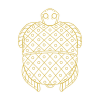
The Elukeluke/Etuoo (tortoise) holds diverse symbolic meanings and associations, including with Ogun (god of war), pride, and trickery. The tortoise is one of the rarest animals depicted on the Emwin Arhe (royal treasures); however, it was used by some carvers of the Igbesamwan to decorate the Aken'ni Elao (carved tusks) and some ivory Ẹgogo (gongs). According to Hans Melzian, the Elukeluke has two praise names: “the thing that swaggers proudly” and “the thing that walks like a cripple.” Both praise names, although contradictory, evoke descriptions of Ọba Ohẹn, who was paralysed from the waist down and attempted to deceive the royal court about this fact.

The Elukeluke appears in stories as an “ambitious and cunning” animal and is often seen as a cautionary figure in Edo oral tradition. Priestess Azaigueni Aghahowa described the Elukeluke as a “great liar” who, in the form of a human, had attempted to deceive an Ọba. On discovering the deceit, “the Ọba cursed his house, which fell upon the tortoise's back and crushed it, becoming a part of him. From that time forward his deceitful character has been publicly acknowledged, because ‘he hides his body’.”

1 annotation
Elukeluke / Etuoo

Provenance

4 events
Production
unknown to February 22, 1897 (day approximate)
Production of pendant plaques by the Igbesamwan in Benin City
Loot
February 19, 1897 (day approximate) to June 1899 (month approximate)
Looting of the Emwin Arre - Inalienable Cultural Artefacts - during the Invasion of the Benin Kingdom in February 1897 and until the end of overt military activity in June 1899
Unknown
2001
The object is known to have come into contact with the National Museum, Lagos.
Transfer
March 28, 2023
The object was transferred from the National Museum, Lagos to the Omo n'Oba n'Edo Uku Akpolokpolo, Ọba of Benin & National Commission for Museums and Monuments, Nigeria.

Institution data

Omo n'Oba n'Edo Uku Akpolokpolo, Ọba of Benin & National Commission for Museums and Monuments, Nigeria
The data was transferred directly by the institution and digitized by Digital Benin in collaboration with the NCMM
Last updated: 2023-11-30
Languages: english, bini; edo
Institution fieldValue
Inventory number
object id
LG2001.RTV.26
URL
weblink
Object Description
description
Pendant plaques, like pendant masks, can be cast in brass or carved in ivory, and were worn as part of ceremonial regalia by members of the royal palace societies. Pendant plaques are typically U-shaped, with a suspension loop or loops at the top. Crotal bells would have been attached to the small round eyelets that decorate the bottom half. Many different motifs are shown; some common ones include images of horses and riders and Portuguese men, or just their heads, hinting at the close ties between Benin Kingdom and Portugal during the sixteenth and seventeenth centuries. Additionally, the Ọba is supported on either side by kneeling attendants in a triad or trinity form, a position often seen as part of festivals and ceremonies in Benin City today (Plankensteiner, 2007, p.369[17]).
Diameter
dimensions
Dimension L (cm)
dimensions
Dimension W (cm)
dimensions
Dimension H (cm)
dimensions
Brief Object Description
designation
Ivory Royal Triad pendant
Material
material
ivory
Object Count
object count
1
Date Made
date made
Associated Guild
producer
Igbesamwan
Production Technique
production technique
Carving
Production Place
production place
Inscriptions
inscriptions
Note
notes
Inventory Book Description
fileNames
images
LG2001RTV26_1.jpg, LG2001RTV26_2.jpg
Sensitive content

Sensitive Content Digital Benin includes colonial material that may contain inaccurate, derogatory or harmful language relating to African and African diasporic communities. Such language may appear in catalogue records, transcriptions, and book, exhibition or museum titles. We recognize that this material may cause distress. Sensitive-content warnings are being implemented across the collection, but this process is ongoing. The language does not reflect Digital Benin’s views; we take an anti-colonial and anti-racist position and are committed to centring the humanity of historically marginalised communities.

Read more about our approach