Loading...
Inventory number
LG1953.22.11
Institution
Omo n'Oba n'Edo Uku Akpolokpolo, Ọba of Benin & National Commission for Museums and Monuments, Nigeria Edo designations

English designations
Categories
Institution Location
1 Adesogbe (Plymouth) Road, P.M.B. 1115, Benin City , Edo State
Inventory number
LG1953.22.11
Institution
Omo n'Oba n'Edo Uku Akpolokpolo, Ọba of Benin & National Commission for Museums and Monuments, Nigeria Edo designations
English designations
Stool
Categories
Ceremonial Objects
Institution Location
1 Adesogbe (Plymouth) Road, P.M.B. 1115, Benin City , Edo State
Iconographies
2
annotations

Ubanu'hi
Inifinity Symbol
1 annotation


Ewi
Mudfish
1 annotation

Provenance
5
events
Institution data
Omo n'Oba n'Edo Uku Akpolokpolo, Ọba of Benin & National Commission for Museums and Monuments, Nigeria
The data was transferred directly by the institution and digitized by Digital Benin in collaboration with the NCMM
Last updated: 2023-11-30
Languages: english, bini; edo
| Institution field | Value |
|---|---|
Inventory number object id | LG1953.22.11 |
URL weblink | https://digitalbenin.org/catalogue/37_LG19532211 |
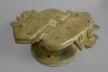
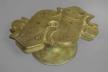
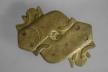
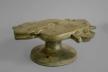
Object Description description | Ẹrhẹ are round stools with two intertwined serpents as the supporting column. Aside the two serpents, which point in two different directions (up and down), other creatures such as frogs, leopards, roosters and human figures are seen on these stools. The Obah n’uhi pattern of design (which has no beginning or end) is seen at the top of these stools, which shows the supremacy of the Ọba (king/emperor). These are ceremonial stools used by the Benin chiefs when performing rituals in ancestral shrines. According to oral tradition, Ogiso Ẹrhẹ was the first to use a throne. In Benin Kingdom, there are two different kinds of stools with ceremonial and ritual functions – the Ẹrhẹ and Agba. The Ẹrhẹ has a circular seat and base with a central supporting column and can be cast in brass or carved in wood. The Agba is rectangular in shape, with a carved panel forming the seat and four carved interconnected panels that serve as the legs. Agba may be used by the Ọba, chiefs and some priests (Hess, 1983, p.41[40]). Although a third kind of stool, Ekete, has been identified in literature (e.g. Ezra 1992, p.263[20]), our own research indicates that it means ‘throne’ and can be used to describe any kind of stool that the Ọba may sit upon. Thus, both Agba and Erhe could be Ekete as well (Hess, 1983, p.41[40]). |
Diameter dimensions | |
Dimension L (cm) dimensions | 37.0 |
Dimension W (cm) dimensions | 24.5 |
Dimension H (cm) dimensions | 14.0 |
Brief Object Description designation | |
Material material | brass |
Object Count object count | 1 |
Date Made date made | |
Associated Guild producer | Igun Ẹrọnmwọn |
Production Technique production technique | Casting |
Production Place production place | Benin City |
Inscriptions inscriptions | |
Note notes | |
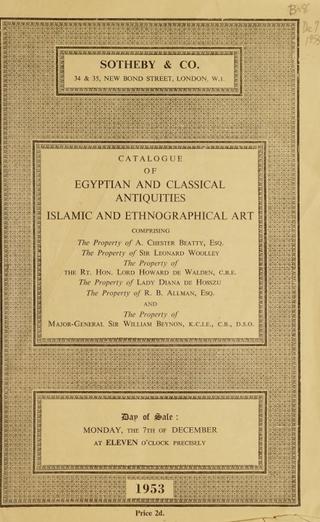
Inventory Book Description | Brass stool from benin. No. 184 in the sale catalogue where it is described as follows: "A FINE BENIN BRASS STOOL, formed of two intertwined catfish, the scales and fins engraved, on a circular support with spreading foot ornamented with a band of scroll decoration, generally in fine state and with good patination, 6" high, 14" diameter. Another example of this rare type is in the British Museum" Purchased by the Nigerian Government at a sale by Messrs. Sotheby & Co. Bond Street, London on December 7th, 1953: Mr. W. B. Fagg assistant keeper, British Museum acted for the Nigerian Government at the sale. |
fileNames images | LG19532211_4.jpg, LG19532211_3.jpg, LG19532211_2.jpg, LG19532211_1.jpg |
Omo n'Oba n'Edo Uku Akpolokpolo, Ọba of Benin & National Commission for Museums and Monuments, Nigeria
The data was transferred directly from the institution and transcribed by the Digital Benin from Inventory book.
Last updated: 2021-02-19
Language: english
| Institution field | Value |
|---|---|
Inventory No object id | LG 1953. 22. 11 |
Department of Antiquities Nigerian Museum Catalogue provenance | Purchases by the Nigerian Government at the Sale by Messrs. Sotheby & Co. Bond Street, London on December 7th, 1953: Mr. W. B. Fagg assistant keeper, British Museum acted for the Nigerian Government at the Sale. n° 184 - brass stool from Benin - £900 |
Object Name (as specified in the 2019 Lagos National Museum store/gallery inventory) designation | Benin Brass stool |
Sections
About
Other
Sensitive content
Sensitive Content Digital Benin includes colonial material that may contain inaccurate, derogatory or harmful language relating to African and African diasporic communities. Such language may appear in catalogue records, transcriptions, and book, exhibition or museum titles. We recognize that this material may cause distress. Sensitive-content warnings are being implemented across the collection, but this process is ongoing. The language does not reflect Digital Benin’s views; we take an anti-colonial and anti-racist position and are committed to centring the humanity of historically marginalised communities.