Loading...
Catalogue No.
EA1976.778
Institution
Canterbury Museum Edo designations

English designations
Categories
Institution Location
11 Rolleston Avenue, Christchurch Central City, Christchurch 8013, New Zealand
Catalogue No.
EA1976.778
Institution
Canterbury Museum Edo designations
English designations
Bolt
Categories
Palace Architecture & Ornamentation
Institution Location
11 Rolleston Avenue, Christchurch Central City, Christchurch 8013, New Zealand
Provenance
4
events
Institution data
Canterbury Museum
The data was transferred directly by the institution.
Last updated: 2021-12-07
Language: english
| Institution field | Value |
|---|---|
Accession No object id | 19XX.1.101 |
Catalogue No. object id | EA1976.778 |
Old Accession No. object id | |
Other Id object id | EA1976.778, E100.45A, E1709.0, 9797, EA1977.778 |
Primary Number object id | 19XX.1.101 |
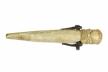
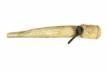
Brief Description description | Plain tapered ivory body, with carved human facial mask. Arms are represented by two moveable iron attachments secured with a bolt through the body. |
Media Materials material | Ivory |
Measurement Notes Y N display dimensions | |
Measurement Precision Y N display dimensions | Precise |
Measurement Reading primary system Y display only dimensions | 26cm |
Measurement Reading secondary system Y display only dimensions | 10 1/4" |
Measurement Type Y display only dimensions | Length |
Name Title object type | Door Bolt: Benin |
Item Count object count | 1 |
Primary Prod Date date made | |
Primary Prod Date Notes date made | |
Primary Prod Place production place | Benin City/Nigeria/Africa |
Acquisition Source Role prior source role | Vendor |
Acq Source Report provenance | Websters |
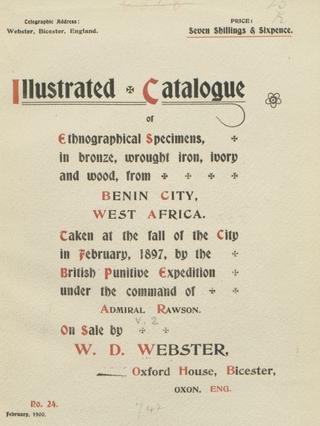
Acquisition Notes provenance | See Websters Catalogue Vol II No 24:27. Purchased at London auction. For photo see document file EA1976.771. |
Acquisition Source provenance | Websters |
Donor report provenance | Websters |
Provenance Notes provenance | |
Accession Date accession date | 1901 |
Acquisition Date accession date | 2-Mar-01 |
Acquisition Method accession method | Purchase |
Associated Notes notes | |
Production Notes notes | |
Related Outward Loan exhibition history | |
Documentation Article bibliography | Roger Fyfe and Sarah Murray. “Benin Art in Canterbury Museum”. Records of the Canterbury Museum. Vol 28, 2014. Pg 7- 30. |
Condition Date condition | |
Condition Keyword condition | |
Condition Notes condition | |
Condition Part condition | |
Condition Person condition | |
Current Condition condition | |
Current Condition Date condition | |
Current Condition Description condition | |
Current Condition Part condition | |
Current Condition Person condition | |
Image Publication Status images | Has image(s) |
Image Ref - Full path images | \\cm-fp4\vernon images\Collection Images\Catalogue Numbers\EA nos\EA1976.778 Fetish.jpg, \\cm-fp4\vernon images\Collection Images\Catalogue Numbers\EA nos\EA1976.778 Fetish side.jpg, \\cm-fp4\vernon images\Collection Images\1971 - 1980\1976\ea1976_778_benin.jpg |
Image Ref - Relative path images | Catalogue Numbers\EA nos\EA1976.778 Fetish.jpg, Catalogue Numbers\EA nos\EA1976.778 Fetish side.jpg, 1971 - 1980\1976\ea1976_778_benin.jpg |
Photo Audio-Visual Ref images | Catalogue Numbers\EA nos\EA1976.778 Fetish.jpg (Image (Electronic)), Catalogue Numbers\EA nos\EA1976.778 Fetish side.jpg (Image (Electronic)), 1971 - 1980\1976\ea1976_778_benin.jpg (Image (Electronic)) |
Primary Image images | \\cm-fp4\vernon images\Collection Images\Catalogue Numbers\EA nos\EA1976.778 Fetish.jpg |
Cataloguer | Paul Hobson, Miss Natasha Carson, Mr Dan Smith |
Classification object type | Ceremonial Artefact |
Collecting Unit | Anthropology/Archaeology |
Curator | Julia Bradshaw |
Curator Comments Date | 13-Oct-21 |
Curator Comments Remarks notes | Previously described as a fetish but Anne Luther from the Digital Benin Project says that it is a door bolt and identical to one held by Pitt Rivers Museum. |
Current | |
Date Catalogued | 26 June 2008, 23 March 2004, 19 October 2001 |
Loan In Details | |
Loan Out Details exhibition history | |
Location General Notes | RECAT.EA.1976.778 (CQ1) |
Other Id Notes | , , , , Published with this reference number in the Records of the Canterbury Museum volume 28, 2014. |
Other Id Type | Catalogue Number, Old Catalogue Number, Card Number, Other Number, Other Number |
Procedural Status | Accessioned |
Record Created Date | 30-Jun-01 |
System ID | 74854 |
Treatment Date | |
Treatment Keyword | |
Treatment Notes | |
Treatment Part | |
Treatment Person |
Sections
About
Other
Sensitive content
Sensitive Content Digital Benin includes colonial material that may contain inaccurate, derogatory or harmful language relating to African and African diasporic communities. Such language may appear in catalogue records, transcriptions, and book, exhibition or museum titles. We recognize that this material may cause distress. Sensitive-content warnings are being implemented across the collection, but this process is ongoing. The language does not reflect Digital Benin’s views; we take an anti-colonial and anti-racist position and are committed to centring the humanity of historically marginalised communities.