Loading...
Reg No.
E/1903.326.0004
Institution
Bernisches Historisches Museum Edo designations
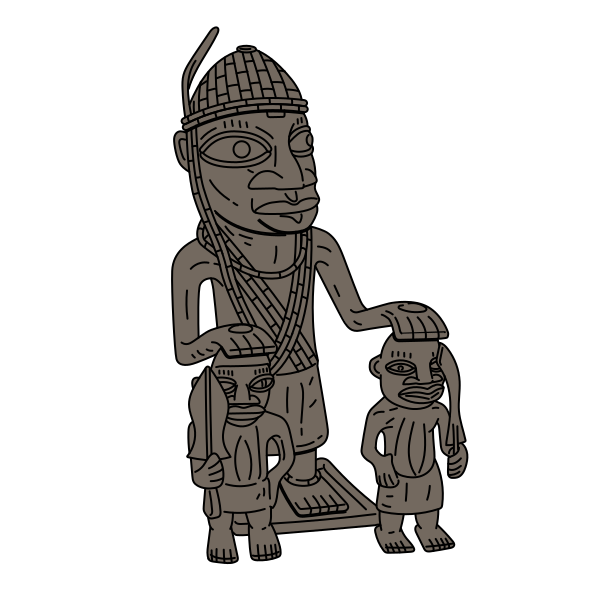
English designations
Categories
Institution Location
Helvetiapl. 5, 3005 Bern, Switzerland
Reg No.
E/1903.326.0004
Institution
Bernisches Historisches Museum Edo designations
English designations
Figure Group
Categories
Figures
Institution Location
Helvetiapl. 5, 3005 Bern, Switzerland
Iconographies
2
annotations

Iwu
Facial and Body Markings
1 annotation


Ukpan obọ eva
Crossed Beaded Baldrics
1 annotation

Provenance
5
events
Institution data
Bernisches Historisches Museum
The data was transferred directly through the Swiss Benin Initiative.
Last updated: 2022-07-04
Language: english
| Institution field | Value |
|---|---|
Reg No. object id | E/1903.326.0004 |
Object name and materials designation | Figure group |
Material material | brass |
Dimension/s dimensions | H. 24.5 cm W. 20.0 cm D. 14.0 cm |
Provisional dating date made | before 1903 |
Creditline prior source | Gift from Prof. M. M. Stein, Prof. Sidler, Ryf und Baur |
Provenances provenance | dates unknown, possibly produced by the Royal Bronze-casting Guild (Igun Eronmwon) in Benin City; [...]; dates unknown, F. W Reichert (collector); date unknown - ca. 1903, Völkerkundemuseum Hamburg; 1903 acquired by Bernisches Historisches Museum with funds from Prof. M. M. Stein, Prof. Sidler, Ryf and Baur |
Institution department and institution | BHM Bernisches Historisches Museum |
Institution acquisition date accession date | 1903 |
Sections
About
Other
Sensitive content
Sensitive Content Digital Benin includes colonial material that may contain inaccurate, derogatory or harmful language relating to African and African diasporic communities. Such language may appear in catalogue records, transcriptions, and book, exhibition or museum titles. We recognize that this material may cause distress. Sensitive-content warnings are being implemented across the collection, but this process is ongoing. The language does not reflect Digital Benin’s views; we take an anti-colonial and anti-racist position and are committed to centring the humanity of historically marginalised communities.