


id
143898
Edo designations
English designations
Altar Tusk
Categories
Altar & Shrine Objects
Location
11150 East Blvd, Cleveland, OH 44106, United States
Loading...

Iconographies

16 annotations
Ẹbẹn
Ceremonial Sword

Ẹbẹn are a type of ceremonial sword of significant importance in the Benin Kingdom. During ceremonies, titled chiefs would hold them or toss them during dances, thereby paying homage to the Ọba at these public events, particularly when a chief receives a certain status. It is forbidden for Ẹbẹn to touch the ground, so the chief must take extra precautions to avoid dropping the Ẹbẹn during the dance. Therefore, the Okae-Odionmwan (head of executioners) dances with the Umozo (warfare or executioner’s sword) behind the dancing chief.

There are two central ceremonial swords used in the royal court of the Benin Kingdom, one of which is the Ẹbẹn, along with the Ada (ceremonial swords). They are distinguished by their blades: the Ẹbẹn blade reflects the shape of a leaf or an oar. Sometimes, it is decorated with openwork designs and/or brass inlays, most commonly shaped as small Ẹbẹn and Ẹkpẹn (leopards). The handle of the Ẹbẹn also has an unusual ring-shaped form, which further differentiates it from the Ada.

1 annotation
Ẹbẹn
Ewu ivie
Coral Beaded Shirt

The Ewu ivie (coral bead shirt) is made of strings of coral beads. This heavy shirt was part of the ceremonial regalia worn only by a small number of high-ranking members of the palace: the Ọba, the Edaiken, the Iy’Ọba, and the Ezọmọ (Girshick Ben-Amos 1999, p. 68). The Ewu ivie would be worn along with the Odigba (coral bead collar).

1 annotation
Ewu ivie
Ẹrhu
Headwear

Many different kinds of Ẹrhu (headwear) are worn by the various figures depicted in the imagery of Benin royal artefacts. Through comparisons with ceremonial regalia still worn by chiefs and members of the royal court, including the Ọba himself, some Ẹrhu have been used to identify the different figures depicted. For example, the conical hat worn by high-ranking town chiefs as part of the pangolin regalia, still worn at ceremonies, is also visible on figures on some Ama-Ẹrọnmwọn (bronze relief plaques) ( ). Other examples include the distinctive bell-shaped helmet associated with the Iyasẹ ( ). Figures who wear a shallow-brimmed hat and a cross have been identified as Ewua or Ohensa priests ( ).

Different kinds of helmets and headwear were worn by warriors, reflecting the many different ranks and roles in the army at any given time, as well as developing trends that were in turn represented on Emwin Arhe created at different points in time. Warrior figures wearing helmets covered in cowrie shells were carved on the Aken'ni Elao (carved tusks) (Blackmun 1984, p. 330), yet on the brass Ama, warriors are sometimes depicted wearing helmets made from crocodile hide or horsehair with a front plate (Osadolor in Plankensteiner 2007, cat. no. 238, p. 457). Helmets made from horsehair with a front plate are one of the more common types represented on the Ama-Ẹrọnmwọn, and the demand for black horse tails was noted by both Portuguese and British traders during the late 17th and 18th centuries (Osadolor in Plankensteiner 2007, cat. no. 238, p. 457). Other warriors depicted on Ama-Ẹrọnmwọn wear helmets with a rounded top, chinstrap, and sometimes also a feather tucked into the left side. These types of headwear are known as Ẹrhu Iyokuo.

Attire worn for battle also differed from that worn for ceremonial occasions, such as the pointed headwear worn in combination with an ornate leopard-head tunic by war chiefs. Depictions of figures wearing this attire on brass Ama-Ẹrọnmwọn (bronze relief plaques) have been interpreted as representing the war chiefs’ participation in the war-ritual Isiokuo festival (Osadolor in Plankensteiner 2007, cat. no. 238, p. 457).

Another distinctive form of headwear is that worn by figures identified as leopard hunters on the brass Ama-Ẹrọnmwọn (relief plaques). These large helmets cover almost all of the leopard hunters’ faces except for their noses, eyes, and upper lips, and are made of an unusual material that remains unidentifiable (Plankensteiner 2007, cat. nos. 68–69, p. 322).

European figures are also portrayed with distinctive hats, such as Portuguese three-cornered hats. These depictions reflect the artists’ keen observation and highlight the impact of European trade and military assistance (Ezra 1992).

1 annotation
Ẹrhu
snake
Ẹyẹn
Snake

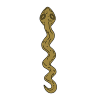
Ẹyẹn (snakes) are among the most common animals depicted by Edo artists on the Emwin Arhe (royal treasures). The varied depictions of these reptiles suggest different snake species, including the Ikpin (python), Arhunmoto (puff adder), and Olose (red-black striped snake); therefore, here we use the generic term for snake: Ẹyẹn.

The identification of snake motifs and depictions as Ikpin, as well as the importance accorded to this species, is a subject of scholarly debate. Paula Ben-Amos (1976, p. 247) argued that the Edo admired the “stature, colouration and crushing power” of the python, which was in turn associated with Olokun. She went on to identify the brass figures of snakes that formerly adorned the roof of the palace, as well as several other snakes, as pythons. Joseph Nevadomsky (1988, p. 77) argued instead that the importance of the Ikpin had been overstated.

Some of these snake representations may in fact be the Arhunmwoto (puff adder). The first to suggest this was the German curator Felix von Luschan (1919) in his early research into the Benin royal treasures. Nevadomsky (1988, pp. 79–80) suggested that the large head, narrow neck, and rough scales are indicative of either the puff adder, a symbol of “material wealth, tribute, and gifts,” or the Gaboon viper.

Another kind of snake that may be depicted is the Olose (red-black striped snake). It has the praise name “king of the snakes” in Edo. Olose is also closely connected to the deity Olokun, both because of its attractiveness and because it inhabits wet environments such as forest streams, which in turn flow into rivers and the sea, where Olokun lives (Nevadomsky 1988, pp. 76–77). Although the exact meanings of these different snakes vary, they share the characteristic of being spiritually powerful creatures.

1 annotation
Ẹyẹn
Ubanu'hi / Obanu'hi
Ubanu'hi / Obanu'hi
Inifinity Symbol

The Ubanu'hi (infinity symbol) is a kind of guilloche or interlaced strapwork motif that can be angular or rounded. It was used by Edo artists in the decoration of many Emwin Arhe (royal treasures) and is ubiquitous in Benin royal arts. Ubanu'hi is a shortened form of “uba no Ọba ya de agbon ke ehimwin yi”, which means “the rope with which the Ọba ties the heaven and earth together” (pers. comm. Chief John Igbineweka Inneh n’Igbesawman, 2022). Similarly, Paula Ben-Amos Girshick (in Plankensteiner 2007, pp. 339, 341) described this as “Ọba n’iri agbon”, or the “rope of the world” pattern.

According to Ọbabanmu Ineh (in Blackmun 1984, p. 51), the use of this motif indicates that objects were carved by members of the Igbesanmwan. However, the motif is found on all types of Emwin Arhe (royal treasures), not only those made of ivory or wood. On the flanges of the Ama (relief plaques) alone, Kathryn Gunsch (2018, pp. 75–77) identified three different versions of the Ubanu'hi and, through her analysis of over 850 plaques, found that these different Ubanu'hi forms align with other characteristics, such as dimensions, the prevalence of ornamental motifs, and stylistic qualities. Together, these provide evidence, she argues, of different production groups among the plaque makers .

Kate Ezra (1992, pp. 209, 264) went on to argue that the use of these motifs indicates that certain objects were used in a “royal context” and were associated with “royal patronage”.

1 annotation
Ubanu'hi / Obanu'hi
Ikpotoki
Portuguese Figure

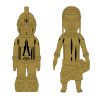
Ikpotoki figures (Portuguese figures) are easily distinguished by their European-style clothing, including hats and helmets, as well as by their facial features, particularly their thin, straight noses and straight hair. The objects Ikpotoki figures are shown wearing or holding provide further indications of their relationship with the Benin Kingdom. When they hold or are positioned alongside Ugianran (manillas), for example, they indicate trade, commerce, and wealth, while weaponry such as firearms, swords, or spears indicates their role as mercenaries in the service of the Ọba. In 1515, Ọba Ẹsigie went to war against the Attah of Idah, the ruler of a neighbouring kingdom. Portuguese mercenaries and weapons assisted the Edo in winning the battle, enabling the further expansion of the Kingdom. Ẹsigie’s reign was particularly important for strengthening ties between the Benin Kingdom and the Portuguese Empire, and he is believed to have spoken fluent Portuguese. With Ẹsigie’s encouragement, Portuguese missionaries established churches in the Benin Kingdom ( ; ), while Portuguese trading factories were also established ( ). Ọba Ẹsigie allowed his son to be baptised and sent him to Portugal to be educated; following his return, he became Ọba Orhogbua ( ).

1 annotation
Ikpotoki
Ẹkpẹn
Leopard

The Ẹkpẹn (leopard) is an animal that appears most often among the motifs decorating the Emwin Arhe (royal treasures). The Ẹkpẹn symbolises the valour and strength of the Ọba, as well as his political authority. The Benin people eulogise the Ọba as the ‘ẹkpẹn n'owa’ (leopard of the home).

When a hunter kills a leopard, he must say “ẹkpẹn n'oha” (I killed a bush leopard), as it is taboo to say that a hunter killed a leopard without specifying that it is a bush leopard, as otherwise this would “be tantamount to symbolically killing the king” (Nevadomsky 1988, p. 81). For this reason, leopards of the bush are called Atalakpa to distinguish them from those that represent the Ọba.

1 annotation
Ẹkpẹn
Asoro
Spears

Asoro (spears) were used as weapons in battle and for hunting ( ; Ọbazee 2025, p. 37). According to , there were two types: long and short. Figures holding Asoro are often depicted on Ama-Ẹrọnmwọn (bronze relief plaques), sometimes in battle scenes and at ceremonies and festivals.

1 annotation
Asoro
Colar Bead
Odigba
Coral beaded collar

Odigba (coral-beaded collar) is a rigid neck collar made of coral beads, worn as part of ceremonial attire only by senior princes who have been made Enigie (Inneh 2007, p. 107). Although Ibafe (2007, p. 43) argued that the Odigba was introduced during the Ogiso period (c. 900–c. 1170 AD) by Ogiso Ere, along with other symbolically important Emwin Arhe, such as the Ada (ceremonial sword) and the Ẹbẹn (ceremonial sword), this seems unlikely, as coral was only introduced in the late 15th century through trade with Portuguese merchants.

1 annotation
Odigba
Iviawẹ
Stacked Beaded Anklet

Ọba gha ye Ivie gie ọwan, ẹ ghi tama rẹn ehe nọ gha bae yi (When the Ọba gifts you a bead, he doesn’t tell you how to wear it) (Daniel Inneh, pers. comm., 27 September 2025).

Iviawẹ (also spelled ĺvîowẹ) are coral-beaded anklets, often worn stacked together (Aigbe 1985, p. 28; Okpokunu, Agbontaen-Eghafona & Ojo 2005, p. 162; Ọbazee 2025, p. 279). Many of the figures depicted on the Emwin Arhe (royal treasures) in brass, bronze, ivory, and wood are shown wearing these. According to Daniel Inneh (pers. comm., 27 September 2025), beads were sent to people whom the Ọba wished to honour, although there was no directive on how to wear them.

Mostly, people who wear Iviawẹ are identified as palace chiefs or priests and priestesses. However, today anyone can wear them as cultural identifiers or fashion pieces.

1 annotation
Iviawẹ
Ukhurhẹ
Ancestral Staff

Representations of figures, often the Ọba, with an Ukhurhẹ (Ancestral Staff) in their right hand recur in a number of Emwin Arre (royal treasures), particularly those carved in wood as Agba (royal stools), cast in brass as part of Osogan (Osun staffs) and Ikẹgobọ (altars to the hand), and carved in ivory as Aken'ni Elao (carved tusks).

Ukhurhẹ are rattle staffs, usually made from wood, although brass examples are believed to have been owned by the Ọba. Ukhurhẹ were, and continue to be, commissioned when the paternal head of a family passes away as a way of commemorating them ( ). Following a ceremony in which they are installed on the family’s ancestral altar, Ukhurhẹ are typically lined up against the back of the altar and are used to communicate with ancestors and the spirit world. When depicted on the Emwin Arhe, Ukhurhẹ are usually held in the right hand of the Ọba, while an Ughavan (celts) is carried in his left hand.

1 annotation
Ukhurhẹ
tribal marks
Iwu
Facial and Body Markings

Iwu are facial and body markings (scarifications) that were historically worn by Edo men and women. However, since the 1960s, the practice has been nearly extinct (Aisien 2011). In the past, Iwu were used as a way of proving that one was an Edo citizen, and the ceremony of having Iwu completed was an important rite of passage for men and women. The Osiwu, who also practised circumcision and other surgical procedures, would carry out the procedure of adding Iwu. There are different types of Iwu: ‘blades’ worn on the torso (Iwu-eko), and those worn on the face, such as Ikharo (three or four markings above the eyebrows), Irho (two narrow ‘blades’ worn on each cheek), Ovbihue (nasal ‘blades’), Ovbi-agbanmwen (chin ‘blade’), and Igho-okpa/Ukpgho (three forehead ‘blades’) (Aisien 2011, p. 22).

The number of Iwu also varied depending on the identity of the person wearing them. For example, royal men would wear six ‘blades’ on their torso, whilst men who were not royal would wear seven ‘blades’. Meanwhile, the Ọba’s female children would wear fifteen ‘blades’, and all other women would wear sixteen (Aisien 2011).

1 annotation
Iwu
Uhunmwu-Ẹkuẹ
Pendant Mask

Uhunmwu-Ẹkuẹ (pendant masks) formed part of the ceremonial regalia worn by court dignitaries to indicate their rank or function and are frequently represented among the Emwin Arhe (royal treasures), particularly those made of brass, bronze, or ivory.

Different animals were depicted on Uhunmwu-Ẹkuẹ, particularly the heads of leopards and crocodiles. The most common type features the face or head of an Ọba. Other examples take the form of an elephant head incorporating the trunk-hand motif, a ram’s head, or, in a very small number of cases, the face of a Portuguese man. Different figures appear to have worn Uhunmwu-Ẹkuẹ with different imagery. For example, warrior chiefs are often depicted wearing leopard-head pendant masks, whereas crocodile-head Uhunmwu-Ẹkuẹ are generally shown being worn only by the Ọba and his Enọbare (Blackmun 2007, cat. no. 137, p. 365).

1 annotation
Uhunmwu-Ẹkuẹ
Ukpan obọ eva
Crossed Beaded Baldrics

The Ukpan obọ eva (coral-bead crossed baldrics) were worn as part of the ehaingbehia, the full ceremonial regalia, by only high-ranking members of the palace, including the Ọba himself, the Iy’Ọba, the Edaiken, and the Ezọmọ (Ben-Amos 1999, pp. 68, 141; Osadolor in Plankensteiner 2007, cat. no. 70, pp. 322–323).

1 annotation
Ukpan obọ eva
Ehẹn
Fish

Ehẹn is a general term used to describe various types of fish (Ọbazee 2025, p. 90; ). Although mudfish are one of the most common motifs in Benin art, other kinds of fish are also represented. According to Blackmun ( ), a greater variety of fish are represented on the Aken'ni Elao (carved tusks) than on other types of royal artefacts. According to Kathy Curnow ( ), fish appear on 70 Ama-Ẹrọnmwọn (bronze relief plaques), making them the most commonly represented animal. Despite their prevalence, the precise species of fish are not easy to identify due to their “generic renderings”, possibly indicating that artists did not always distinguish between specific varieties ( ). Fish are represented on the Ama-Ẹrọnmwọn both in profile and from above.

1 annotation
Ehẹn
alligator
Ẹghughu
Crocodile

In the riverine area surrounding Benin City, there are two types of crocodile. The Ẹghughu, known in English as the dwarf or bush crocodile, is believed to be more docile ( ; Ọbazee 2025, p. 133). The second type is the Àgbákà, the aggressive Nile crocodile ( ; Ọbazee 2025, p. 11).

Crocodiles are one of the important animals represented in the historical Emwin Arhe, and they are known as Olokun’s guards or the “policemen” of the waters. The powerful and ferocious qualities of these animals might explain why warrior figures are often depicted wearing Uhunmwu-Ẹkuẹ (pendant masks) in the shape of crocodile heads on Ama-Ẹrọnmwọn (bronze relief plaques) ( ). Olokun devotees use crocodiles as sacrificial animals in offerings during the worship of Olokun.

1 annotation
Ẹghughu

Provenance

4 events
Production
1750 (year uncertain/approximate) to February 22, 1897 (day approximate)
The object was produced by Unknown member(s) of the Igbesamwan guild in Benin City.
Looted
February 22, 1897 (day approximate) to June 1899 (year approximate)
The object was looted by February 1897 Unknown member of the British colonial military campaign on Benin from Benin Kingdom.
Purchase
1961 (approximate)
The object was purchased by Katherine Coryton Merkel) White (Reswick with its destination in Gates Mills.
Gift
1968
The object was given as a gift by Katherine Coryton Merkel) White (Reswick to the Cleveland Museum of Art from Gates Mills to Cleveland.

Institution data

Cleveland Museum of Art
The data was downloaded via a public data access of the institution.
Last updated: 2021-02-13
Language: english
Institution fieldValue
accession_number
object id
1968.284
id
object id
143898
title
designation
Ancestral Altar Tusk
digital_description
description
tombstone
description
Ancestral Altar Tusk, c. 1820. Nigeria, Benin Kingdom, Ẹdo peoples, members of the Igbesanmwan (wood and ivory carvers) guild. Elephant ivory; overall: 197.4 cm (77 11/16 in.). The Cleveland Museum of Art, Gift of Katherine C. White 1968.284
wall_description
description
Ọba Ọsẹmwẹdẹ commissioned the carving of this tusk to connect with his ancestors and symbolize his strength. It is covered with royal figures wearing elaborate regalia and scenes of power, ritual, and violence. While Benin royal symbols may look similar across centuries, their meanings can shift. Ọsẹmwẹdẹ’s reign was prosperous due to trade with the Dutch; however, 16th-century Portuguese men are carved on the lower tusk. By the 1800s they represented <em>any</em> European traders. This tusk’s surface likely became worn and cracked from frequent washing, bleaching, and the applying of a white clay (<em>orhue</em>) linked to peace, purity, and prosperity.
dimensions/diameter/width
dimensions
dimensions/overall/depth
dimensions
dimensions/overall/height
dimensions
1.974
dimensions/overall/width
dimensions
measurements
dimensions
Overall: 197.4 cm (77 11/16 in.)
type
object type
Sculpture
creation_date
date made
c. 1820
creation_date_earliest
date made
1815
creation_date_latest
date made
1825
technique
production technique
Elephant ivory
creditline
prior source
Gift of Katherine C. White
provenance/0/date
provenance
1820s
provenance/0/description
provenance
Commissioned by Ọba Ọsẹmwẹdẹ [r. 1815–50] from the Igbesanmwan
provenance/1/date
provenance
after 1850
provenance/1/description
provenance
Ọba Ọsẹmwẹdẹ [r. 1815–50], Royal Palace, Benin City, by descent to Ovọnramwẹn (Ovọnramwẹn Nogbaisi [c. 1857–1914, r. 1888–97]
provenance/2/date
provenance
1897
provenance/2/description
provenance
Brought to England (or Europe) following the Siege of Benin
provenance/3/date
provenance
by at least 1961-1968
provenance/3/description
provenance
Katherine (Merkel) White Reswick [1929-1980], Gates Mills, OH, given to the Cleveland Museum of Art
provenance/4/date
provenance
1968-
provenance/4/description
provenance
The Cleveland Museum of Art, Cleveland, OH
provenance/5/date
provenance
provenance/5/description
provenance
provenance/6/description
provenance
provenance/7/date
provenance
provenance/7/description
provenance
provenance/8/date
provenance
provenance/8/description
provenance
culture
ethnic attribution
Nigeria, Benin Kingdom, Ẹdo peoples, members of the Igbesanmwan (wood and ivory carvers) guild
collection
department and institution
African Art
current_location
department and institution
108A Sub-Saharan
department
department and institution
African Art
fun_fact
notes
exhibitions/current/0/description
exhibition history
<i>Year in Review: 1968</i>. The Cleveland Museum of Art, Cleveland, OH (organizer) (January 29-March 9, 1969).
exhibitions/current/0/id
exhibition history
301285
exhibitions/current/0/opening_date
exhibition history
1969-01-29T05:00:00
exhibitions/current/0/title
exhibition history
Year in Review: 1968
exhibitions/current/1/description
exhibition history
exhibitions/current/1/id
exhibition history
exhibitions/current/1/opening_date
exhibition history
exhibitions/current/1/title
exhibition history
exhibitions/legacy
exhibition history
CMA 1968: "African Images: The Katherine White Reswick Collection," cat. no. 144, repr.<br>CMA 1969: "Year in Review 1968," CMA Bulletin LVI (Jan., 1969), p. 46, no. 56, repr. p. 43.
citations/0/citation
bibliography
Blackmun, Barbara Winston. 1994. "History and Statecraft on a Tusk from Old Benin". <em>The Bulletin of the Cleveland Museum of Art. </em>81 (4): 87-115.
citations/0/page_number
bibliography
citations/0/url
bibliography
citations/1/citation
bibliography
citations/1/page_number
bibliography
citations/1/url
bibliography
citations/2/citation
bibliography
citations/2/page_number
bibliography
citations/2/url
bibliography
citations/3/citation
bibliography
citations/3/page_number
bibliography
citations/3/url
bibliography
citations/4/citation
bibliography
citations/4/page_number
bibliography
citations/4/url
bibliography
citations/5/citation
bibliography
citations/5/page_number
bibliography
citations/5/url
bibliography
citations/6/citation
bibliography
citations/6/page_number
bibliography
citations/6/url
bibliography
citations/7/citation
bibliography
citations/7/page_number
bibliography
share_license_status
license
CC0
images/full/filename
images
1968.284_full.tif
images/full/filesize
images
195260108
images/full/height
images
7951
images/full/url
images
https://openaccess-cdn.clevelandart.org/1968.284/1968.284_full.tif
images/full/width
images
8185
images/print/filename
images
1968.284_print.jpg
images/print/filesize
images
882745
images/print/height
images
3303
images/print/url
images
https://openaccess-cdn.clevelandart.org/1968.284/1968.284_print.jpg
images/print/width
images
3400
images/web/filename
images
1968.284_web.jpg
images/web/filesize
images
163951
images/web/height
images
874
images/web/url
images
https://openaccess-cdn.clevelandart.org/1968.284/1968.284_web.jpg
images/web/width
images
900
url
weblink
https://clevelandart.org/art/1968.284
former_accession_numbers/0
1033.68
former_accession_numbers/1
updated_at
2020-11-14 10:01:39.805000
Sensitive Content

Digital Benin collates digital material from institutions, and some of this material is inherently colonial and contains words, terms and phrases that are inaccurate, derogatory and harmful towards African and African diasporic communities. Catalogue transcriptions, book titles, exhibition titles and museum titles may contain harmful terms. We recognise the potential for the material to cause physical and mental distress as well as evoke strong emotions. Owing to the scale of the collection’s data, a process to implement sensitive-content warnings in the displayed data is still incomplete. The material within the catalogue does not represent Digital Benin’s views. Digital Benin maintains a strong anti-colonial, anti-racist position and affirms its support for centring the humanity of historically marginalised and disenfranchised communities. Read more about the background of this statement here