Registration number
Af1954,23.297
Institution
British Museum
Edo designations
English designations
Carved Wooden Panel
Location
Great Russell St, Bloomsbury, London WC1B 3DG, United Kingdom
Loading...
Carved Wooden Panel
Carved Wooden Panel
Carved Wooden Panel

Iconographies

17 annotations
Ekhara
Umbrella

Ekhara (umbrellas) play a multifaceted role in Benin art, reflecting both their function as status symbols and their association with European visitors. On some Ama-Ẹrọnmwọn (bronze relief plaques), sunshades resembling Asa are held by the Ọba’s attendants to protect him from the sun. European-style Ekhara, as we know them today, are also depicted in late 19th-century wooden carvings produced by the Emada. In her analysis of the Aken'ni Elao, Barbara Blackmun ( ) observed that on earlier objects, umbrellas were generally depicted only in the hands of foreign figures rather than those identified as members of the Benin Kingdom.

On later objects, particularly those dating to the late 19th century, this changes. The Ọba and high-ranking chiefs such as the Ezọmọ are depicted being shielded from the sun by attendants carrying Ekhara, a practice also described by Europeans visiting Benin City (e.g., ). Like many imported luxury goods, the Ekhara was incorporated into the visual language of royal power and became an important status symbol, associated with the wealth, authority, and elevated position of those permitted to use it.

1 annotation
Ekhara
Ukpan obọ eva
Crossed Beaded Baldrics

The Ukpan obọ eva (coral-bead crossed baldrics) were worn as part of the ehaingbehia, the full ceremonial regalia, by only high-ranking members of the palace, including the Ọba himself, the Iy’Ọba, the Edaiken, and the Ezọmọ (Ben-Amos 1999, pp. 68, 141; Osadolor in Plankensteiner 2007, cat. no. 70, pp. 322–323).

1 annotation
Ukpan obọ eva
Colar Bead
Odigba
Coral beaded collar

Odigba (coral-beaded collar) is a rigid neck collar made of coral beads, worn as part of ceremonial attire only by senior princes who have been made Enigie (Inneh 2007, p. 107). Although Ibafe (2007, p. 43) argued that the Odigba was introduced during the Ogiso period (c. 900–c. 1170 AD) by Ogiso Ere, along with other symbolically important Emwin Arhe, such as the Ada (ceremonial sword) and the Ẹbẹn (ceremonial sword), this seems unlikely, as coral was only introduced in the late 15th century through trade with Portuguese merchants.

1 annotation
Odigba
Beaded Crown
Ẹde
Beaded Crown

Although many other members of the Benin royal court wore a variety of hats and forms of headwear, only the Ọba may wear the Ẹde (beaded crown). The Ọba must never be seen bare-headed, and successive Ọbas introduced different styles and types of crowns ( ).

Across different media and objects, Ọbas are depicted wearing various types of crowns, all elaborately crafted from coral beads. Some feature tall projections rising from the crown, known as Oro, while others have curved projections extending from either side of the head, known as the winged cap. The latter was introduced only in the 19th century, most likely by Ọba Osẹmwẹndẹ ( ). Depictions of Ọba Esigie on Ama-Ẹrọnmwọn (bronze relief plaques) show him wearing an elaborate crown decorated with large jasper or coral beads ( ).

1 annotation
Ẹde
Ada
Ceremonial sword

The Ada is a symbol of authority usually borne in the presence of the Ọba by a designated holder, the Omada, which translates as ‘Ada bearer’. The Ọba has almost exclusive rights to the use of the Ada, except when he permits titled chiefs, such as the Oliha, to possess one. During the Ogiso period, predating the current Ọba dynasty, the Ada is said to have been a symbol of ancestral power, with the ability to control the future (Ben-Amos 1995, p. 25). The Ada is ranked higher than the Ẹbẹn, another symbolically important ceremonial sword.

1 annotation
Ada
tribal marks
Iwu
Facial and Body Markings

Iwu are facial and body markings (scarifications) that were historically worn by Edo men and women. However, since the 1960s, the practice has been nearly extinct (Aisien 2011). In the past, Iwu were used as a way of proving that one was an Edo citizen, and the ceremony of having Iwu completed was an important rite of passage for men and women. The Osiwu, who also practised circumcision and other surgical procedures, would carry out the procedure of adding Iwu. There are different types of Iwu: ‘blades’ worn on the torso (Iwu-eko), and those worn on the face, such as Ikharo (three or four markings above the eyebrows), Irho (two narrow ‘blades’ worn on each cheek), Ovbihue (nasal ‘blades’), Ovbi-agbanmwen (chin ‘blade’), and Igho-okpa/Ukpgho (three forehead ‘blades’) (Aisien 2011, p. 22).

The number of Iwu also varied depending on the identity of the person wearing them. For example, royal men would wear six ‘blades’ on their torso, whilst men who were not royal would wear seven ‘blades’. Meanwhile, the Ọba’s female children would wear fifteen ‘blades’, and all other women would wear sixteen (Aisien 2011).

1 annotation
Iwu
Ukpan obọ ọkpa
Single Beaded Baldric

Ukpan obọ ọkpa is a single baldric worn diagonally across the torso, from the left shoulder to the right hip. Barbara Blackmun described these baldrics as an “Ẹkpẹn band,” worn by figures as “a sign of distinction” ( ).

1 annotation
Ukpan obọ ọkpa
Ẹkirẹ
Frog

Ẹkirẹ is the Edo term for frog ( ; Ọbazee 2025, p. 135). The Ẹkirẹ carries significant and often ambiguous symbolic importance, primarily linked to its liminal nature and association with spiritual and magical powers. As an amphibian that lives on the threshold between water and land, the Ẹkirẹ is seen as a messenger of Olokun. This connection reinforces the Ọba’s (king’s) ability to bridge the human and spiritual realms, a concept consistently present in Benin art.

While not as common as the mudfish, frogs appear on various Benin artworks, including Aken'ni Elao (carved tusks), pendant plaques, and Ẹrhẹ (royal stools). Their presence often relates to medicinal and occult practices. Frogs can be used in powerful curses, with a jumping frog signifying failure, and a frog, along with a coiled fish, used in rituals to release such curses. They are also associated with Osun, the deity of medicine, and scenes of snakes swallowing frogs can represent supernatural attacks or strong spiritual powers. For warriors, the Ẹkirẹ could even symbolise an aspect of their protective equipment and was used in palace rituals to encourage success in battle ( ).

1 annotation
Ẹkirẹ
king with mudfish legs
TBC_Ọba Ohẹn
King with Mudfish Legs

This motif of an Ọba with legs represented as two mudfish is often interpreted as Ọba Ohẹn, who reigned c. 1334–1370. According to oral traditions, Ohẹn suffered from paralysis of the legs and unsuccessfully attempted to conceal his condition from the chiefs and members of the royal court. The Iyasẹ Emuze eventually hid in the Ọba’s chambers to discover his secret ( ). When Ohẹn discovered this, he ordered the Iyasẹ to be executed. However, the people learned of the order and turned against the Ọba. According to the tradition, they plotted to kill him ritually by digging a hole beneath his throne and stoning him with Orhue (white kaolin chalk) when he fell into it ( ; ).

Not all representations of an Ọba with mudfish legs, however, are understood to refer to Ohẹn. Variations in the objects and animals carried by the figure are thought to indicate different meanings ( ; ). Members of the Igbesamwan and Igun-Ẹrọnmwọn have emphasised the significance of these accompanying motifs (Blackmun 1984, pp.249–255). When the mudfish-legged Ọba is shown holding aquatic creatures such as crocodiles, for example, the image has been interpreted as a “cosmological image” representing the correspondence between the two monarchs: the Ọba of Benin, ruler of the land, and Olokun, ruler of the waters ( ). By contrast, representations in which the Ọba holds swords or staffs have been interpreted specifically as depictions of Ọba Ohẹn.

1 annotation
TBC_Ọba Ohẹn
Osa
Osa

“Only Osa and the Osuan know what is in the palm frond” (Inneh 2007, p. 113)

The title of Osa is paired with that of Osuan, and both titles were created by Ọba Ewuare I to protect the Ọba and the Edo people. The Osa worships the deity Uwen, who is associated with protection, healing, and the prevention of wounds, particularly during warfare (Inneh 2007, p. 113).

During ceremonies such as Ugie and Oduduwa, the Osa and Osuan support the Ọba on either side, a pose that is frequently reflected in the visual language of Emwin Arhe (royal treasures) (Blackmun 2007, cat. nr. 168, p. 167). Both are often depicted wearing basketry headwear with a pointed Oro projection, similar to the headwear still worn by holders of these titles today (Inneh 2007, fig. 8, p. 110).

During the Igue festival, the Osa and Osuan wrap raffia palm cloth around their waists, which “indicate[s] the deep secrecy of the inner details of the palace worship and Ugie ceremonies” (Inneh 2007, p. 113).

1 annotation
Osa
Iviawẹ
Stacked Beaded Anklet

Ọba gha ye Ivie gie ọwan, ẹ ghi tama rẹn ehe nọ gha bae yi (When the Ọba gifts you a bead, he doesn’t tell you how to wear it) (Daniel Inneh, pers. comm., 27 September 2025).

Iviawẹ (also spelled ĺvîowẹ) are coral-beaded anklets, often worn stacked together (Aigbe 1985, p. 28; Okpokunu, Agbontaen-Eghafona & Ojo 2005, p. 162; Ọbazee 2025, p. 279). Many of the figures depicted on the Emwin Arhe (royal treasures) in brass, bronze, ivory, and wood are shown wearing these. According to Daniel Inneh (pers. comm., 27 September 2025), beads were sent to people whom the Ọba wished to honour, although there was no directive on how to wear them.

Mostly, people who wear Iviawẹ are identified as palace chiefs or priests and priestesses. However, today anyone can wear them as cultural identifiers or fashion pieces.

1 annotation
Iviawẹ
Ẹguẹn
Anklet

Ẹguẹn are worn by the Ọba and chiefs as part of their Ehaengbehia, the full regalia worn during special ceremonies. Ẹguẹn are worn around the ankles or calves and can be made from beads, ivory, brass or even iron. A separate category, called Elubase, refers to those which have integrated rattles or crotal bell attachments, however both are described as anklets in English.

As early as 1899, Read and Dalton commented that the anklets worn by figures shown on plaques were a signifier of high rank. Today, anklets continue to signify social status, with the Ọba wearing many ivory and coral anklets stretching up his calves as part of his ceremonial regalia (Okpokunu, Agbontaen‐Eghafona & Ojo, 2005, p.162[106]). However, anklets were not the preserve of the Ọba alone, and different kinds and quantities were worn by other members of the royal court and Edo people. For example, Flora Kaplan (2006, p.85[107]) described a photograph of Iy’Ọba Aghahowa N’Errua, who took her title in 1981, in which she wears coral anklets as one of a number of insignia of her newly invested high rank. In contrast, brass anklets would be worn by young male attendants to the Ọba (see attendant figure), such as sword bearers or Emada pages (Kaplan, 2006, p.90[107]).

1 annotation
Ẹguẹn
Enobare
Supporter

Enobare is the term used for the supporting figures who are typically depicted alongside the Ọba, holding his arms or hands as part of the Royal Triad motif. Their identities are interpreted variously: they may represent the Osa and Osuan, who support the Ọba during certain ceremonial contexts, or, particularly in representations dating to the 18th century, the Edaiken (crown prince) and Ezọmọ ( ).

1 annotation
Enobare
Ewi
Mudfish

Depictions of Ewi (mudfish) are among the most frequent motifs in the Emwin Arhe (royal treasures). Mudfish hold an important place in Edo belief, both as representations of the god Olokun and as symbols of royalty (Plankensteiner 2007, p. 410), as well as of “prosperity, peace, well-being and fertility” (Ben-Amos 1976, p. 245). Mudfish are also particularly common animals for sacrifice, and mudfish-shaped Orhiẹvbẹ (kola-nut boxes) were used to make offerings or store kola nuts.

Yet, the appearance of Ewi across the Emwin Arhe is not consistent, and it has been argued that different species of mudfish were depicted by Edo artists, each with different qualities and capabilities. For example, the electric shock of Malapterurus electricus resembles the fierceness of the Ọba, while the liminal qualities of the Synodontis clarias mudfish, which lives both on land and in water, similarly reflect the Ọba’s rule over land and sea (Gallagher 1983, p. 93). With these different qualities in mind, the mudfish is an important symbol of Benin kingship and royalty.

Sometimes the Ọba was depicted by artists with mudfish rather than legs (see Ọba with Mudfish Legs).

1 annotation
Ewi
Ewu ivie
Coral Beaded Shirt

The Ewu ivie (coral bead shirt) is made of strings of coral beads. This heavy shirt was part of the ceremonial regalia worn only by a small number of high-ranking members of the palace: the Ọba, the Edaiken, the Iy’Ọba, and the Ezọmọ (Girshick Ben-Amos 1999, p. 68). The Ewu ivie would be worn along with the Odigba (coral bead collar).

1 annotation
Ewu ivie
Igan
Feather

Igan (feathers) are commonly depicted tucked into the headdresses and hats of chiefs represented on Emwin Arre (royal treasures). These feathers are from the Oɛɣohɔ (vulturine fish eagle) and symbolise respected old age and proper chieftaincy ( ).

1 annotation
Igan
Osuan
Osuan

“Only Osa and the Osuan know what is in the palm frond” ( )

The title of Osuan is paired with that of Osa, and both were created by Ọba Ewuare I to protect the Ọba and the Edo people as a whole ( ). According to Inneh ( ), the Osuan is responsible for Ora, the deity associated with fertility. The Osuan is therefore responsible for ensuring the fecundity of the land and people of the Kingdom ( ).

During ceremonies such as Ugie and Oduduwa, the Osa and Osuan support the Ọba on either side, a pose that is frequently reflected in the visual language of Emwin Arhe (royal treasures) ( ). Both are often depicted wearing basketry headwear with a pointed Oro projection, similar to the headwear still worn by holders of these titles today ( ). The Osuan, as well as other members of the Ooton guild to which the titleholder belongs, are often depicted holding an Unwẹnrhiẹnọtan (switch) in one or both hands. This pose reflects the historical role of the Osuan during sacrificial ceremonies, when the Unwẹnrhiẹnọtan was held aloft to “fend off intrusive spirits that crowded around as the victim died” ( ).

During the Igue festival, both the Osa and Osuan wrap raffia palm cloth around their waists, which “indicate[s] the deep secrecy of the inner details of the palace worship and Ugie ceremonies” ( ).

1 annotation
Osuan

Provenance

4 events
Production
1922 (approximate)
The object was produced in Benin City.
Exhibition
April 1924 to October 31, 1925
The object was exhibited at Wembley Park.
Purchase
1924
The object was purchased by Henry Solomon Wellcome, London Wellcome Institute for the History of Medicine and the Wellcome Collection in London.
Donation
1954
The object was donated by London Wellcome Institute for the History of Medicine and the Wellcome Collection to the British Museum in London.

Institution data

British Museum
The data was transferred directly by the institution.
Last updated: 2025-06-10
Language: english
Institution fieldValue
Registration number
object id
Af1954,23.297
Additional IDs
object id
29064 (WHMM number)~109 (Dark number)
PRN
object id
EAF21233
Object Type
designation
panel
Description
description
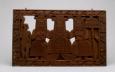
Panel; carved from wood. Rectangular in form, part openwork; front surface carved in low relief with central figure of Oba with mudfish legs, arms supported on both sides by attendants. Naked male figure holding ada sword at right side. Umbrella and right arm depicted on left side. Border at top and bottom has alternating carvings of frogs and shells. Bottom border has inscription in centre. Side borders carved with frogs, shells and human arms. Two metal picture hooks at top.
Ethnic name (made by)
ethnic attribution
Edo
Date
1924 (circa)
Production place
production place
Made in: Benin City
Findspot
place collected
Found/Acquired: London
Materials
material
wood ~metal
Technique
production technique
carved
Dimensions
dimensions
Height: 46.30 cm~Width: 76.90 cm~Depth: 2.70 cm
Inscription
inscriptions
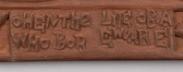
Inscription:~ Inscription details: inscription (bottom border)~ Inscription quoted: Ohen lite Oba who bor Ewuare~ Inscription note: Ohen refers to Oba Ohen (c.1334-1370) who was paralysed from the waist down. He is also sometimes assoicated with Olokun, the god of the sea, fertility and wealth, with the mudfish legs representing this close relationship. Ewaure refers to Oba Ewuare (c.1440-1473).
Curator’s comments
provenance
Register 1954: "Carved wood panel showing central figure with legs ending in fish heads supported by two standing figures, all have beaded caps and collars, on one side is a naked man holding a sword on the other, a hand holding an umbrella. The carving is in low relief, in places the background is completely cut away. Bought at Wembley, 1924. £4. An inscription (carved) below the central figure reads:- "Ohen the Liie (lame?) Oba who bor (sic) Ewuare."; See Collection File: Af1954,23.297-300.
Condition
condition
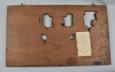
Good; white substance/staining at bottom right corner at front. Small white paint spot at front left side. Some staining on back on right side and corner and small darker stians in other places.
Subjects
iconography
royal/imperial ~frog ~shell
Associated events
event
Associated Event: British Empire Exhibition, Wembley - 1924
Acquisition name (acquisition)
provenance
Wellcome Institute for the History of Medicine
Acquisition name (previous)
provenance
Previous owner/ex-collection: British Empire Exhibition, Wembley 1924-5
Acquisition date
accession date
1954.0
Acquisition notes (excavation)
provenance
This panel was part of a larger collection purchased by the WHMM from the British Empire Exhibition, Wembley in 1924. The panel cost £4.0.0. It formed part of the Timber Exhibit in the Nigerian Pavilion and was part of a group of Edo stool tops commissioned in Benin for show at Wembley. See Af1954,23.297 to 300 and 314.
Sensitive Content

Digital Benin collates digital material from institutions, and some of this material is inherently colonial and contains words, terms and phrases that are inaccurate, derogatory and harmful towards African and African diasporic communities. Catalogue transcriptions, book titles, exhibition titles and museum titles may contain harmful terms. We recognise the potential for the material to cause physical and mental distress as well as evoke strong emotions. Owing to the scale of the collection’s data, a process to implement sensitive-content warnings in the displayed data is still incomplete. The material within the catalogue does not represent Digital Benin’s views. Digital Benin maintains a strong anti-colonial, anti-racist position and affirms its support for centring the humanity of historically marginalised and disenfranchised communities. Read more about the background of this statement here