
Iconographies







Provenance
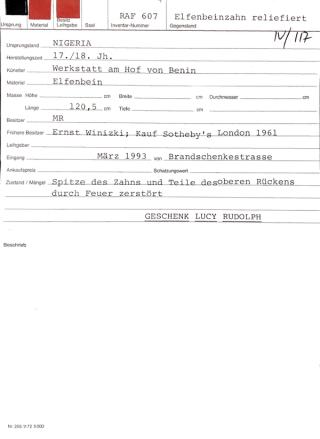
Institution data
| Institution field | Value |
|---|---|
Reg No. object id | RAF 607 |
Object name and materials designation | Carved elephant tusk |
Material material | ivory |
Dimension/s dimensions | H. 114,7 W. 12,5 D. 15 |
Provisional dating date made | 18th century |
Creditline prior source | Purchased from: Ernst Winizki, Zürich |
Provenances provenance | 18th century, comissioned from the Royal Ivory-sculptors Guild (Igbesanmwan) by the Royal Palace of Benin; by descent to Oba Ovonramwen (Ovonramwen Nogbaisi, b. about 1857 - d. about 1914; r. 1888 - 1897); 1897, looted from the Royal Palace during the British military occupation of Benin; [...]; ca. 1900 Arnold Ridyard (?) (collector and engineer Elder Dempster & Co) or George William Neville (?) (agent Elder Dempster & Co); until 1908, Willaim John Davey (?) (manager Elder Dempster & Co.); until 1928, Lydia Davey (?); until 1946, Harold Davey (?); until 1962 Florence E. Davey; 1962 Sothebys's London; from 1962, Kenneth John Hewett (dealer, London); until 1993, Ernst Winizki (dealer); 1993, purchased by Museum Rietberg Zürich |
Institution department and institution | MRZ Museum Rietberg Zürich |
Institution acquisition date accession date | March 1993 |
Additional IDs |
Digital Benin collates digital material from institutions, and some of this material is inherently colonial and contains words, terms and phrases that are inaccurate, derogatory and harmful towards African and African diasporic communities. Catalogue transcriptions, book titles, exhibition titles and museum titles may contain harmful terms. We recognise the potential for the material to cause physical and mental distress as well as evoke strong emotions. Owing to the scale of the collection’s data, a process to implement sensitive-content warnings in the displayed data is still incomplete. The material within the catalogue does not represent Digital Benin’s views. Digital Benin maintains a strong anti-colonial, anti-racist position and affirms its support for centring the humanity of historically marginalised and disenfranchised communities. Read more about the background of this statement here