


Iconographies







Provenance
Institution data
| Institution field | Value |
|---|---|
Identifikationsnummer object id | C 2898 |
Titel designation | Holzplatte mit Reliefschnitzerei |
Materialien material | ORGANISCH/ PFLANZLICH/Holz |
Heutiges Staatsgebiet des Herstellungsortes production place | Afrika/Westafrika/Nigeria/Benin-Reich |
Provenienz/Name prior source provenance | Umlauff |
Provenienz Objektitinerar Akteure Orte Daten provenance | J.F.G. Umlauff |
Provenienz/Affiliation provenance | J.F.G. Umlauff |
Provenienz/Country provenance | Germany |
Provenienz/Date of Birth provenance | 1833 |
Provenienz/Date of Death provenance | 1889 |
Provenienz/First Name provenance | Johann Gustav Friederich |
Provenienz/No provenance | 38 |
Provenienz/Place of Birth provenance | |
Provenienz/Place of Death provenance | |
Provenienz/Profession provenance | Ethnographica dealer |
Provenienz/Role-Function/0 provenance | Consignor |
Provenienz/Role-Function/1 provenance | Intermediary |
Provenienz/Sex provenance | male |
Provenienz/Short Biography provenance | J.F.G. Umlauff was a well-known Hamburg family business founded by Johann Gustav Friederich Umlauff (1833–1889) in 1869 and continued by his son Heinrich Umlauff (1868–1925). Initially run as a natural produce shop and shellfish factory, it later added ethnographic shows and the trade in ethnographic objects to its business portfolio. The acquisition of objects for resale took place (presumably also through intermediaries) via the port of Hamburg. Between 1900 and 1937, the museum acquired a total of six objects from the Kingdom of Benin from the Umlauff company, first by purchase, then later by exchange. |
Provenienz/Street provenance | |
Provenienz/Town provenance | Hamburg |
Hersteller kulturhist. Herkunftsgesellschaft ethnic attribution | --/Edo |
Heutiger Aufbewahrungsort Sammlung department and institution | Museum am Rothenbaum. Kulturen und Künste der Welt (MARKK) |
Akquisitionsdatum accession date | 1901 |
Alte Inventarnummer | |
Inventurdatum | 28.07.2009 |
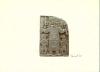
Label Text (deu) | Holzplatte mit Reliefschnitzerei Unbekannter Omada-Künstler, Königreich Benin, Nigeria, 19. Jh. / Holz / Ankauf von J.F.G. Umlauff, 1901, Inv. Nr. C 2898 Die Schnitzerei zeigt einen Würdenträger mit zwei Musikanten. Oben links ist ein Steinschlossgewehr dargestellt, dessen Hahn und Verschlussdeckel klar sichtbar sind. Oben links ist das Brett durch Feuer beschädigt. Es handelt sich um ein Werk eines Omada, junge Knaben, die als Pagen und Schwerträger am Hof arbeiteten. Es war vermutlich Oba Adolo im 19. Jh., der ihnen erlaubte, schnitzen zu lernen, möglicherweise unter Anleitung von Mitgliedern der Schnitzergilde. Im Unterschied zu jener, beschnitzten sie keine Objekte für den zeremoniellen Gebrauch sondern Stühle, Holzplatten, Schachteln, Kisten, Türen oder Kokosnussschalen. |
Label Text (eng) | Wood Plaque with Relief Carvings Unidentified Omada artist, Benin Kingdom, Nigeria, 19th century / Wood / Acquired from J.F.G. Umlauff, 1901, Inv. no. C 2898 The carving shows a dignitary with two musicians. On the top left a flintlock rifle is depicted, its cock and breech cap are clearly visible. This corner of the board is damaged by fire. It is a work of an Omada, young boys who worked as pages and sword bearers at court. It was presumably Oba Adolo who allowed them to learn carving in the 19th century, possibly under the guidance of members of the carvers’ guild. Unlike the latter, they did not carve objects for ceremonial use, but rather chairs, wooden panels, boxes, chests, doors or coconut shells. |
Maße | Höhe: 32,20 cm; Breite: 23,20 cm |
Digital Benin collates digital material from institutions, and some of this material is inherently colonial and contains words, terms and phrases that are inaccurate, derogatory and harmful towards African and African diasporic communities. Catalogue transcriptions, book titles, exhibition titles and museum titles may contain harmful terms. We recognise the potential for the material to cause physical and mental distress as well as evoke strong emotions. Owing to the scale of the collection’s data, a process to implement sensitive-content warnings in the displayed data is still incomplete. The material within the catalogue does not represent Digital Benin’s views. Digital Benin maintains a strong anti-colonial, anti-racist position and affirms its support for centring the humanity of historically marginalised and disenfranchised communities. Read more about the background of this statement here