Ibierugha and TBC
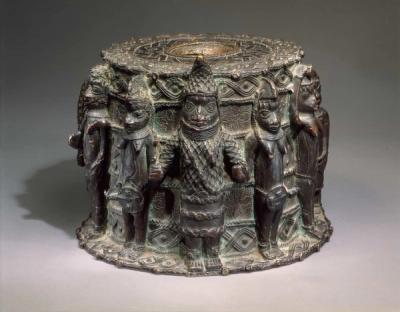
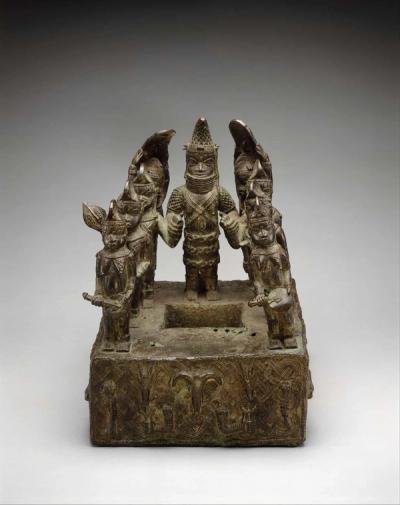
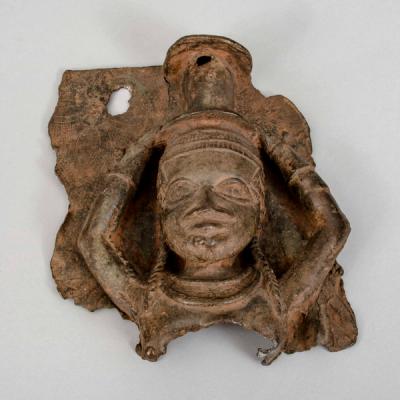
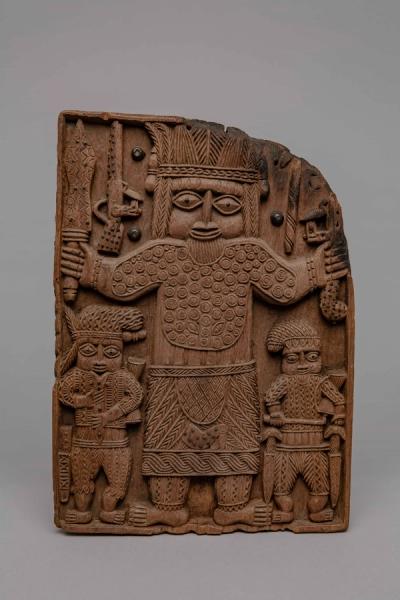
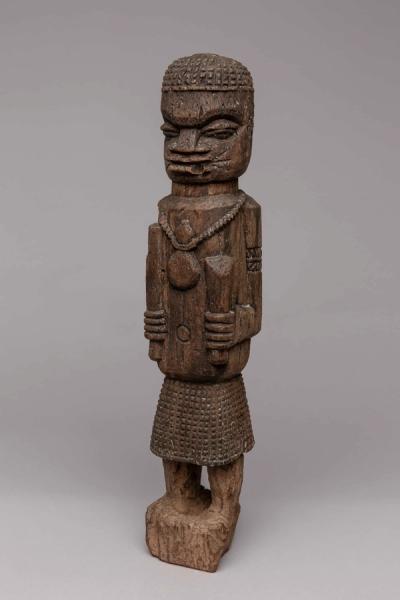
Figures of young men and women, often depicted nude except for waist beads, occur frequently throughout the visual language of Emwin Arhe (royal artefacts), particularly on Ama-Ẹrọnmwọn (bronze relief plaques), Urhotọ (altar tableaux), and Aken'ni Elao (carved tusks). These figures are typically shown attending or supporting high-status individuals such as the Ọba, Iy’Ọba, or warrior chiefs. Their smaller scale visually reinforces their subordinate status.
Attendants may carry symbols of state, such as the Ada and Ẹbẹn (ceremonial swords), on behalf of the Ọba; Ẹzuzu (fans), used to cool the Ọba and Iy’Ọba and to waft away evil spirits; or Asa (shields), held over the heads of higher-status figures to protect them from malevolent forces (Kaplan 2007, p. 149). Other attendants are shown carrying offerings, sometimes contained in specialised vessels such as Ẹkpoki (cylindrical boxes) or Orhiẹvbẹ (kola-nut bowls).
Ibierugha (male attendant figures) are distinguished by a characteristic crest-like hairstyle with a braided lock of hair falling over the left ear (Völger 2007, cat. no. 9, p. 279). The Ọba was typically attended by young men, while the Iy’Ọba was attended by young women. Attendants of both genders were usually provided with clothing by the Ọba or Iy’Ọba once they reached maturity, at which point the royal household would also arrange suitable marriage partners for them (Ezra 1992, p. 81).
Digital Benin collates digital material from institutions, and some of this material is inherently colonial and contains words, terms and phrases that are inaccurate, derogatory and harmful towards African and African diasporic communities. Catalogue transcriptions, book titles, exhibition titles and museum titles may contain harmful terms. We recognise the potential for the material to cause physical and mental distress as well as evoke strong emotions. Owing to the scale of the collection’s data, a process to implement sensitive-content warnings in the displayed data is still incomplete. The material within the catalogue does not represent Digital Benin’s views. Digital Benin maintains a strong anti-colonial, anti-racist position and affirms its support for centring the humanity of historically marginalised and disenfranchised communities. Read more about the background of this statement here