
Identifikationsnummer
C 2955
Edo designations
English designations
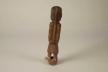
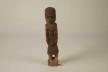
Male Figure
Categories
Figures
Location
1 Adesogbe (Plymouth) Road, P.M.B. 1115, Benin City , Edo State
Loading...
Male Figure
Male Figure
Male Figure
Male Figure
Male Figure

Iconographies

3 annotations
Uko
Container

Uko are flask-shaped containers with globular bodies and narrow openings, which could be made from calabash or cast in brass. The Uko depicted on Emwin Arhe (royal treasures) are usually worn around the neck or waist of figures, particularly those identified as ritual specialists or warriors, suggesting that they may have contained protective or ritual substances. Figures on Ama-Ẹrọnmwọn (bronze relief plaques) are sometimes shown holding or pouring from larger Uko, likely referencing the presentation of offerings during ceremonies and festivals. Uko motifs also decorate the flanges of Ikẹgobọ (altars to the hand), where they may similarly reference vessels used to contain liquid offerings.

1 annotation
Uko
hairstyles
Eto
hairstyles

Hairstyles are used to determine a person's status in the society, as chiefs, common folks, chief's wives and the wives of the Ọba all wear different hairstyles. We have Okuku, Ikpe~okhokho, Idu~akpata

1 annotation
Eto
Ibierugha and TBC
Attendant

Figures of young men and women, often depicted nude except for waist beads, occur frequently throughout the visual language of Emwin Arhe (royal artefacts), particularly on Ama-Ẹrọnmwọn (bronze relief plaques), Urhotọ (altar tableaux), and Aken'ni Elao (carved tusks). These figures are typically shown attending or supporting high-status individuals such as the Ọba, Iy’Ọba, or warrior chiefs. Their smaller scale visually reinforces their subordinate status.

Attendants may carry symbols of state, such as the Ada and Ẹbẹn (ceremonial swords), on behalf of the Ọba; Ẹzuzu (fans), used to cool the Ọba and Iy’Ọba and to waft away evil spirits; or Asa (shields), held over the heads of higher-status figures to protect them from malevolent forces (Kaplan 2007, p. 149). Other attendants are shown carrying offerings, sometimes contained in specialised vessels such as Ẹkpoki (cylindrical boxes) or Orhiẹvbẹ (kola-nut bowls).

Ibierugha (male attendant figures) are distinguished by a characteristic crest-like hairstyle with a braided lock of hair falling over the left ear (Völger 2007, cat. no. 9, p. 279). The Ọba was typically attended by young men, while the Iy’Ọba was attended by young women. Attendants of both genders were usually provided with clothing by the Ọba or Iy’Ọba once they reached maturity, at which point the royal household would also arrange suitable marriage partners for them (Ezra 1992, p. 81).

1 annotation
Ibierugha and TBC

Provenance

5 events
Production
unknown to February 22, 1897 (day approximate)
The object was produced by Unknown member(s) of the Igbesamwan guild in Benin City.
Looted
February 22, 1897 (day approximate) to June 1899 (year approximate)
The object was looted by February 1897 Unknown member of the British colonial military campaign on Benin from Benin Kingdom.
Unknown
February 22, 1897 (year approximate) to 1901
The object is known to have come into contact with Christoph Schultz, later in Hamburg.
Purchase
1901
The object was purchased by the MARKK Museum am Rothenbaum Kulturen und Künste der Welt from Christoph Schultz in Hamburg.
Restitution
December 16, 2022
The object was restituted by the MARKK Museum am Rothenbaum Kulturen und Künste der Welt to the Omo n'Oba n'Edo Uku Akpolokpolo, Ọba of Benin & National Commission for Museums and Monuments, Nigeria through Carsten Brosda, S.E. Yusuf Maitama Tuggar, Abba Isa Tijani and Barbara Plankensteiner from Hamburg to Nigeria.

Institution data

MARKK Museum am Rothenbaum Kulturen und Künste der Welt
The data was transferred directly by the institution.
Last updated: 2022-06-10
Languages: german, english
Institution fieldValue
Identifikationsnummer
object id
C 2955
Titel
designation
Holzfigur
Materialien
material
ORGANISCH/ PFLANZLICH/Holz
Heutiges Staatsgebiet des Herstellungsortes
production place
Afrika/Westafrika/Nigeria/Benin-Reich
Provenienz/Name
prior source
provenance
Schultz
Provenienz Objektitinerar Akteure Orte Daten
provenance
H. Schultz
Provenienz/Affiliation
provenance
Provenienz/Country
provenance
Provenienz/Date of Birth
provenance
unknown
Provenienz/Date of Death
provenance
unknown
Provenienz/First Name
provenance
Christoph
Provenienz/No
provenance
34
Provenienz/Place of Birth
provenance
unknown
Provenienz/Place of Death
provenance
unknown
Provenienz/Profession
provenance
Presumably Merchant or Sailor
Provenienz/Role-Function/0
provenance
Consignor
Provenienz/Role-Function/1
provenance
Collector
Provenienz/Sex
provenance
male
Provenienz/Short Biography
provenance
Christoph Schultz offered a relief plaque from the Kingdom of Benin for sale to the then Berliner Kunstgewerbemuseum and later to the Königlichen Museum für Völkerkunde in 1902. Schulz, who was based in Harburg, who presumably worked as a merchant or sailor, was most likely the same person who sold two pieces from the Kingdom of Benin to the Hamburg Museum für Völkerkunde (today MARKK) in the same year.
Provenienz/Street
provenance
Provenienz/Town
provenance
Hersteller kulturhist. Herkunftsgesellschaft
ethnic attribution
--/Edo
Heutiger Aufbewahrungsort Sammlung
department and institution
Museum am Rothenbaum. Kulturen und Künste der Welt (MARKK)
Akquisitionsdatum
accession date
1901
Alte Inventarnummer
Inventurdatum
11.08.2009
Label Text (deu)
Figur eines Priesters Unbekannter Künstler der Holzschnitzergilde Igbesanmwan / Königreich Benin, Nigeria, 19. Jh. / Holz / Ankauf von Christoph Schultz, 1901, Inv. Nr. C 2955
Label Text (eng)
Figure of a Priest Unidentified workshop of the Guild of Wood Carvers Igbesanmwan / Benin Kingdom, Nigeria, 19th century / Wood / Acquired from Christoph Schultz, 1901, Inv. no. C 2955
Maße
Sensitive Content

Digital Benin collates digital material from institutions, and some of this material is inherently colonial and contains words, terms and phrases that are inaccurate, derogatory and harmful towards African and African diasporic communities. Catalogue transcriptions, book titles, exhibition titles and museum titles may contain harmful terms. We recognise the potential for the material to cause physical and mental distress as well as evoke strong emotions. Owing to the scale of the collection’s data, a process to implement sensitive-content warnings in the displayed data is still incomplete. The material within the catalogue does not represent Digital Benin’s views. Digital Benin maintains a strong anti-colonial, anti-racist position and affirms its support for centring the humanity of historically marginalised and disenfranchised communities. Read more about the background of this statement here