


Object Number
1991.17.61
Edo designations
English designations
Stool
Categories
Ceremonial Objects
Location
1000 5th Ave, New York, NY 10028, United States
Loading...
Stool
Stool
Stool
Stool

Iconographies

20 annotations
Ubanu'hi / Obanu'hi
Ubanu'hi / Obanu'hi
Inifinity Symbol

The Ubanu'hi (infinity symbol) is a kind of guilloche or interlaced strapwork motif that can be angular or rounded. It was used by Edo artists in the decoration of many Emwin Arhe (royal treasures) and is ubiquitous in Benin royal arts. Ubanu'hi is a shortened form of “uba no Ọba ya de agbon ke ehimwin yi”, which means “the rope with which the Ọba ties the heaven and earth together” (pers. comm. Chief John Igbineweka Inneh n’Igbesawman, 2022). Similarly, Paula Ben-Amos Girshick (in Plankensteiner 2007, pp. 339, 341) described this as “Ọba n’iri agbon”, or the “rope of the world” pattern.

According to Ọbabanmu Ineh (in Blackmun 1984, p. 51), the use of this motif indicates that objects were carved by members of the Igbesanmwan. However, the motif is found on all types of Emwin Arhe (royal treasures), not only those made of ivory or wood. On the flanges of the Ama (relief plaques) alone, Kathryn Gunsch (2018, pp. 75–77) identified three different versions of the Ubanu'hi and, through her analysis of over 850 plaques, found that these different Ubanu'hi forms align with other characteristics, such as dimensions, the prevalence of ornamental motifs, and stylistic qualities. Together, these provide evidence, she argues, of different production groups among the plaque makers .

Kate Ezra (1992, pp. 209, 264) went on to argue that the use of these motifs indicates that certain objects were used in a “royal context” and were associated with “royal patronage”.

1 annotation
Ubanu'hi / Obanu'hi
Asoro
Spears

Asoro (spears) were used as weapons in battle and for hunting ( ; Ọbazee 2025, p. 37). According to , there were two types: long and short. Figures holding Asoro are often depicted on Ama-Ẹrọnmwọn (bronze relief plaques), sometimes in battle scenes and at ceremonies and festivals.

1 annotation
Asoro
Agbada
Sword

Agbada is a type of short sword with a double-edged blade, used by warriors in hand-to-hand combat ( ; ; Ọbazee 2025, p. 10). Warrior figures carrying Agbada are often depicted on the Ama-Ẹrọnmwọn (bronze relief plaques), both in scenes of combat and in ceremonial contexts.

1 annotation
Agbada
Umozo
Warfare Sword

The Umozo is a type of sword with a short, broad, and curved single-edged blade that was used by warriors during warfare (Bradbury 1973, p. 260; Osadolor 2001, p. 109). According to Benson Osadolor (2001, p. 109), it is remembered in Benin City as one of the oldest kinds of weapons used in warfare and “was better for the attack than defence”.

2 annotations
Umozo
Umozo
TBC_Warrior figure
Warrior

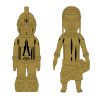
The frequency with which Benin warriors are depicted in Emwin Arhe (royal treasures) reflects the importance of the army and military to the Kingdom, as well as the role of royal art as an archive in which artists from the palace guilds recorded important people, events, and institutions. The army was organised into a number of regiments, with soldiers grouped according to the weapons they used, including archers, swordsmen, crossbowmen, and spearmen ( ).

Warrior figures are frequently shown carrying weapons such as Asa (shields), Asoro (spears), warfare swords such as the Umozo or Ọhọ (executioners’ or warfare swords), Uhanbọ (bows), Ẹkpẹde (crossbows), and Ifẹnmwẹ (arrows), which were sometimes poisoned, as well as Osisi (firearms). Their dress also provides important indications of their military role. On both the Aken'ni Elao (carved tusks) and Ama-Ẹrọnmwọn (bronze relief plaques), warriors are depicted in a relatively standardised form, typically wearing an Ohian Ẹkpẹn (leopard tunic), Akọn Ẹkpen (leopard’s tooth neck ornament), an Ẹroro pendant around the neck, and the Uko ugbo-ohamwen (fortified chest band) ( ).

Differences are particularly apparent in the warriors’ headwear, both between individual figures and between representations on Aken'ni Elao and Ama-Ẹrọnmwọn. On the Ama - Eronmwon, the most common forms of headwear are crocodile-hide helmets and horsetail helmets with a front plate ( ). On the Aken'ni Elao, some warriors wear double-horned helmets ( ), while others wear simple rounded hats or helmets ( ). The most frequently represented warrior type on the tusks, however, wears a helmet with cowries sewn onto a front panel ( ).

2 annotations
TBC_Warrior figure
TBC_Warrior figure
Ẹbẹn
Ceremonial Sword

Ẹbẹn are a type of ceremonial sword of significant importance in the Benin Kingdom. During ceremonies, titled chiefs would hold them or toss them during dances, thereby paying homage to the Ọba at these public events, particularly when a chief receives a certain status. It is forbidden for Ẹbẹn to touch the ground, so the chief must take extra precautions to avoid dropping the Ẹbẹn during the dance. Therefore, the Okae-Odionmwan (head of executioners) dances with the Umozo (warfare or executioner’s sword) behind the dancing chief.

There are two central ceremonial swords used in the royal court of the Benin Kingdom, one of which is the Ẹbẹn, along with the Ada (ceremonial swords). They are distinguished by their blades: the Ẹbẹn blade reflects the shape of a leaf or an oar. Sometimes, it is decorated with openwork designs and/or brass inlays, most commonly shaped as small Ẹbẹn and Ẹkpẹn (leopards). The handle of the Ẹbẹn also has an unusual ring-shaped form, which further differentiates it from the Ada.

1 annotation
Ẹbẹn
Ise vbe eigho
Proclamation Staff

The Isẹ vbe ẹigho is a type of proclamation staff held by the Ọba during the two main annual ceremonies in the Edo calendar: Igue and Ugie Erha Ọba. Its form resembles that of the Ẹgogo (gong), but it has a longer handle and a distinctive horizontal cross at the base of the V-shaped upper section. In depictions on Emwin Arre (royal treasures), the Ọba alone carries the Isẹ vbe ẹigho, usually in his left hand, while holding the Ebẹn (ceremonial sword) in his right. Such representations appear on carved wooden Agba (ceremonial stools), Aken'ni Elao (carved ivory tusks), and cast-brass representations of the Ọba.

The staff is emblematic of the Ọba’s power and authority (Ben-Amos Girschick 2007, p. 158; ). Together with the coral-beaded regalia worn during these ceremonies, the Isẹ vbe ẹigho is understood to confer upon the Ọba the power to swear oaths and pronounce curses.

1 annotation
Ise vbe eigho
Ewi
Mudfish

Depictions of Ewi (mudfish) are among the most frequent motifs in the Emwin Arhe (royal treasures). Mudfish hold an important place in Edo belief, both as representations of the god Olokun and as symbols of royalty (Plankensteiner 2007, p. 410), as well as of “prosperity, peace, well-being and fertility” (Ben-Amos 1976, p. 245). Mudfish are also particularly common animals for sacrifice, and mudfish-shaped Orhiẹvbẹ (kola-nut boxes) were used to make offerings or store kola nuts.

Yet, the appearance of Ewi across the Emwin Arhe is not consistent, and it has been argued that different species of mudfish were depicted by Edo artists, each with different qualities and capabilities. For example, the electric shock of Malapterurus electricus resembles the fierceness of the Ọba, while the liminal qualities of the Synodontis clarias mudfish, which lives both on land and in water, similarly reflect the Ọba’s rule over land and sea (Gallagher 1983, p. 93). With these different qualities in mind, the mudfish is an important symbol of Benin kingship and royalty.

Sometimes the Ọba was depicted by artists with mudfish rather than legs (see Ọba with Mudfish Legs).

1 annotation
Ewi
Ukpan obọ eva
Crossed Beaded Baldrics

The Ukpan obọ eva (coral-bead crossed baldrics) were worn as part of the ehaingbehia, the full ceremonial regalia, by only high-ranking members of the palace, including the Ọba himself, the Iy’Ọba, the Edaiken, and the Ezọmọ (Ben-Amos 1999, pp. 68, 141; Osadolor in Plankensteiner 2007, cat. no. 70, pp. 322–323).

1 annotation
Ukpan obọ eva
Beaded Crown
Ẹde
Beaded Crown

Although many other members of the Benin royal court wore a variety of hats and forms of headwear, only the Ọba may wear the Ẹde (beaded crown). The Ọba must never be seen bare-headed, and successive Ọbas introduced different styles and types of crowns ( ).

Across different media and objects, Ọbas are depicted wearing various types of crowns, all elaborately crafted from coral beads. Some feature tall projections rising from the crown, known as Oro, while others have curved projections extending from either side of the head, known as the winged cap. The latter was introduced only in the 19th century, most likely by Ọba Osẹmwẹndẹ ( ). Depictions of Ọba Esigie on Ama-Ẹrọnmwọn (bronze relief plaques) show him wearing an elaborate crown decorated with large jasper or coral beads ( ).

1 annotation
Ẹde
Ukhurhẹ
Ancestral Staff

Representations of figures, often the Ọba, with an Ukhurhẹ (Ancestral Staff) in their right hand recur in a number of Emwin Arre (royal treasures), particularly those carved in wood as Agba (royal stools), cast in brass as part of Osogan (Osun staffs) and Ikẹgobọ (altars to the hand), and carved in ivory as Aken'ni Elao (carved tusks).

Ukhurhẹ are rattle staffs, usually made from wood, although brass examples are believed to have been owned by the Ọba. Ukhurhẹ were, and continue to be, commissioned when the paternal head of a family passes away as a way of commemorating them ( ). Following a ceremony in which they are installed on the family’s ancestral altar, Ukhurhẹ are typically lined up against the back of the altar and are used to communicate with ancestors and the spirit world. When depicted on the Emwin Arhe, Ukhurhẹ are usually held in the right hand of the Ọba, while an Ughavan (celts) is carried in his left hand.

1 annotation
Ukhurhẹ
Obọ
Fist/Hand

The fist motif—particularly a clenched fist with an extended thumb—carries significant symbolic weight. It is central to the cult of the hand, a major aspect of Edo religion that focuses on an individual’s ability to achieve success through their own actions, skills, and enterprise ( ). This cult is primarily observed by those who have already attained considerable wealth or status, including hunters, warriors, and craftsmen.

The fist symbolises physical prowess and strength, denoting the individual’s might and accomplishment ( ). The hand is credited with enabling the accumulation of great riches and high status. This is sometimes linked to the idea that wealth results from both personal effort and the favour of Olokun, the god of wealth. On Ukhurhẹ (ancestral staffs), a clenched fist or hand grasping a mudfish signifies royal or chiefly authority. The image of a hand holding a coiled mudfish can also illustrate the Ọba’s formidable power to “cast and then release a curse” or to “set up obstacles and remove them” ( ). The fist is sometimes accompanied by other motifs symbolising strength, chieftaincy, and longevity, such as tools like the hammer and pliers or feathers of the vulturine fish eagle ( ). The fist motif is frequently depicted on Aken'ni Elao (carved tusks), on wooden Ikẹgobọ (altars to the hand), and on Ukhurhẹ.

1 annotation
Obọ
Udahae
Beaded forehead band

The Udahae is a forehead band made from coral beads and worn by chiefs. Sometimes a white Igan (feather) from the Oɛɣohɔ (vulturine fish eagle) is tucked into the left side of the Udahae. According to Benin oral tradition, the Udahae was introduced by Ọba Ezoti, the first son of Ọba Ewuare I. During his coronation, Ezoti was shot in the forehead with a poisoned arrow. To stop the bleeding, a band of red beads was wrapped around his forehead while he made public appearances. Fourteen days later, he died from his wound. Since then, Benin chiefs have worn the red-beaded Udahae around their foreheads to commemorate the cap used by Ezoti to stop the bleeding (Egharevba 1968, p. 21).

1 annotation
Udahae
Igan
Feather

Igan (feathers) are commonly depicted tucked into the headdresses and hats of chiefs represented on Emwin Arre (royal treasures). These feathers are from the Oɛɣohɔ (vulturine fish eagle) and symbolise respected old age and proper chieftaincy ( ).

2 annotations
Igan
Igan
tribal marks
Iwu
Facial and Body Markings

Iwu are facial and body markings (scarifications) that were historically worn by Edo men and women. However, since the 1960s, the practice has been nearly extinct (Aisien 2011). In the past, Iwu were used as a way of proving that one was an Edo citizen, and the ceremony of having Iwu completed was an important rite of passage for men and women. The Osiwu, who also practised circumcision and other surgical procedures, would carry out the procedure of adding Iwu. There are different types of Iwu: ‘blades’ worn on the torso (Iwu-eko), and those worn on the face, such as Ikharo (three or four markings above the eyebrows), Irho (two narrow ‘blades’ worn on each cheek), Ovbihue (nasal ‘blades’), Ovbi-agbanmwen (chin ‘blade’), and Igho-okpa/Ukpgho (three forehead ‘blades’) (Aisien 2011, p. 22).

The number of Iwu also varied depending on the identity of the person wearing them. For example, royal men would wear six ‘blades’ on their torso, whilst men who were not royal would wear seven ‘blades’. Meanwhile, the Ọba’s female children would wear fifteen ‘blades’, and all other women would wear sixteen (Aisien 2011).

1 annotation
Iwu
Round Neck Bead
Ikele
Coral bead circlet

Ikele is a single stiff string or circlet of coral beads. It is worn by chiefs, such as senior chiefs who have been made Enigie (Inneh 2007, p.107), and is a sign of nobility and rank. The Ikele may only be worn once the Ọba has conferred a person with the right to wear the beads, and the Ikele must always be worn when appearing before the Ọba. According to Ekhaguosa Aisien (in Plankensteiner 2007, cat. nr. 301, p.512) when a chief is wearing the Ikele, they may not eat nor drink in public, and they “constitute an embassy of the Benin Palace wherever he might be.”

1 annotation
Ikele
king with mudfish legs
TBC_Ọba Ohẹn
King with Mudfish Legs

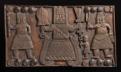
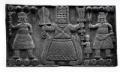
This motif of an Ọba with legs represented as two mudfish is often interpreted as Ọba Ohẹn, who reigned c. 1334–1370. According to oral traditions, Ohẹn suffered from paralysis of the legs and unsuccessfully attempted to conceal his condition from the chiefs and members of the royal court. The Iyasẹ Emuze eventually hid in the Ọba’s chambers to discover his secret ( ). When Ohẹn discovered this, he ordered the Iyasẹ to be executed. However, the people learned of the order and turned against the Ọba. According to the tradition, they plotted to kill him ritually by digging a hole beneath his throne and stoning him with Orhue (white kaolin chalk) when he fell into it ( ; ).

Not all representations of an Ọba with mudfish legs, however, are understood to refer to Ohẹn. Variations in the objects and animals carried by the figure are thought to indicate different meanings ( ; ). Members of the Igbesamwan and Igun-Ẹrọnmwọn have emphasised the significance of these accompanying motifs (Blackmun 1984, pp.249–255). When the mudfish-legged Ọba is shown holding aquatic creatures such as crocodiles, for example, the image has been interpreted as a “cosmological image” representing the correspondence between the two monarchs: the Ọba of Benin, ruler of the land, and Olokun, ruler of the waters ( ). By contrast, representations in which the Ọba holds swords or staffs have been interpreted specifically as depictions of Ọba Ohẹn.

1 annotation
TBC_Ọba Ohẹn

Provenance

5 events
Production
unknown to February 22, 1897 (day approximate)
The object was produced by Unknown member(s) of the Emada in Benin City.
Looted
February 22, 1897 (day approximate) to June 1899 (year approximate)
The object was looted by February 1897 Unknown member of the British colonial military campaign on Benin from Benin Kingdom.
Unknown
1955 (approximate) to 1973
The object is known to have come into contact with Graham Gallery, later in New York City.
Purchase
1973 to 1991
The object was purchased by Klaus Gunther & Amelia 'Dolly' Perls from Graham Gallery in New York City.
Gift
1991
The object was given as a gift by Klaus Gunther & Amelia 'Dolly' Perls to the Metropolitan Museum of Art in New York City.

Institution data

Metropolitan Museum of Art
The data was transferred directly by the institution.
Last updated: 2021-07-30
Language: english
Institution fieldValue
Object Number
object id
1991.17.61
Object Sort Number
object id
1991 17 61
Primary Rendition No
object id
DP372519
Title
designation
object type
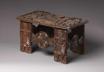
Stool: Oba with Mudfish Legs (Agba)
Medium
material
Wood, metal tacks
Dimensions
dimensions
H. 14 1/2 x W. 25 x D. 14 1/8 in. (36.8 x 63.5 x 35.9 cm)
Classification
object type
Wood-Furniture
Date
date made
19th century
Geo: City
production place
Court of Benin
Geo: Country
production place
Nigeria
Credit Line
prior source
Gift of Mr. and Mrs. Klaus G. Perls, 1991
Provenance
provenance
[Graham Gallery, New York, acquired by 1973]; Mr. and Mrs. Klaus G. Perls, New York, until 1991
Dynasty
reign associated name
Oranmiyan
Culture
ethnic attribution
Edo peoples
ExhibitionHistory
exhibition history
Likeness and Beyond: Portraits from Africa and theWorld Center for African Art, February 14, 1990–August 12,1990 Kimbell Art Museum, September 16, 1990–November 11,1990 Royal Art of Benin from the Perls Collection The Metropolitan Museum of Art, January 16, 1992–September 13,1992
Bibliography
bibliography
Ezra, Kate. Royal Art of Benin: The Perls Collection in the Metropolitan Museum of Art. New York: The Metropolitan Museum of Art, 1992, p. 270, no. 129.
Published References
bibliography
Dark, P. 1973. An Introduction to Benin Art and Technology. Oxford, pl. 19, figs. 37, 38. Jean M. Borgatti and Richard Brilliant. 1990. Likeness and Beyond: Portraits from Africa and the World, exhibition catalogue. Center for African Art, New York, no. 7. "ROYAL ART OF BENIN. The Perls Collection in The Metropolitan Museum of Art." Kate Ezra. The Metropolitan Museum of Art and Harry N. Abrams Inc., New York 1992 Cat. 129
Sensitive Content

Digital Benin collates digital material from institutions, and some of this material is inherently colonial and contains words, terms and phrases that are inaccurate, derogatory and harmful towards African and African diasporic communities. Catalogue transcriptions, book titles, exhibition titles and museum titles may contain harmful terms. We recognise the potential for the material to cause physical and mental distress as well as evoke strong emotions. Owing to the scale of the collection’s data, a process to implement sensitive-content warnings in the displayed data is still incomplete. The material within the catalogue does not represent Digital Benin’s views. Digital Benin maintains a strong anti-colonial, anti-racist position and affirms its support for centring the humanity of historically marginalised and disenfranchised communities. Read more about the background of this statement here