
ID
211797
Edo designations
English designations
Relief Plaque
Categories
Palace Architecture & Ornamentation
Location
1 Adesogbe (Plymouth) Road, P.M.B. 1115, Benin City , Edo State
Loading...
Relief Plaque
Relief Plaque

Iconographies

5 annotations
Pot
Akhẹ
Clay pot

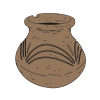
Akhẹ (clay pots) are made by the Imakhe (guild of potters). Pots were used for a variety of purposes, including everyday storage of water in simple, undecorated or minimally decorated vessels, while others served ritual purposes. Akhẹ Osun, for example, are often highly decorated with animal motifs such as lizards, frogs, and snakes, all of which are associated with the deity Osun. Rounded Akhẹ with open tops are depicted on both the Ama-Ẹrọnmwọn (bronze relief plaques) and pendant plaques. They are usually shown being carried either on the heads of figures or propped on their left shoulders.

1 annotation
Akhẹ
Ukpọn
Wrapper

Ukpọn is the Edo term for cloth (Aigbe 1985, p. 55; Ọbazee 2025, p. 542) and is used here to refer to the wrappers or kilts worn by many of the figures depicted on the Emwin Arre (royal treasures). The cloth worn around the waist may be plain, but it is more commonly richly decorated with motifs associated with the monarchy, power, and wealth, such as the Ọba'nui (infinity symbol) and Uhunme Ikpotoki (Portuguese heads).

The Benin Kingdom was renowned for its textile production, both for local use and for trade ( ). Within the royal court, members of the Owina n’Ido produced ukhuen cloth for the Ọba and other members of the court, who wore it as wrappers during festivals and ceremonies ( ).

Alongside locally produced textiles, imported cloth was also an important commodity in the Benin Kingdom’s trade networks. Textiles were exchanged with neighbouring production centres, particularly Ijebu ( ), while European traders brought silks, woollens, linens, and cotton from Europe and Asia from the 15th century onwards ( ).

1 annotation
Ukpọn
Ẹgba
Bracelets

Ẹgba (bracelets) are worn as part of ceremonial costumes and could be made of brass, bronze, iron, ivory or wood. The material determines the status of the individual wearing it, as the Ọba controls the use and production of brass, bronze and ivory. Ẹgba is the designation used to describe bracelets worn around the upper arm that could potentially become amulets by putting charms or medicine in them.

1 annotation
Ẹgba
Abuwa
Hand of Wealth

Abuwa ornaments are made from red ododo cloth and are a symbol of wealth (Inneh 2007, pp. 110–111). ‘Abuwa’ is understood to translate directly as “hand of wealth” (Ezra 1992, p. 313). The Abuwa is worn at the waist by high-ranking chiefs as part of their ‘pangolin skin’ ceremonial regalia (Inneh 2007, p. 110) and continues to be worn today.

1 annotation
Abuwa
Water fern
Ebe Amẹ
Water Fern

Ebe Amẹ refers to a wide variety of plants, particularly the leaves of the water fern or river leaf, found in riverine areas of southern Nigeria ( ). Artists from the Igun-Ẹrọnmwọn used these as a decorative motif in the background of most Ama-Ẹrọnmwọn (bronze relief plaques). The petals of the Ebe Amẹ, like the points of the ἀghàdàgháda (crossroads), represent the four cardinal directions: north, east, south, and west. The number four plays a foundational role in the Edo calendar, which is structured around four market days ( ).

1 annotation
Ebe Amẹ

Provenance

6 events
Production
1504 (approximate) to 1550 (approximate)
The object was produced by Unknown member(s) of the Igun-Ẹrọnmwọn guild in Benin City.
Looted
February 22, 1897 (day approximate) to June 1899 (year approximate)
The object was looted by February 1897 Unknown member of the British colonial military campaign on Benin from Benin Kingdom.
Unknown
January 1898 to July 1898
The object is known to have come into contact with Friedrich Erdmann, in Benin City.
Transfer
July 1898 (year approximate)
The object was transferred from Friedrich Erdmann through Bey & Co. from Benin City to Hamburg.
Purchase
1899
The object was purchased by the Ethnologisches Museum, Staatliche Museen zu Berlin from Heinrich Bey and Bey & Co. from Hamburg to Berlin.
Restitution
August 25, 2022
The object was restituted by the Ethnologisches Museum, Staatliche Museen zu Berlin to the Omo n'Oba n'Edo Uku Akpolokpolo, Ọba of Benin & National Commission for Museums and Monuments, Nigeria through Hermann Parzinger and Abba Isa Tijani from Berlin to Nigeria.

Related archival documents

1 documents
See all
Date

Institution data

Ethnologisches Museum, Staatliche Museen zu Berlin
The data was transferred directly by the institution.
Last updated: 2021-06-14
Language: german
Institution fieldValue
ID
object id
211797
Sachbegriff
designation
Sachbegriff: Reliefplatte
Titel
designation
Titel: Höfling
Objektref.
description
E 1151/1898, Erwerbung: I/41/1899: III C 8348-8531, Altertümer (Benin), H. Bey, Hamburg, 1898, Heinrich Bey (1882); VIII A 10757, Positiv, SW, Reliefplatte, Bronze, Kurt Grunst (*04.04.1921); VIII A 12103, Positiv, SW, Rückseite der Bronzeplatte " , ein Gefäß auf d. Kopfe tragend" (OT), Kurt Grunst (*04.04.1921)
Texte Online
description
Online Beschreibung, [Benin_Königreich]
Material / Technik
material
Material: Messing; Ausgabe: Messing
Material / Technik // Alle
material
Messing, Messing
Maße
dimensions
H: 37 cm, B: 15 cm
Objekttyp
object type
Allgemein
Sachbegr. Ausgabe
object type
Reliefplatte (Relief plaque)
Anzahl Teile
object count
1
Datierung
date made
16. Jh.
Geogr. Bezüge
production place
Nigeria ( Land ); Benin ( Königreich )
Geogr. Bezüge // Alle
production place
Benin, Nigeria
Beteiligte
prior source
Heinrich Bey (1882), Sammler
Beteiligte // (Name, Sortierung=kleinste)
prior source
Bey, Heinrich
Veräußerer
prior source
null
Erwerb. Notiz
provenance
Erwerbung von: H. Bey; Notiz: Rückführung Wiesbaden; Ausgabe: 16. Jh., im Auftrag von Oba Esigie (reg. 1517-1550) oder seines Sohnes Oba Orhogbua (reg. 1550-1570), Königspalast, Benin-Stadt; durch Erbschaft an Oba Ovonramwen (ca. 1857-1914; reg. 1888-97), Königspalast, Benin-Stadt; geplündert im Zusammenhang mit der britischen Eroberung von Benin, 1897; in unbekanntem Besitz nach der Eroberung des Königreichs Benin; gesammelt im Auftrag der Firma Bey & Co., zwischen 1897 und 1898 im Gebiet des späteren kolonialen Nigeria; verkauft an das Königliche Museum für Völkerkunde in Berlin, 1899.
Verw. Institution
department and institution
Ethnologisches Museum, Staatliche Museen zu Berlin
Erwerb. Datum
accession date
1899
Besitzart
accession method
Erwerbungsart
accession method
Ankauf
Digital Assets
images
Vorlage; Vorlage; Vorlage; Vervielfältigung; Vorlage; Vervielfältigung; Vorlage; Vervielfältigung; Vorlage; III C 8411.JPG, Repro Digitalisat
Erwerb. Nr.
I/41/1899
Ident. Nr.
III C 8411
Ident. Nr. // (Sortiernr.)
0003 C 08411
Obj. Status
vorhanden
object_images/creator
license
Claudia Obrocki
Sensitive Content

Digital Benin collates digital material from institutions, and some of this material is inherently colonial and contains words, terms and phrases that are inaccurate, derogatory and harmful towards African and African diasporic communities. Catalogue transcriptions, book titles, exhibition titles and museum titles may contain harmful terms. We recognise the potential for the material to cause physical and mental distress as well as evoke strong emotions. Owing to the scale of the collection’s data, a process to implement sensitive-content warnings in the displayed data is still incomplete. The material within the catalogue does not represent Digital Benin’s views. Digital Benin maintains a strong anti-colonial, anti-racist position and affirms its support for centring the humanity of historically marginalised and disenfranchised communities. Read more about the background of this statement here