


Iconographies














Provenance
Institution data
| Institution field | Value |
|---|---|
ObjectID object id | 1312 |
ObjectName designation object type | Tusk |
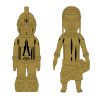
Description description | Ivory tusk commissioned by Ezomo (high-ranking noble and military commander) Ekeneza under Oba (King) Akengbuda; motifs include deified kings and commanders from the past, Edo warriors, European soldiers, and courtly women, as well as leopards, elephants, reptiles, and mudfish |
Medium material | Ivory |
Dimensions dimensions | 43 x 71 x 17 1/2 in. (109.2 x 180.3 x 44.5 cm) |
Dated date made | 1775-1777 |
Country production place | Nigeria (Benin Kingdom) |
CreditLine prior source | The Miscellaneous Works of Art Purchase Fund |
Provenance prior source provenance | [According to a letter from Bernard Black, Gallery Duveen-Graham Modern Art, New York, dated August 27, 1956: "The tusk was purchased from a private collection in Kilmallock, County Limerick, Ireland. Records, if any, were lost but the owner was of the decided opinion that her father had obtained it from one of the members of the punitive expedition which the British Government sent into Benin in February, 1897. It remained in the possession of the family until sold recently to us."]; Fall of 1956: Sold by Gallery Duveen-Graham Modern Art to Mia |
Culture ethnic attribution | Edo |
CuratorialRemarks notes | The identification of the tusk's patron and the interpretation of its iconography have been provided to Mia in 2013 by the late scholar Dr. Barbara Blackmun, specialist of Benin culture. These data are available. |
Notes notes | |
Exhibitions exhibition history | * Toledo Museum of Art, Toledo, Ohio, February 1-22, 1959. |
Bibliography bibliography | * William Fagg. 1963. Nigerian Images. London * Toledo Museum of Art. 1959. The African Image, p. 14, cat. 54. Toledo |
ObjectNumber | 56.33 |
Digital Benin collates digital material from institutions, and some of this material is inherently colonial and contains words, terms and phrases that are inaccurate, derogatory and harmful towards African and African diasporic communities. Catalogue transcriptions, book titles, exhibition titles and museum titles may contain harmful terms. We recognise the potential for the material to cause physical and mental distress as well as evoke strong emotions. Owing to the scale of the collection’s data, a process to implement sensitive-content warnings in the displayed data is still incomplete. The material within the catalogue does not represent Digital Benin’s views. Digital Benin maintains a strong anti-colonial, anti-racist position and affirms its support for centring the humanity of historically marginalised and disenfranchised communities. Read more about the background of this statement here