Loading...
OBJECTID
C15745
Institution
Buffalo Museum of Sciences Edo designations

English designations
Categories
Institution Location
1020 Humboldt Pkwy, Buffalo, NY 14211, United States
OBJECTID
C15745
Institution
Buffalo Museum of Sciences Edo designations
English designations
Relief Plaque
Categories
Palace Architecture & Ornamentation
Institution Location
1020 Humboldt Pkwy, Buffalo, NY 14211, United States
Iconographies
5
annotations
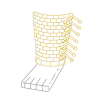
Iviawẹ
Stacked Beaded Anklet
1 annotation


Akọn Ẹkpen
Leopard Teeth Neck Ornament
1 annotation


Ebe Amẹ
Water Fern
1 annotation


Odigba
Coral beaded collar
2 annotations


Provenance
6
events
Institution data
Buffalo Museum of Sciences
The data was transferred directly by the institution.
Last updated: 2021-07-01
Language: english
| Institution field | Value |
|---|---|
ACCESSNO object id | 1947.003 |
HOMELOC object id | R2B-11 |
OBJECTID object id | C15745 |
OBJNAME designation object type | Plaque |
DESCRIP description object type | Two relief figures in ornate armor-like costumes. Feet and arm of one figure missing. Floral pattern on background. This plaque and hundreds like it once hung in the Royal Palace at Benin. In 1897, British soldiers removed these plaques during a punitive expedition . Many objects were later returned to Nigeria but most were sold to museums and private collectors. The largest collection of Nigerian bronzes is housed at the British Museum in London. This plaque was purchased by the Buffalo Museum of Science from a gallery in London in 1947. |
MATERIAL material | Brass |
CURVALMAX dimensions | 0 |
CURVALUE dimensions | 0 |
DEPTH dimensions | 0 |
DEPTHFT dimensions | 0 |
DEPTHIN dimensions | 0 |
DIAMETER dimensions | 0 |
DIAMETERFT dimensions | 0 |
DIAMETERIN dimensions | 0 |
DIMTYPE dimensions | 1 |
HEIGHT dimensions | 46.99 |
HEIGHTFT dimensions | 1.541666667 |
HEIGHTIN dimensions | 18.5 |
LENGTH dimensions | 0 |
LENGTHFT dimensions | 0 |
LENGTHIN dimensions | 0 |
WIDTH dimensions | 31.115 |
WIDTHFT dimensions | 1.020833333 |
WIDTHIN dimensions | 12.25 |
WEIGHT weight | 0 |
WEIGHTIN weight | 0 |
WEIGHTLB weight | 0 |
SPECIES object type | Plaque |
SUBJECTS iconography | Art/Artifact 1988-1990 |
DATE date made | LATE 16-EARLY 17 C. |
ERA date made | LATE 16-EARLY 17 C. |
ORIGIN production place | |
SITE production place | BENIN CITY |
UDF2 production place | Centrl W Africa |
UDF3 production place | Nigeria |
UDF4 production place | Bendel State |
UDF6 production place | |
COLLECTOR prior source | Berkeley Galleries |
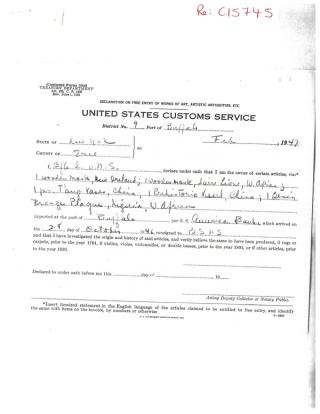
PROVENANCE provenance | Purchased on January 2nd 1947 from Berkeley Galleries, 20 Davies St. Berkeley Square, London, England. |
COLLDATE date collected | / / |
EXCAVADATE date collected | / / |
CULTURE ethnic attribution | Kingdom Of Benin |
COLLECTION department and institution | Division of Anthropology |
RECAS accession method | Purchase |
NOTES notes | SEE FILE UNDER C# |
PUBNOTES bibliography | Published: Yes CUMMINGS,VIRGINIA L. OUT OF AFRICA pp17,23 #206 BSNS EXHIBIT CATALOG BUFFALO SOC NATL SCI BUFFALO NY 1969 GRAMLY,R.MICHAEL MASTERPIECES OF THE ANTHROPOLOGY COLLECTION pp14-15 fig 13 BSNS EXHIBIT CATALOG BUFFALO SOC NATL SCI BUFFALO NY 1981 DANTO,ARTHUR et al ART/ARTIFACT p55 EXHIBIT CATALOG CENTER FOR AFRICAN ART NY 1988 |
CONDITION condition | |
IMAGEFILE images | 078\C15745.JPG |
CAPTION | C15745 |
CAT | O |
CATBY | KHL |
CATDATE | 06/16/2021 |
CATTYPE | History |
CIRCUM | 0 |
CIRCUMFT | 0 |
CIRCUMIN | 0 |
CONDDATE | / / |
CONDEXAM | |
EARLYDATE | 1,550 |
EXHIBITNO | 0 |
EXHSTART | / / |
FLAGDATE | / / : : AM |
GPARENT | 8: Communication Artifact |
IDDATE | / / |
IMAGENO | 1 |
INSDATE | / / |
INVNBY | MEB |
INVNDATE | 02/24/2014 |
LATEDATE | 1,650 |
LOANDUE | / / |
LOANNO | 0 |
LOANRENEW | / / |
LOCFIELD1 | ANTHRO LAB |
LOCFIELD3 | |
LOCFIELD4 | |
MAINTDATE | / / |
OUTDATE | / / |
PARENT | Ceremonial Artifact |
PREPDATE | / / |
RECFROM | Berkeley Galleries |
RENEWUNTIL | / / |
REPATDATE | / / |
REPATNOTES | Is it a burial? No Is a burial associated? No Is it sacred? No Patrimony? No |
REPATNOTIC | / / |
STATUS | OK |
STATUSBY | KHL |
STATUSDATE | 06/16/2021 |
TEMPDATE | 02/24/2014 |
TLOCFIELD1 | Culture Studio |
TLOCFIELD3 | BIG RED |
UDF1 | Africa |
UDF11 | E |
UDF12 | 1947 |
UDF13 | 0 |
UDF14 | 0 |
UDF15 | 0 |
UDF16 | 1 |
UDF17 | 0 |
UDF18 | / / |
UDF19 | / / |
UDF20 | / / |
UDF5 | Mid-western |
UDF8 | |
UPDATED | 06/16/2021 |
VALUEDATE | 03/01/2003 |
WEBINCLUDE | .F. |
XCORD | 0 |
YCORD | 0 |
ZCORD | 0 |
Sections
About
Other
Sensitive content
Sensitive Content Digital Benin includes colonial material that may contain inaccurate, derogatory or harmful language relating to African and African diasporic communities. Such language may appear in catalogue records, transcriptions, and book, exhibition or museum titles. We recognize that this material may cause distress. Sensitive-content warnings are being implemented across the collection, but this process is ongoing. The language does not reflect Digital Benin’s views; we take an anti-colonial and anti-racist position and are committed to centring the humanity of historically marginalised communities.