Loading...





Registration number
Af1954,23.370
Institution
British Museum Edo designations

English designations
Categories
Institution Location
Great Russell St, Bloomsbury, London WC1B 3DG, United Kingdom
Registration number
Af1954,23.370
Institution
British Museum Edo designations
English designations
Altar Ring
Categories
Altar & Shrine Objects
Institution Location
Great Russell St, Bloomsbury, London WC1B 3DG, United Kingdom
Iconographies
2
annotations

Ẹgogo
Gong
1 annotation

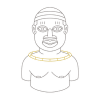
Ikele
Coral bead circlet
1 annotation

Provenance
4
events
Institution data
British Museum
The data was transferred directly by the institution.
Last updated: 2025-06-10
Language: english
| Institution field | Value |
|---|---|
Registration number object id | Af1954,23.370 |
Additional IDs object id | 123338 (Wellcome Collection number)~86 (Dark number) |
PRN object id | EAF21292 |
Object Type designation | altar-ornament (?) |
Description description | Brass altar-ring with human figures and birds. |
Ethnic name (made by) ethnic attribution | Edo |
Date date made | 16thC - 19thC |
Findspot place collected | Found/Acquired: Benin City |
Materials material | brass |
Technique production technique | lost-wax cast |
Dimensions dimensions | Height: 29.00 cm~Width: 26.50 cm~Depth: 9.10 cm~Weight: 3691.00 g |
Curator’s comments provenance | Register 1954 Brass ring on which are cast seven human figures, four birds and other objects. Foster. 20/10/32. £15.15.=. |
Exhibition history exhibition history | Exhibited: 1970-1973, London, Museum of Mankind, Divine Kingship in Africa |
Subjects iconography | bird |
Associated events event | Associated Event: British Expedition to Benin City - Feb 1897 |
Acquisition name (acquisition) provenance | Wellcome Institute for the History of Medicine |
Acquisition name (previous) provenance | Previous owner/ex-collection: Foster's |
Acquisition date accession date | 1954.0 |
Sections
About
Other
Sensitive content
Sensitive Content Digital Benin includes colonial material that may contain inaccurate, derogatory or harmful language relating to African and African diasporic communities. Such language may appear in catalogue records, transcriptions, and book, exhibition or museum titles. We recognize that this material may cause distress. Sensitive-content warnings are being implemented across the collection, but this process is ongoing. The language does not reflect Digital Benin’s views; we take an anti-colonial and anti-racist position and are committed to centring the humanity of historically marginalised communities.