Loading...


Registration number
Af1928,0112.2.a-b
Institution
British Museum Edo designations

English designations
Categories
Institution Location
Great Russell St, Bloomsbury, London WC1B 3DG, United Kingdom
Registration number
Af1928,0112.2.a-b
Institution
British Museum Edo designations
English designations
Anklet
Categories
Contextual Objects: Beyond Benin
Institution Location
Great Russell St, Bloomsbury, London WC1B 3DG, United Kingdom
Provenance
5
events
Institution data
British Museum
The data was transferred directly by the institution.
Last updated: 2025-06-10
Language: english
| Institution field | Value |
|---|---|
Registration number object id | Af1928,0112.2.a-b |
PRN object id | EAF16550 |
Object Type designation | anklet |
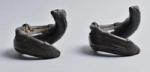
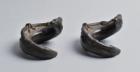
Description description | Anklets, pair of; lost-wax cast in copper alloy or ? bronze. Semi-spiral in form, each decorated with four concentric circular motifs, ladderlike bands and a knot. |
Ethnic name (made by) ethnic attribution | Edo (?) |
Date date made | 1500-1900 (?) |
Production place production place | Made in: Nigeria |
Findspot place collected | Found/Acquired: Benin City |
Materials material | copper alloy ~bronze (?) |
Technique production technique | lost-wax cast |
Dimensions dimensions | Height: 8.70 cm (a)~Width: 11.10 cm (a)~Depth: 11.10 cm (a)~Weight: 1802.00 g (a)~Height: 8.90 cm (b)~Width: 11.50 cm (b)~Depth: 10.90 cm (b)~Weight: 1745.00 g (b) |
Curator’s comments provenance | The term ‘Lower Niger Bronze Industry’ was created and first used by William Buller Fagg (1957, 1963, 1970) to identify a miscellaneous group of lost-wax cast objects which were stylistically and/or iconographically distinct from Igbo-Ukwu, Ife and Benin City pieces. The objects are associated with various locations in southern Nigeria, south of the confluence of Benue and Niger Rivers and between the borders with the Republic of Benin and Cameroon. They are thought to have been made prior to European contact, circa pre-1500 A.D. Sometimes referred to as the ‘Lower Niger Bronze Industries’ or ‘Lower Niger Bronzes’. Fagg, William B. (1957) ‘Introduction’. In Plass, Margaret. Lost wax; metal casting on the Guinea Coast. London: London Institute of Contemporary Arts. Fagg, William. (1963). Nigerian images: The splendor of African sculpture. New York ; London: Praeger. Fagg, William. (1970) Divine Kingship in Africa. London: Published for the Trustees of the British Museum by British Museum Publications. ; See Collection File: Af1928,0112.1-3. |
Bibliographic references bibliography | Fagg 1960: cat. 21 (Grouped in 'Lower Niger Bronze Industry' section) |
Exhibition history exhibition history | Exhibited: 1991 Feb-Apr, Norwich, Sainsbury Centre for Visual Arts, Man and Metal in Ancient Nigeria |
Condition condition | Good. |
Acquisition name (acquisition) provenance | Sir Sydney Burney |
Acquisition name (excavator) provenance | Field Collection by: Ralph Frederick Locke |
Acquisition date accession date | 1928.0 |
Sections
About
Other
Sensitive content
Sensitive Content Digital Benin includes colonial material that may contain inaccurate, derogatory or harmful language relating to African and African diasporic communities. Such language may appear in catalogue records, transcriptions, and book, exhibition or museum titles. We recognize that this material may cause distress. Sensitive-content warnings are being implemented across the collection, but this process is ongoing. The language does not reflect Digital Benin’s views; we take an anti-colonial and anti-racist position and are committed to centring the humanity of historically marginalised communities.