Loading...


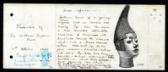
Registration number
Af1897,1011.1
Institution
British Museum Edo designations

English designations
Categories
Institution Location
Great Russell St, Bloomsbury, London WC1B 3DG, United Kingdom
Registration number
Af1897,1011.1
Institution
British Museum Edo designations
English designations
Commemorative Queen Mother Head
Categories
Altar & Shrine Objects
Heads
Institution Location
Great Russell St, Bloomsbury, London WC1B 3DG, United Kingdom
Iconographies
4
annotations
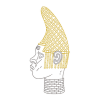
Ukpẹ ọkhọkhọ
Curved conical hairstyle worn by Iy'Ọba
1 annotation

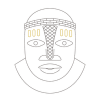
Ikharo
Forehead markings
2 annotations



Odigba
Coral beaded collar
1 annotation

Provenance
8
events
Institution data
British Museum
The data was transferred directly by the institution.
Last updated: 2025-06-10
Language: english
| Institution field | Value |
|---|---|
Registration number object id | Af1897,1011.1 |
PRN object id | EAF14446 |
Object Type designation | commemorative head |
Description description | Commemorative head of Queen Mother; lost-wax cast in brass. Naturalistic, almost life-size female head with curving conical hairstyle covered with openwork coral bead net; long strings of coral beads at sides and back. Wears high coral bead collar. Two vertical marks on forehead originally inset with iron; four scarification marks above each eye. Pupils inlaid with iron. |
Ethnic name (made by) ethnic attribution | Edo |
Date date made | 16thC(early) |
Production place production place | Made in: Benin City |
Findspot place collected | Found/Acquired: Benin City |
Materials material | brass ~iron |
Technique production technique | lost-wax cast ~inlaid |
Dimensions dimensions | Height: 41.00 cm~Width: 15.50 cm~Depth: 17.00 cm~Weight: 3.90 kg |
Curator’s comments provenance | See the essay on this head by Flora Kaplan in John Mack (ed), ‘Africa, arts and cultures’, BM 2000, pp.14-15. This brass head representing Queen Mother Idia was made to be placed on her altar following her death. It is said that Oba Esigie instituted the title of Queen Mother and established the tradition of casting heads of this type in honour of her military and ritual powers. ; Read & Dalton 1899: Head of a young woman. She wears a high pointed head-dress formed of a network of beads, from the lower end of which depends a fringe formed of strings of similar beads. Like Af1897,1217.3 she has four cicatrices on each eyebrow, and two bands between, but these latter, like the pupils of the eyes, are inlaid with iron. The perfection of the work both from the technical and the artistic points of view would indicate that it belongs to the earlier period of these works of art. This specimen, presented by Sir William Ingram, Bart., in 1897, appears like Af1897,1217.3 to be of considerable antiquity, being covered in the same way with a fine green patina. |
Bibliographic references bibliography | Read & Dalton 1899: pl IX.4 |
Exhibition history exhibition history | Exhibited: 1970-1973, London, Museum of Mankind, Divine Kingship in Africa 1991 Feb-Apr, Norwich, Sainsbury Centre for Visual Arts, Man and Metal in Ancient Nigeria 1997-1998 Sep-Jan, Osaka, National Museum of Ethnology, Images of Other Cultures 1998, Feb-Apr, Tokyo, Setagaya Art Museum, Images of Other Cultures 2013 July-November, Cambridge, Fitzwilliam Museum, Origins of the Afro Comb |
Condition condition | Good; iron inserts missing on forehead and pupils. |
Associated events event | Associated Event: British Expedition to Benin City - Feb 1897 |
Acquisition name (acquisition) provenance | Sir William James Ingram |
Acquisition name (excavator) provenance | Field Collection by: Sir Arthur Vyell Vyvyan |
Acquisition date accession date | 1897 |
Acquisition notes (acquisition) provenance | Purchased by the donor at a Stevens auction on 24 August 1897. This object is described in the catalogue as 'Large brass casting with five figures on top...', Lot 216. It previously formed part of the collection of Sir Arthur Vyell Vyvyan who served on the British Expedition to Benin City. |
Acquisition notes (excavation) provenance | This commemorative head was looted from Benin City in 1897 by Arthur Vyvyan who served as Lieutenant on the HMS Theseus during the British Expedition to Benin City. |
Sections
About
Other
Sensitive content
Sensitive Content Digital Benin includes colonial material that may contain inaccurate, derogatory or harmful language relating to African and African diasporic communities. Such language may appear in catalogue records, transcriptions, and book, exhibition or museum titles. We recognize that this material may cause distress. Sensitive-content warnings are being implemented across the collection, but this process is ongoing. The language does not reflect Digital Benin’s views; we take an anti-colonial and anti-racist position and are committed to centring the humanity of historically marginalised communities.