Loading...
Inventarisnummer
AM-254-2
Institution
Wereldmuseum
Categories
Institution Location
Willemskade 25, 3016 DM Rotterdam, Netherlands
Inventarisnummer
AM-254-2
Institution
Wereldmuseum
Categories
Altar & Shrine Objects
Healing & Divining Objects
Institution Location
Willemskade 25, 3016 DM Rotterdam, Netherlands

Iconographies

3 annotations

Headwear
Ẹrhu
Headwear

Many different kinds of Ẹrhu (headwear) are worn by the various figures depicted in the imagery of Benin royal artefacts. Through comparisons with ceremonial regalia still worn by chiefs and members of the royal court, including the Ọba himself, some Ẹrhu have been used to identify the different figures depicted. For example, the conical hat worn by high-ranking town chiefs as part of the pangolin regalia, still worn at ceremonies, is also visible on figures on some Ama-Ẹrọnmwọn (bronze relief plaques). Other examples include the distinctive bell-shaped helmet associated with the Iyasẹ. Figures who wear a shallow-brimmed hat and a cross have been identified as Ewua or Ohensa priests.

Different kinds of helmets and headwear were worn by warriors, reflecting the many different ranks and roles in the army at any given time, as well as developing trends that were in turn represented on Emwin Arhe created at different points in time. Warrior figures wearing helmets covered in cowrie shells were carved on the Aken'ni Elao (carved tusks) (Blackmun 1984, p. 330), yet on the brass Ama, warriors are sometimes depicted wearing helmets made from crocodile hide or horsehair with a front plate (Osadolor in Plankensteiner 2007, cat. no. 238, p. 457). Helmets made from horsehair with a front plate are one of the more common types represented on the Ama-Ẹrọnmwọn, and the demand for black horse tails was noted by both Portuguese and British traders during the late 17th and 18th centuries (Osadolor in Plankensteiner 2007, cat. no. 238, p. 457). Other warriors depicted on Ama-Ẹrọnmwọn wear helmets with a rounded top, chinstrap, and sometimes also a feather tucked into the left side. These types of headwear are known as Ẹrhu Iyokuo.

Attire worn for battle also differed from that worn for ceremonial occasions, such as the pointed headwear worn in combination with an ornate leopard-head tunic by war chiefs. Depictions of figures wearing this attire on brass Ama-Ẹrọnmwọn (bronze relief plaques) have been interpreted as representing the war chiefs’ participation in the war-ritual Isiokuo festival (Osadolor in Plankensteiner 2007, cat. no. 238, p. 457).

Another distinctive form of headwear is that worn by figures identified as leopard hunters on the brass Ama-Ẹrọnmwọn (relief plaques). These large helmets cover almost all of the leopard hunters’ faces except for their noses, eyes, and upper lips, and are made of an unusual material that remains unidentifiable (Plankensteiner 2007, cat. nos. 68–69, p. 322).

European figures are also portrayed with distinctive hats, such as Portuguese three-cornered hats. These depictions reflect the artists’ keen observation and highlight the impact of European trade and military assistance (Ezra 1992).

1 annotation
Ẹrhu
Iconography image
Ẹbẹn
Ceremonial Sword

Ẹbẹn are a type of ceremonial sword of significant importance in the Benin Kingdom. During ceremonies, titled chiefs would hold them or toss them during dances, thereby paying homage to the Ọba at these public events, particularly when a chief receives a certain status. It is forbidden for Ẹbẹn to touch the ground, so the chief must take extra precautions to avoid dropping the Ẹbẹn during the dance. Therefore, the Okae-Odionmwan (head of executioners) dances with the Umozo (warfare or executioner’s sword) behind the dancing chief.

There are two central ceremonial swords used in the royal court of the Benin Kingdom, one of which is the Ẹbẹn, along with the Ada (ceremonial swords). They are distinguished by their blades: the Ẹbẹn blade reflects the shape of a leaf or an oar. Sometimes, it is decorated with openwork designs and/or brass inlays, most commonly shaped as small Ẹbẹn and Ẹkpẹn (leopards). The handle of the Ẹbẹn also has an unusual ring-shaped form, which further differentiates it from the Ada.

1 annotation
Ẹbẹn
Forehead markings
Ikharo
Forehead markings

Ikharo are linear keloid markings depicted on the forehead of Uhunmwu-Elao (commemorative heads) in groups of three or four above each eye. The exact meaning of Ikharo is debated; some have argued that they relate to the gender or tribal identification of the person on whom they are depicted. For example, Gabriel Ọbazee has argued that they were worn only by men; however, their use in depictions is not consistent with this, and the Iy’Ọba are also shown wearing them. Flora Kaplan argued that they are instead a stylistic feature employed by artists that varied over time.

The naming of these markings differs between publications. For example, Ekhaguosa Aisien and Joseph Nevadomsky describe these markings as “agbaguda n'ehae”, which they write translates literally as “blades of the forehead”. However, Aisien later went on to call these “ikharo”, as used here. Kate Ezra referred to these forehead markings as ikharo, meaning “tribal mark [of eye]”.

1 annotation
Ikharo

Provenance

3 events
Production
unknown to 1968
The object was produced by Unknown member(s) of the Igun-Ẹrọnmwọn guild.
Unknown
unknown to 1968
The object is known to have come into contact with Willem E. Geyskens.
Purchase
1968
The object was purchased by the Wereldmuseum from Willem E. Geyskens.

Institution data

Wereldmuseum
The data was transferred directly by the institution.
Last updated: 2022-07-19
Language: dutch
Institution fieldValue
Inventarisnummer
object id
AM-254-2
Objectnaam
designation
object type
Orakel
Titel
designation
object type
Orakel
Associatie/beschrijving (online getoond)
description
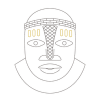
Een orakel in de vorm van een menselijk hoofd. Aan de onderzijde loopt het hoofd breder uit. De ogen zijn groot met een gefigureerde rand eromheen. Brede neus en zeer kleine Bovenop staat een figuur met in de hand een breed zwaard. Hij heeft grote ogen en
Materiaal en techniek (NB: ook thesaurustermen aanpassen!)
material
Koperlegering
Afmetingenlabel (H x B x D)
dimensions
H 12 cm x B 9,5 cm x Dp 11,5 cm
Datering
date made
voor 1970
Verzamelgeschiedenis (toelichting)
provenance
'Two arm cuffs (AM-178-1, AM-192-5) were bought from Willem Geyskens (1923-1989), Diest (Belgium) in 1968. Two years later, in 1970, a small bronze ‘oracle’ (AM-254-2), a terracotta memorial head (AM-254-3) were bought together with a bronze head (AM-254-1), discussed earlier. Geyskens lived in Diest, and later in Tessenderlo (both in Belgium), at the time of his interactions with the Afrika Museum. According to several auction house catalogues he collected objects in Nigeria ‘in situ’ when he worked there as ‘wood merchant’ (The Yale University Art Gallery 2020, Catawiki 2018). He sold more than 250 objects to the Afrika Museum. According to the online ‘African Heritage Research & Documentation Centre’, Geyskens ‘imported Tropical wood, but due to his good contacts in Nigeria he was able to bring out large quantities mainly of Yoruba art, a.o. most of the known Ogboni “bronzes”’ (African Heritage Documentation and Research Centre 2020). William Fagg, who commented on the oracle in August 1977 writes: ‘this could be an oracle of a relatively recent date, after the punitive ...’.' (Excerpt from Provenance no. 2 'The Benin Collections at the National Museum of World Cultures' written by Rosalie Hans with Annette Schmidt, 26-01-2021).
Cultuur (NB: ook thesaurusterm aanpassen!)
ethnic attribution
Bini
Deelcollectie
department and institution
Materiële cultuurcollectie
Verwervingsdatum
accession date
1970-12-09
Wijze van verwerving
accession method
Bruikleen
Literatuur
bibliography
Publicaties over het object
bibliography
For more information about the provenance, see <a href="https://issuu.com/tropenmuseum/docs/2021_provenance_2__benin__e-book" target="_blank"> Provenance #2 – the Benin collections at the National Museum of World Cultures </a> (NB: Issuu uses cookies).
Objectstatus
legal status
Bruikleen Langdurig
Met dank aan (online getoond)
Bruikleen van de Nederlandse Provincie van de Congregatie van de Heilige Geest (CSSp.)
Periode (NB: ook thesaurusterm aanpassen!)
Verkorte naam
AFRIK
Sensitive content

Sensitive Content Digital Benin includes colonial material that may contain inaccurate, derogatory or harmful language relating to African and African diasporic communities. Such language may appear in catalogue records, transcriptions, and book, exhibition or museum titles. We recognize that this material may cause distress. Sensitive-content warnings are being implemented across the collection, but this process is ongoing. The language does not reflect Digital Benin’s views; we take an anti-colonial and anti-racist position and are committed to centring the humanity of historically marginalised communities.

Read more about our approach