Loading...
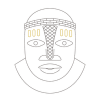
Commemorative Head
Commemorative Head
Commemorative Head
Object number
AE:1898.190
Edo designations
English designations
Categories
Institution Location
Kildare St, Dublin 2, Ireland
Object number
AE:1898.190
Edo designations
English designations
Commemorative Head
Categories
Altar & Shrine Objects
Heads
Institution Location
Kildare St, Dublin 2, Ireland

Iconographies

3 annotations

Star beads
Ititi ako
Star beads

The Ititi ako is a cluster of coral beads, usually three or four, attached to a pin and used to embellish the royal crowns on Uhunmwu-Elao (commemorative heads) and Uhunmwu-Ẹkuẹ (pendant masks). These bead clusters are also known as star beads, which indicate the prosperous destiny of an individual or wearer. Apart from enhancing the appearance of the wearer, they also represent the individual’s high social status. Judging from their presence on a variety of head sculptures, both men and women wore Ititi ako.

1 annotation
Ititi ako
Forehead markings
Ikharo
Forehead markings

Ikharo are linear keloid markings depicted on the forehead of Uhunmwu-Elao (commemorative heads) in groups of three or four above each eye. The exact meaning of Ikharo is debated; some have argued that they relate to the gender or tribal identification of the person on whom they are depicted. For example, Gabriel Ọbazee has argued that they were worn only by men; however, their use in depictions is not consistent with this, and the Iy’Ọba are also shown wearing them. Flora Kaplan argued that they are instead a stylistic feature employed by artists that varied over time.

The naming of these markings differs between publications. For example, Ekhaguosa Aisien and Joseph Nevadomsky describe these markings as “agbaguda n'ehae”, which they write translates literally as “blades of the forehead”. However, Aisien later went on to call these “ikharo”, as used here. Kate Ezra referred to these forehead markings as ikharo, meaning “tribal mark [of eye]”.

1 annotation
Ikharo
Colar Bead
Odigba
Coral beaded collar

Odigba (beaded collar) is a rigid neck collar made of beads, worn as part of ceremonial attire only by senior princes who have been made Enigie. Although Ibafe (2007, p. 43) argued that the Odigba was introduced during the Ogiso period (c. 900–c. 1170 AD) by Ogiso Ere, along with other symbolically important Emwin Arre, such as the Ada (ceremonial sword) and the Ebẹn (ceremonial sword). The Odigba was initially made of beads, while coral was incorporated only later, following its introduction through trade with Portuguese merchants in the late fifteenth century.

1 annotation
Odigba

Provenance

4 events
Production
unknown to February 22, 1897 (day approximate)
Production of Uhunmwu-Elao by the Igun-Ẹrọnmwọn guild in Benin City
Loot
February 19, 1897 (day approximate) to June 1899 (month approximate)
Looting of the Emwin Arre - Inalienable Cultural Artefacts - during the Invasion of the Benin Kingdom in February 1897 and until the end of overt military activity in June 1899
Unknown
February 22, 1897 (day approximate) to 1898
The object is known to have come into contact with William Downing Webster.
Purchase
1898
The object was purchased by the National Museum of Ireland from William Downing Webster.

Institution data

National Museum of Ireland
The data was transferred directly by the institution.
Last updated: 2022-07-13
Language: english
Institution fieldValue
Object number
object id
AE:1898.190
Object name
designation
object type
religious/ritual equipment
Description
description
Mask, base for carved Tusk which stood on sacrificial alter (cast brass). Nos 189-193 were taken from Benin when the place was looted by the British troops in 1897.
Production place
production place
Benin City, Nigeria, West Africa, Africa
Acquisition source
prior source
Webster, W.D.
Notes
notes
Images
images
Yes
License
license
"This image is reproduced with the kind permission of the National Museum of Ireland, in whom the copyright vests. The image may not be copied in any form or medium, nor made available by any means without the consent of the copyright owner."
Sensitive content

Sensitive Content Digital Benin includes colonial material that may contain inaccurate, derogatory or harmful language relating to African and African diasporic communities. Such language may appear in catalogue records, transcriptions, and book, exhibition or museum titles. We recognize that this material may cause distress. Sensitive-content warnings are being implemented across the collection, but this process is ongoing. The language does not reflect Digital Benin’s views; we take an anti-colonial and anti-racist position and are committed to centring the humanity of historically marginalised communities.

Read more about our approach