Loading...
Object Number
A213
Institution
Barnes Foundation Edo designations

English designations
Categories
Institution Location
2025 Benjamin Franklin Pkwy, Philadelphia, PA 19130, United States
Object Number
A213
Institution
Barnes Foundation Edo designations
English designations
Pendant Mask
Categories
Ceremonial Regalia
Institution Location
2025 Benjamin Franklin Pkwy, Philadelphia, PA 19130, United States
Iconographies
2
annotations

Udahae
Beaded forehead band
1 annotation


Ititi ako
Star beads
1 annotation

Provenance
4
events
Institution data
Barnes Foundation
The data was transferred directly by the institution.
Last updated: 2021-09-14
Language: english
| Institution field | Value |
|---|---|
Object Number object id | A213 |
Title designation | Hip Ornament or Pendant |
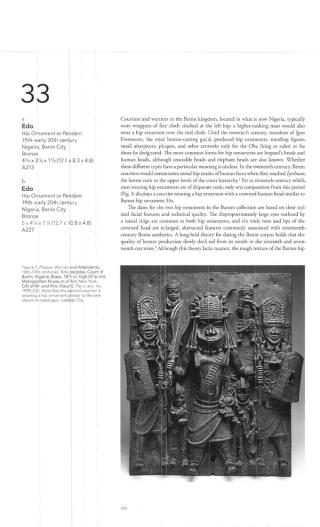
Description description | A small mask with large eyes, nose, and mouth, rings around the chin line and a headdress with a diamond pattern. |
Medium material | Copper alloy |
Dimensions dimensions | Overall: 4 3/4 x 3 1/4 x 1 7/8 in. (12.1 x 8.3 x 4.8 cm) Overall (with mount): 6 15/16 x 3 1/4 x 2 7/8 in. (17.6 x 8.3 x 7.3 cm) Mount: 6 7/16 x 3 x 2 9/16 in. (16.4 x 7.6 x 6.5 cm) |
Classification object type | Jewelry |
Object Name object type | Pendants |
Mark(s) inscriptions | Inscribed in black crayon or graphite on bottom of mount: "18 [or possibly 81]"; Inagaki seal impressed on back of vertical support of mount |
Dated date made | 19th–early 20th century |
Place made production place | Benin City, Nigeria, Africa |
Provenance prior source | Purchased by Albert C. Barnes from Paul Guillaume, Paris, December 1922 |
Culture ethnic attribution | Edo |
Department department and institution | Gallery |
Curatorial Remarks notes | This type of "mask" was actually designed to be worn at the waist as part of the regalia of a Benin king. Early examples of the genre, of which four exist, are carved in ivory and depicted Queen Mother Idia. This example, cast in copper alloy, takes the form of a face with a headdress decorated with coral beads and an openwork beard. It appears to be a later example, possibly post-1897 (the date of the British Punitive Expedition that sacked Benin). (Dr. Christa Clarke, March 2003) |
Exhibition History exhibition history | |
Bibliography bibliography | Clarke, Christa. African Art in the Barnes Foundation: The Triumph of L'Art redacted e and the Harlem Renaissance. New York: Skira Rizzoli, 2015, 180, 182, pl. 33a. Guillaume, Paul and Thomas Munro. Primitive redacted Sculpture. New York: Harcourt, Brace & Company, 1926, pl. 38 "Benin mask, XVth century." Medgyes, Ladislas. "The Art of the African redacted ." International Studio. (November 1922): 145 "A mask in black bronze from Benin (collection Bela Hein)." |
Published References bibliography | President's Files, receipt from Paul Guillaume, December 1922, no. 18 "Petit masque Bénin" (AR.ABC.1922.70) |
Attribution producer | Unidentified artist |
Barnes Foundation
The data was transferred directly by the institution.
Last updated: 2022-06-01
Language: english
| Institution field | Value |
|---|---|
Accession Number object id | A213 |
Title designation | Hip Ornament or Pendant |
Long Description description | |
Sort Description description | |
Medium material | Copper alloy |
Dimensions dimensions | Overall: 4 3/4 x 3 1/4 x 1 7/8 in. (12.1 x 8.3 x 4.8 cm)Overall (with mount): 6 15/16 x 3 1/4 x 2 7/8 in. (17.6 x 8.3 x 7.3 cm)Mount: 6 7/16 x 3 x 2 9/16 in. (16.4 x 7.6 x 6.5 cm) |
Year date made | 19th–early 20th century |
Artist producer | Unidentified artist |
Culture ethnic attribution | Edo |
Exhibition History exhibition history | |
Location display status | Off View |
Viewing Status display status | Currently not on view |
Bibliography bibliography | Clarke, Christa. African Art in the Barnes Foundation: The Triumph of L'Art redacted e and the Harlem Renaissance. New York: Skira Rizzoli, 2015, 180, 182, pl. 33a. Guillaume, Paul and Thomas Munro. Primitive redacted Sculpture. New York: Harcourt, Brace & Company, 1926, pl. 38 "Benin mask, XVth century." Medgyes, Ladislas. "The Art of the African redacted ." International Studio. (November 1922): 145 "A mask in black bronze from Benin (collection Bela Hein)." |
Copyright Status license | Copyright Undetermined |
Sections
About
Other
Sensitive content
Sensitive Content Digital Benin includes colonial material that may contain inaccurate, derogatory or harmful language relating to African and African diasporic communities. Such language may appear in catalogue records, transcriptions, and book, exhibition or museum titles. We recognize that this material may cause distress. Sensitive-content warnings are being implemented across the collection, but this process is ongoing. The language does not reflect Digital Benin’s views; we take an anti-colonial and anti-racist position and are committed to centring the humanity of historically marginalised communities.