Loading...


Object id
999.42.33929
Institution
Hood Museum of Art Edo designations

English designations
Categories
Institution Location
Hood Museum of Art
Dartmouth
6 E Wheelock St, Hanover, NH 03755, USA
Object id
999.42.33929
Institution
Hood Museum of Art Edo designations
English designations
Pendant Mask
Categories
Ceremonial Regalia
Institution Location
Hood Museum of Art
Dartmouth
6 E Wheelock St, Hanover, NH 03755, USA
Iconographies
3
annotations

Udahae
Beaded forehead band
1 annotation


Ititi ako
Star beads
1 annotation

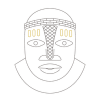
Ikharo
Forehead markings
1 annotation

Provenance
10
events
Institution data
Hood Museum of Art
The data was retrieved from the institution’s website.
Last updated: 2026-02-09
Language: english
| Institution field | Value |
|---|---|
object id | 999.42.33929 |
producer | Unidentified Edo maker |
description | Hip Ornament Representing the Head of a Benin Court Official |
date made | attributed to the early 18th century |
material | Brass and iron |
dimensions | Overall: 8 in. (20.3 cm) |
accession method | Hood Museum of Art, Dartmouth: Purchased through gifts from the Lathrop Fellows |
Geography place collected | Site Looted: Kingdom of Benin, Nigeria, Western Africa, Africa |
Period date made | 1600-1800 |
Object Name designation | Ceremonial Artifact: Mask |
Research Area | Africa |
Course History | "SART 65, Architecture I, Zenovia Toloudi, Spring 2015 French Living and Learning Center, Loic Lerme, Fall 2021 HIST 5.08/AAAS 19, Africa and the World, Naaborko Sackeyfio-Lenoch, Summer 2022 HIST 5.08/AAAS 19, Africa and the World, Naaborko Sackeyfio-Lenoch, Summer 2022 HIST 5.08/AAAS 19, Africa and the World, Naaborko Sackeyfio-Lenoch, Summer 2022 GERM 13.01, Beyond Good and Evil, Veronika Fuechtner, Fall 2022 Art History 63.02, Why Are Museums...?, Mary Coffey, Winter 2023 Philosophy 23.01, Ethics and the Arts, Kenneth Walden, Winter 2023 Art History 20.04, Faith and Empire, Beth Mattison, Spring 2023 History 10.02, Archival Research, M. Cecillia Gaposchkin, Summer 2023 Art History 63.13, Bad Art!, Katie Hornstein, Summer 2023 Philosophy 23.01, Ethics and the Arts, Kenneth Walden, Fall 2023 History 10.02, Archival Research and the Production of History, Leslie Butler, Summer 2024 Art History 63.13, Bad Art!, Katie Hornstein, Summer 2025 History 10.02, Archival Research, Julia Rabig, Summer 2025" |
Exhibition History exhibition history | Art That Lives? Exploring Figural Art from Africa, Allvin P. Gutman Gallery, Hood Museum of Art, Dartmouth College, Hanover, New Hampshire, July 25, 2009-July 2010. Introduction to the History of Art II, 1500 to present, Harrington Gallery Teaching Exhibition, ArtH2, Hood Museum of Art, Dartmouth College, Hanover, New Hampshire, January 24-March 14, 2004. Main Lobby, Hood Museum of Art, Dartmouth College, Hanover, New Hampshire, December 15, 1999- August 1, 2000. The Beauty of the Bronze: Selections from the Hood Museum of Art, Gene Y. Kim Class of 1985 Gallery, Hood Museum of Art, Dartmouth College, Hanover, New Hampshire, October 13, 2012-March 18, 2014. Works from the Continent of Africa, Ivan Albright Gallery, Hood Museum of Art, Dartmouth College, Hanover, New Hampshire, January 26, 2019-March 15, 2020. |
Publication History bibliography | General Pitt-Rivers, Antique Works of Art from Benin, first published in London, 1900 (privately printed), reprinted by Hacker Art Books, Inc., New York, 1971, ill. p. 42, fig. 126-127. Barbara Thompson, "The African Collection at the Hood Museum of Art," African Arts, Volume XXXVII, No. 2, Los Angeles: African Studies Center, University of California, 2004, ill. p. 28. Alexander Bortolot, Art That Lives? Exploring Figural Art from Africa, Hood Mueum of Art, Hanover: Trustees of Dartmouth College, 2009, ill. p. 5, p. 20, no. 14. John R. Stomberg, The Hood Now: Art and Inquiry at Dartmouth, Hanover, New Hampshire: Hood Museum of Art, Dartmouth College, 2019, p. 96, ill. plate no. 27. |
Provenance provenance | Looted by the British Punitive Expedition , in 1897; Pitt-River Museum, Farnham, Dorset, England; John Hewitt, England; Merton Simpson Gallery, New York; Donald Morris Gallery, Detroit, Michigan; Robert and Judith Weston, Detroit; Julian Kaplin, Toledo, Ohio; Estate of Julian Kaplin, Toledo, Ohio; Donald Morris Gallery, Inc., New York, New York, sold to present collection, 1999. |
Hood Museum of Art
The data was transferred directly by the institution.
Last updated: 2021-08-12
Language: english
| Institution field | Value |
|---|---|
Object Number object id | 999.42.33929 |
Title designation object type | Hip Ornament Representing the Head of a Benin Court Official |
Medium material | Brass and iron |
Dimensions dimensions | Overall: 8 in. (20.3 cm) |
Object Name object type | Ceremonial Artifact: Mask |
Date date made | attributed to the early 18th century |
Maker producer | Unidentified Edo maker |
Place Made production place | Africa, Western Africa, Nigeria |
Credit Line prior source | Purchased through gifts from the Lathrop Fellows |
Period date made | 1600-1800 |
Sections
About
Other
Sensitive content
Sensitive Content Digital Benin includes colonial material that may contain inaccurate, derogatory or harmful language relating to African and African diasporic communities. Such language may appear in catalogue records, transcriptions, and book, exhibition or museum titles. We recognize that this material may cause distress. Sensitive-content warnings are being implemented across the collection, but this process is ongoing. The language does not reflect Digital Benin’s views; we take an anti-colonial and anti-racist position and are committed to centring the humanity of historically marginalised communities.