Loading...
Object Number
81.17.493
Institution
Seattle Art Museum Edo designations

English designations
Categories
Institution Location
1300 1st Ave, Seattle, WA 98101, United States
Object Number
81.17.493
Institution
Seattle Art Museum Edo designations
English designations
Pendant Mask
Categories
Ceremonial Regalia
Institution Location
1300 1st Ave, Seattle, WA 98101, United States
Iconographies
3
annotations

Ubanu'hi
Inifinity Symbol
1 annotation


Ikharo
Forehead markings
2 annotations


Provenance
7
events
Institution data
Seattle Art Museum
The data was transferred directly by the institution.
Last updated: 2021-01-08
Language: english
| Institution field | Value |
|---|---|
Object Number object id | 81.17.493 |
Title, Date, Medium designation material date made | Belt mask of Iyoba (Mother of the Oba) Idia, ca. 1517 - 1550 |
Label Text description | "Iyoba Idia's visage is the most widely known face of an African royal woman after the Egyptian Queen, Nefertiti." (Nkiru Nzegwu, 2005) Queen Idia's face conveys the considerable determination and allure that has inspired centuries of respect for her role as an astute leader of the Benin kingdom. This icon was one of four created in her honor by her son, Oba Esigie, who led the kingdom to the height of its prosperity in the sixteenth century. All four were worn each year in a ceremony by a succession of Obas up until 1897, when a British military force confiscated them from the Oba's bedroom in the palace and brought them back to Europe. |
Medium material | Ivory |
Dimensions dimensions | 4 3/4 x 9 3/16 in. (12 x 23.3cm) |
Classification object type | Ivories |
Credit Line prior source | Gift of Katherine White and the Boeing Company |
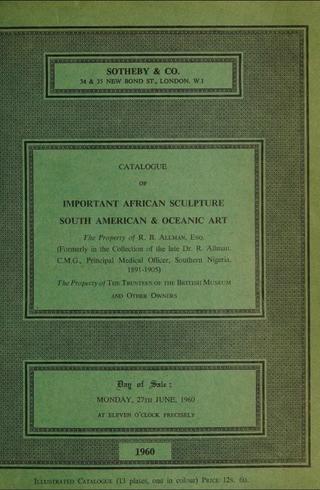
Provenance provenance | Taken from a box in the Oba�s bedroom in the royal palace of Benin City by Dr. Robert Allman, Principal Medical Officer for the British Punitive Expedition , Feb. 16, 1897; [Sotheby's, London, Important African Sculpture, South American & Oceanic Art, Monday, June 27, 1960, lot no. 120, reproduced]; purchased at auction by K.J. Hewett (1919-1994), London, England; John Wise (1902-1981), New York, New York; sold to Katherine White (1929-1980), Seattle, Washington, Dec. 19, 1960 |
Attribution ethnic attribution | Nigerian |
Exhibition History exhibition history | Kansas City, Missouri, The Nelson Gallery and Atkins Museum, The Imagination of Primitive Man, 1962. Cleveland, Ohio, The Cleveland Museum of Art, African Tribal Images: The Katherine White Reswick Collection, July 10 - Sept. 1, 1968 (Philadelphia, Pennsylvania, University of Pennsylvania Museum, Oct. 10 - Dec. 1, 1968). Los Angeles, California, African Art In Motion: Icon and Act, Frederick S. Wight Art Gallery, University of California, Jan. 20 - Mar. 17, 1974 (Washington, D.C., National Gallery of Art, Apr. 21 - Aug. 30, 1974). Seattle, Washington, Seattle Art Museum, African Panoplies: Art for Rulers, Traders, Hunters, and Priests, Apr. 21- Aug. 14, 1988. Chicago, Illinois, Art Institute of Chicago, Benin - Kings and Rituals: Court Arts from Nigeria, July 8 - Sept. 21, 2008. |
Published References bibliography | Important African Sculpture, South American, Haida and Oceanic Art, June 27, 1960, Sotheby's (London, 1960): p. 32, lot no. 120, reproduced frontispiece (color) and folding plate, n.p. Fagg, William. African Tribal Images: The Katherine White Collection. Cleveland, Ohio: The Cleveland Museum of Art, 1968; p. 141. Mathes, Charles. Treasures of American Museums, Mallard Press, 1991; p. 3. Selected Works, Seattle, Washington: Seattle Art Museum, 1991; p. 35 Kaplan, Flora Edouwaye S. "Images of the Queen Mother in Benin Court Art." African Arts vol. 26, no. 3 (July 1993): pp. 54-63, 86-88, reproduced p. 56, fig. 1. Museum for Volkerkunde Wien, Vienna, Austria, Benin � Kings and Rituals: Court Arts from Nigeria, Snoeck Publishers, 2007; p. 142, reproduced fig. 3 |
eMuseum webpage with additional info weblink |
Sections
About
Other
Sensitive content
Sensitive Content Digital Benin includes colonial material that may contain inaccurate, derogatory or harmful language relating to African and African diasporic communities. Such language may appear in catalogue records, transcriptions, and book, exhibition or museum titles. We recognize that this material may cause distress. Sensitive-content warnings are being implemented across the collection, but this process is ongoing. The language does not reflect Digital Benin’s views; we take an anti-colonial and anti-racist position and are committed to centring the humanity of historically marginalised communities.