Loading...
Spoon
Spoon
Spoon
Spoon
Eingangsnummer
67918
Edo designations
English designations
Categories
Institution Location
Reiss-Engelhorn-Museen, Museum Weltkulturen D5, 68159 Mannheim, Germany
Eingangsnummer
67918
Edo designations
English designations
Spoon
Categories
Ceremonial Objects
Institution Location
Reiss-Engelhorn-Museen, Museum Weltkulturen D5, 68159 Mannheim, Germany

Iconographies

2 annotations

tribal marks
Iwu
Facial and Body Markings

Iwu are facial and body markings (scarifications) that were historically worn by Edo men and women. However, since the 1960s, the practice has been nearly extinct. ). In the past, Iwu were used as a way of proving that one was an Edo citizen, and the ceremony of having Iwu completed was an important rite of passage for men and women. The Osiwu, who also practised circumcision and other surgical procedures, would carry out the procedure of adding Iwu. There are different types of Iwu: ‘blades’ worn on the torso (Iwu-eko), and those worn on the face, such as Ikharo (three or four markings above the eyebrows), Irho (two narrow ‘blades’ worn on each cheek), Ovbihue (nasal ‘blades’), Ovbi-agbanmwen (chin ‘blade’), and Igho-okpa/Ukpgho (three forehead ‘blades’).

The number of Iwu also varied depending on the identity of the person wearing them. For example, royal men would wear six ‘blades’ on their torso, whilst men who were not royal would wear seven ‘blades’. Meanwhile, the Ọba’s female children would wear fifteen ‘blades’, and all other women would wear sixteen.

1 annotation
Iwu
Forehead markings
Ikharo
Forehead markings

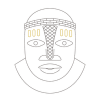
Ikharo are linear keloid markings depicted on the forehead of Uhunmwu-Elao (commemorative heads) in groups of three or four above each eye. The exact meaning of Ikharo is debated; some have argued that they relate to the gender or tribal identification of the person on whom they are depicted. For example, Gabriel Ọbazee has argued that they were worn only by men; however, their use in depictions is not consistent with this, and the Iy’Ọba are also shown wearing them. Flora Kaplan argued that they are instead a stylistic feature employed by artists that varied over time.

The naming of these markings differs between publications. For example, Ekhaguosa Aisien and Joseph Nevadomsky describe these markings as “agbaguda n'ehae”, which they write translates literally as “blades of the forehead”. However, Aisien later went on to call these “ikharo”, as used here. Kate Ezra referred to these forehead markings as ikharo, meaning “tribal mark [of eye]”.

1 annotation
Ikharo

Provenance

4 events
Production
1525 (approximate) to 1600 (approximate)
Production of ivory Uhẹnhẹn/Ekuyẹ In Benin
Loot
February 19, 1897 (day approximate) to June 1899 (month approximate)
Looting of the Emwin Arre - Inalienable Cultural Artefacts - during the Invasion of the Benin Kingdom in February 1897 and until the end of overt military activity in June 1899
Unknown
February 22, 1897 (day approximate) to 1925
The object is known to have come into contact with Hans Meyer.
Purchase
1925
The object was purchased by the Reiss-Engelhorn-Museen, Museum Weltkulturen from Hans Meyer.

Institution data

Reiss-Engelhorn-Museen, Museum Weltkulturen
The data was transferred directly by the institution.
Last updated: 2021-09-23
Language: german
Institution fieldValue
Alte Inventarnummer
object id
Alte Nummer
object id
Eingangsnummer
object id
67918
Inventarnummer
object id
IV Af 3104
Titel (Museumsobjekt)
designation
Elfenbeinlöffel
Material
material
Elfenbein
Maße zum Objekt
dimensions
Länge: 21,00 cm; Breite: 4,50 cm; Höhe: 3,00 cm
Objektbezeichnung
object type
Löffel
Fundort/Herkunft
production place
Benin-Reich <hist.>
Voreigentümer/in
prior source
provenance
Meyer, Hans, Dr.
Ethnie/Sprachgruppe
ethnic attribution
Sammlung
department and institution
VK IV Afrika
Eingangsjahr
accession date
1925
Eingangsart
accession method
Kauf
Bild
images
rem/Maria Schumann
Sensitive content

Sensitive Content Digital Benin includes colonial material that may contain inaccurate, derogatory or harmful language relating to African and African diasporic communities. Such language may appear in catalogue records, transcriptions, and book, exhibition or museum titles. We recognize that this material may cause distress. Sensitive-content warnings are being implemented across the collection, but this process is ongoing. The language does not reflect Digital Benin’s views; we take an anti-colonial and anti-racist position and are committed to centring the humanity of historically marginalised communities.

Read more about our approach