Loading...


Number
МАЭ № 595-4
Edo designations

English designations
Categories
Institution Location
University Embankment, 3, St Petersburg, Russia, 199034
Number
МАЭ № 595-4
Edo designations
English designations
Commemorative Queen Mother Head
Categories
Altar & Shrine Objects
Heads
Institution Location
University Embankment, 3, St Petersburg, Russia, 199034
Iconographies
5
annotations

Ititi ako
Star beads
1 annotation


Udahae
Beaded forehead band
1 annotation


Ikharo
Forehead markings
1 annotation

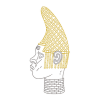
Ukpẹ ọkhọkhọ
Curved conical hairstyle worn by Iy'Ọba
1 annotation


Odigba
Coral beaded collar
1 annotation

Provenance
4
events
Institution data
Peter the Great Museum of Anthropology and Ethnography (the Kunstkamera)
The data was retrieved from the institution's website.
Last updated: 2021-02-19
Language: english
| Institution field | Value |
|---|---|
Number object id | МАЭ № 595-4 |
Title designation | Image of the head of the mother of ruler Oba |
Annotation description | In African states, the rank of the queen-mother was one of the highest, and her rights were almost the same as those of the main ruler of the city. She disposed of the life and death of her subjects; she was given the same honor as the king. The tradition of casting bronze heads of kings and queens for altars is considered the oldest in Benin's unique palace art. The depictions of these heads were not realistic portraits, but rather symbolic icons; this is the so-called idealizing naturalism. Usually the rulers and their mothers were not so much depicted as they were designated. The Queen Mother is shown a traditional coral mesh hairdo. Such heads were made using the so-called “lost wax technique”. First, the earthen block was covered with wax and shaped into the desired shape. Clay was put on top of it and heated. The wax was leaking out and a metal alloy was poured in instead. It is usually called Benin bronze, but it is closer in composition to brass. Heads and other items of court art were created by professional artisans by order of the royal court. They often formed corporations and lived in special neighborhoods. |
Material material | bronze, clay (?) |
The size dimensions | Height - 46.0; base diameter - 23.5; head diameter - 17.0. |
Date date made | XVIII century |
Geographical localization of the place of creation production place | Nigeria |
Place of creation production place | Nigeria |
Collectors-person prior source | Meyer Hans (22 March 1858 - 5 July 1929) |
Ethnicity ethnic attribution | edo |
Publications bibliography | Olderogge Dmitry Alekseevich Antiquities of Benin, II (uhuv-elao of Benin kings) // Collection of the Museum of Anthropology and Ethnography / otv. ed. S.P. Tolstov. - M .; L .: Publishing house of the Academy of Sciences of the USSR, 1955. - 461 p .: ill. - (Collection of the Museum of Anthropology and Ethnography; vol. 16) 1955 Olderogge Dmitry Alekseevich Antiquities of Benin (from the collections of the Museum of Anthropology and Ethnography) // Collection of the Museum of Anthropology and Ethnography / otv. ed. S.P. Tolstov. - M .; L .: Publishing house of the Academy of Sciences of the USSR, 1953 .-- 554 p .: ill. - (Collection of the Museum of Anthropology and Ethnography; vol. 15). |
URL weblink | https://collection.kunstkamera.ru/en/entity/OBJECT/14295 |
Albums | Great Benin |
Collection | Ethnography of Africa |
Keywords | peoples of africa, benue-congo, edo |
Peter the Great Museum of Anthropology and Ethnography (the Kunstkamera)
The data was retrieved from the institution's website.
Last updated: 2021-02-19
Language: russian
| Institution field | Value |
|---|---|
Музейный номер object id | МАЭ № 595-4 |
Наименование, название designation | Изображение головы матери правителя Оба |
Материал material | бронза, глина (?) |
Размер dimensions | Высота - 46,0; диаметр основания - 23,5; диаметр головы - 17,0. |
Время создания date made | XVIII век |
Географическая локализация места создания production place | Нигерия |
Место создания production place | Нигерия |
Собиратель-частное лицо prior source | Мейер Ганс (22 марта 1858 - 5 июля 1929) |
Этническая принадлежность ethnic attribution | эдо |
Аннотация notes | В африканских государствах ранг царицы-матери был одним из высших, а ее права были почти такими же, как у главного правителя города. Она распоряжалась жизнью и смертью подданных; ей воздавали такие же почести, как и царю. Традиция отливки бронзовых голов царей и цариц для алтарей считается древнейшей в уникальном дворцовом искусстве Бенина. Изображения этих голов были не реалистическими портретами, а скорее, символическими иконами; это так называемый идеализирующий натурализм. Обычно правители и их матери не столько изображались, сколько обозначались. У царицы-матери показана традиционная прическа с коралловой сеточкой на волосах. Подобные головы делали в так называемой «технике утраченного воска». Сначала глиняную болванку покрывали воском и придавали ему нужную форму. Поверх него накладывали глину и нагревали. Воск вытекал, и вместо него заливали металлический сплав. Его обычно называют бенинской бронзой, но по составу он ближе к латуни. Головы и другие предметы придворного искусства создавали ремесленники-профессионалы по заказу царского двора. Они нередко объединялись в корпорации и жили в специальных кварталах. |
Публикации bibliography | Ольдерогге Дмитрий Алексеевич Древности Бенина, II (ухув-элао бенинских царей) // Сборник Музея антропологии и этнографии / отв. ред. С.П. Толстов. - М.; Л.: Изд-во АН СССР, 1955. - 461 с.: ил. - (Сборник Музея антропологии и этнографии; т. 16) 1955 Ольдерогге Дмитрий Алексеевич Древности Бенина (по коллекциям Музея антропологии и этнографии) // Сборник Музея антропологии и этнографии / отв. ред. С.П. Толстов. - М.; Л.: Изд-во АН СССР, 1953. - 554 с.: ил. - (Сборник Музея антропологии и этнографии; т. 15). |
URL weblink | https://collection.kunstkamera.ru/entity/OBJECT/14295 |
Альбомы | Великий Бенин |
Ключевые слова | народы Африки, бенуэ-конго, эдо |
Собрание | Этнография Африки |
Sections
About
Other
Sensitive content
Sensitive Content Digital Benin includes colonial material that may contain inaccurate, derogatory or harmful language relating to African and African diasporic communities. Such language may appear in catalogue records, transcriptions, and book, exhibition or museum titles. We recognize that this material may cause distress. Sensitive-content warnings are being implemented across the collection, but this process is ongoing. The language does not reflect Digital Benin’s views; we take an anti-colonial and anti-racist position and are committed to centring the humanity of historically marginalised communities.