Loading...
Number
МАЭ № 595-12
Edo designations

English designations
Categories
Institution Location
University Embankment, 3, St Petersburg, Russia, 199034
Number
МАЭ № 595-12
Edo designations
English designations
Relief Plaque
Categories
Palace Architecture & Ornamentation
Institution Location
University Embankment, 3, St Petersburg, Russia, 199034
Iconographies
3
annotations

Igan
Feather
1 annotation

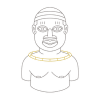
Ikele
Coral bead circlet
1 annotation


Iwu
Facial and Body Markings
1 annotation

Provenance
4
events
Institution data
Peter the Great Museum of Anthropology and Ethnography (the Kunstkamera)
The data was retrieved from the institution's website.
Last updated: 2021-02-19
Language: english
| Institution field | Value |
|---|---|
Number object id | МАЭ № 595-12 |
Title designation | Warrior plaque |
Annotation description | |
Material material | bronze |
The size dimensions | Height - 46.0; width - 19.0; maximum thickness - 4.5. |
Date date made | XVI-XVII centuries |
Geographical localization of the place of creation production place | Nigeria |
Place of creation production place | Nigeria |
Collectors-person prior source | Meyer Hans (22 March 1858 - 5 July 1929) |
Ethnicity ethnic attribution | edo |
Publications bibliography | Olderogge Dmitry Alekseevich Antiquities of Benin, II (uhuv-elao of Benin kings) // Collection of the Museum of Anthropology and Ethnography / otv. ed. S.P. Tolstov. - M .; L .: Publishing house of the Academy of Sciences of the USSR, 1955. - 461 p .: ill. - (Collection of the Museum of Anthropology and Ethnography; vol. 16) 1955 Olderogge Dmitry Alekseevich Antiquities of Benin (from the collections of the Museum of Anthropology and Ethnography) // Collection of the Museum of Anthropology and Ethnography / otv. ed. S.P. Tolstov. - M .; L .: Publishing house of the Academy of Sciences of the USSR, 1953 .-- 554 p .: ill. - (Collection of the Museum of Anthropology and Ethnography; vol. 15). |
URL weblink | https://collection.kunstkamera.ru/en/entity/OBJECT/14652 |
Albums | Great Benin |
Collection | Ethnography of Africa |
Keywords | peoples of africa, benue-congo, edo |
Peter the Great Museum of Anthropology and Ethnography (the Kunstkamera)
The data was retrieved from the institution's website.
Last updated: 2021-02-19
Language: russian
| Institution field | Value |
|---|---|
Музейный номер object id | МАЭ № 595-12 |
Наименование, название designation | Плакетка с изображением воина |
Материал material | бронза |
Размер dimensions | Высота - 46,0; ширина - 19,0; толщина максимальная - 4,5. |
Время создания date made | XVI-XVII вв. |
Географическая локализация места создания production place | Нигерия |
Место создания production place | Нигерия |
Собиратель-частное лицо prior source | Мейер Ганс (22 марта 1858 - 5 июля 1929) |
Этническая принадлежность ethnic attribution | эдо |
Аннотация notes | |
Публикации bibliography | Ольдерогге Дмитрий Алексеевич Древности Бенина, II (ухув-элао бенинских царей) // Сборник Музея антропологии и этнографии / отв. ред. С.П. Толстов. - М.; Л.: Изд-во АН СССР, 1955. - 461 с.: ил. - (Сборник Музея антропологии и этнографии; т. 16) 1955 Ольдерогге Дмитрий Алексеевич Древности Бенина (по коллекциям Музея антропологии и этнографии) // Сборник Музея антропологии и этнографии / отв. ред. С.П. Толстов. - М.; Л.: Изд-во АН СССР, 1953. - 554 с.: ил. - (Сборник Музея антропологии и этнографии; т. 15). |
URL weblink | https://collection.kunstkamera.ru/entity/OBJECT/14652 |
Альбомы | Великий Бенин |
Ключевые слова | народы Африки, бенуэ-конго, эдо |
Собрание | Этнография Африки |
Sections
About
Other
Sensitive content
Sensitive Content Digital Benin includes colonial material that may contain inaccurate, derogatory or harmful language relating to African and African diasporic communities. Such language may appear in catalogue records, transcriptions, and book, exhibition or museum titles. We recognize that this material may cause distress. Sensitive-content warnings are being implemented across the collection, but this process is ongoing. The language does not reflect Digital Benin’s views; we take an anti-colonial and anti-racist position and are committed to centring the humanity of historically marginalised communities.