Loading...
Accession Number
26.180
Institution
Detroit Institute of Arts Edo designations

English designations
Categories
Institution Location
5200 Woodward Ave, Detroit, MI 48202, United States
Accession Number
26.180
Institution
Detroit Institute of Arts Edo designations
English designations
Commemorative Queen Mother Head
Categories
Altar & Shrine Objects
Heads
Institution Location
5200 Woodward Ave, Detroit, MI 48202, United States
Iconographies
5
annotations

Ititi ako
Star beads
1 annotation


Ikharo
Forehead markings
1 annotation


Udahae
Beaded forehead band
1 annotation


Odigba
Coral beaded collar
1 annotation

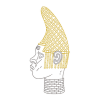
Ukpẹ ọkhọkhọ
Curved conical hairstyle worn by Iy'Ọba
1 annotation

Provenance
4
events
Institution data
Detroit Institute of Arts
The data was retrieved from the institution’s website.
Last updated: 2026-02-09
Language: english
| Institution field | Value |
|---|---|
Accession Number object id | 26.180 |
Title description | Royal Portrait |
Artwork Date date made | between 1750 and 1850 |
Artist producer | ---------- |
Life Dates | ---------- |
Nationality | African |
Culture ethnic attribution | Benin |
Medium material | Bronze, cast |
Dimensions dimensions | Sight: 21 × 10 1/2 × 10 1/2 inches (53.3 × 26.7 × 26.7 cm) |
Classification designation | Metalwork |
Department department and institution | African Art |
Credit accession method | City of Detroit Purchase |
Copyright license | Public Domain |
Markings | Please note: This section is empty |
Provenance provenance | Fritz Gurlitt (Germany); 1926-present, purchase by the Detroit Institute of Arts (Detroit, Michigan, USA) |
Exhibition History exhibition history | Please note: This section is empty |
Published References bibliography | Masterpieces of Art in Memory of W.R. Valentiner. Exh. cat., North Carolina Museum of Art. Raleigh, April 6 - May 17, 1959, no. 217. World Primitive Art. Exh. cat., The University Art Gallery, Oakland University. Rochester Michigan, November 4 - 29, 1965. Detroit Collects African Art. Exh. cat., DIA. Detroit, April 21-May 29, 1977, no. 86 (ill.). Kan, Micheal, African Masterworks In The Detroit Institute of Arts. Washington, 1995, no. 33. |
Catalogue Raisoneé | Please note: This section is empty |
Credit Line for Reproduction license | Benin, African, Royal Portrait, between 1750 and 1850, bronze, cast. Detroit Institute of Arts, City of Detroit Purchase, 26.180. |
Detroit Institute of Arts
The data was transferred directly by the institution.
Last updated: 2022-08-29
Language: english
| Institution field | Value |
|---|---|
Accession number object id | 26.180 |
Title designation | Royal Portrait |
Web Description description | This regal head commemorates the important central role in Benin politics fulfilled by the Queen Mother, or lye oba, who held the rank of a high chief. Her son, the king, consulted with her about all questions of leadership and policy making during his reign. Ironically, all direct contact between the king and his mother was forbidden; they communicated from separate palaces through messengers. This bronze head, which shows the queen's distinctive "chicken's beak" hairdo, would have adorned the ancestral shrine established in her honor after her death. |
Medium material | bronze, cast |
Dimensions dimensions | Sight: 21 × 10 1/2 × 10 1/2 inches (53.3 × 26.7 × 26.7 cm) |
Artwork/Object creation date date made | between 1750 and 1850 |
Artist or Maker producer | Benin, African |
Donor/purchase credit line prior source | City of Detroit Purchase |
Provenance provenance | Fritz Gurlitt (Germany); 1926-present, purchase by the Detroit Institute of Arts (Detroit, Michigan, USA) |
Curatorial department department and institution | Africa, Oceania & Indigenous Americas |
Published References bibliography | Masterpieces of Art in Memory of W.R. Valentiner. Exh. cat., North Carolina Museum of Art. Raleigh, April 6 - May 17, 1959, no. 217. World Primitive Art. Exh. cat., The University Art Gallery, Oakland University. Rochester Michigan, November 4 - 29, 1965. Detroit Collects African Art. Exh. cat., DIA. Detroit, April 21-May 29, 1977, no. 86 (ill.). African Masterworks In The Detroit Institute of Arts. Washington and London: The Detroit Institute of Arts and Smithsonian Institution Press, 1995, cat. no. 33. |
Credit line for reproduction license | Benin, African, Royal Portrait, between 1750 and 1850, bronze, cast. Detroit Institute of Arts, City of Detroit Purchase, 26.180. |
Credit Line | Benin, African, Royal Portrait, between 1750 and 1850, bronze, cast. Detroit Institute of Arts, City of Detroit Purchase, 26.180. |
Sections
About
Other
Sensitive content
Sensitive Content Digital Benin includes colonial material that may contain inaccurate, derogatory or harmful language relating to African and African diasporic communities. Such language may appear in catalogue records, transcriptions, and book, exhibition or museum titles. We recognize that this material may cause distress. Sensitive-content warnings are being implemented across the collection, but this process is ongoing. The language does not reflect Digital Benin’s views; we take an anti-colonial and anti-racist position and are committed to centring the humanity of historically marginalised communities.