Loading...

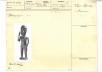
Inventory no. [ObjInventarNrS]
25161
Institution
Weltkulturen Museum Frankfurt am Main Edo designations

English designations
Categories
Institution Location
Schaumainkai 29-37, 60594 Frankfurt am Main, Germany
Inventory no. [ObjInventarNrS]
25161
Institution
Weltkulturen Museum Frankfurt am Main Edo designations
English designations
Male Figure
Categories
Figures
Institution Location
Schaumainkai 29-37, 60594 Frankfurt am Main, Germany
Iconographies
2
annotations
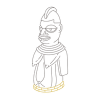
Àkpólú
Waist beads
1 annotation


Iwu
Facial and Body Markings
1 annotation

Provenance
4
events
Institution data
Weltkulturen Museum Frankfurt am Main
The data was transferred directly by the institution.
Last updated: 2021-04-20
Language: english
| Institution field | Value |
|---|---|
Inventory no. [ObjInventarNrS] object id | 25161 |
Object designation [ObjTitelOriginalS] designation object type | Figure. female |
Description [ObjReserve02M] description | 25161.Standing, fan in one hand. Naked except for waist cord. Not old, because scores of a modern file on the lips. Purchase price 35.- |
Mat./Technique [ObjTechMatM] material | Yellow cast iron; Very pure brass with extremely high zinc content, very little tin, low lead content, extremely low trace element concentrations and significantly elevated cadmium value. |
Dimensions [ObjMasse1S] dimensions | H 19.5 |
Dating [ObjDatierungS] date made | late 19th century |
Year from [ObjJahrVonL] date made | |
Year until [ObjJahrBisL] date made | |
Geographical reference [ObjGeografieS] production place | Kingdom of Benin (Africa->West Africa->Nigeria) |
Name sorting [KueSortierungS_0] prior source | Konietzko Julius |
Name sorting [KueSortierungS_1] prior source | |
First Name 2 [KueVorNameS_1] provenance | |
First name [KueVorNameS_0] provenance | Julius |
Function collector 2 [OkuFunktionS_1] provenance | |
Function collector [OkuFunktionS_0] provenance | Collector |
Inventory note [ObjFeld07M] provenance | |
Last Name 2 [KueNameS_1] provenance | |
Last name [KueNameS_0] provenance | Konietzko |
Date of acquisition[ObjFeld04M] accession date | 04.1926 |
Acquisition type [ObjFeld02M] accession method | |
Comemnts[ObjCreditlineM] notes | |
Exhibition exhibition history | |
Literature bibliography | |
Type [ObjSystematikS] object type | Souvenir (Art) |
Type of ownership [ObjFeld01M] accession method | |
Type of person 2 [KueTypS_1] | |
Type of person [KueTypS_0] | Person |
Weltkulturen Museum Frankfurt am Main
The data was transferred directly by the institution.
Last updated: 2021-04-20
Language: german
| Institution field | Value |
|---|---|
Inventarnr. [ObjInventarNrS] object id | 25161 |
Beschreibung [ObjReserve02M] description | 25161. Stehend, in einer Hand Fächer. Bis auf Hüftschnur nackt. Nicht alt, da Riefen einer modernen Feile auf den Lippen. Ankaufspreis 35.- |
Mat./Technik [ObjTechMatM] material production technique | Gelbguß; Sehr reines Messing mit extrem hohem Zinkgehalt, sehr wenig Zinn, geringem Bleigehalt, extrem niedrigen Spurenelementkonzentrationen und deutlich erhöhtem Cadmiumwert |
Maßangaben [ObjMasse1S] dimensions | H 19.5 |
Gattung [ObjSystematikS] object type | Souvenir (Kunst) |
Objektbezeichnung [ObjTitelOriginalS] object type | Figur. Weiblich |
Datierung [ObjDatierungS] date made | spätes 19. Jh |
Jahr bis [ObjJahrBisL] date made | |
Jahr von [ObjJahrVonL] date made | |
Geogr. Bezug [ObjGeografieS] production place | Königtum Benin (Afrika->Westafrika->Nigeria) |
Nachname 2 [KueNameS_1] prior source | |
Nachname [KueNameS_0] prior source | Konietzko |
Namensortierung [KueSortierungS_0] prior source | Konietzko Julius |
Namenssortierung [KueSortierungS_1] prior source | |
Vorname 2 [KueVorNameS_1] prior source | |
Vorname [KueVorNameS_0] prior source | Julius |
Funktion Sammler 2 [OkuFunktionS_1] prior source role | |
Funktion Sammler [OkuFunktionS_0] prior source role | Sammler |
Erwerbsdatum [ObjFeld04M] accession date | 04.1926 |
Besitzart [ObjFeld01M] accession method | |
Erwerbungsart [ObjFeld02M] accession method | |
Bemerkungen [ObjCreditlineM] notes | |
Inventar Notiz [ObjFeld07M] notes | |
Ausstellung exhibition history | |
Literatur bibliography | |
Personentyp 2 [KueTypS_1] | |
Personentyp [KueTypS_0] | Person |
Sections
About
Other
Sensitive content
Sensitive Content Digital Benin includes colonial material that may contain inaccurate, derogatory or harmful language relating to African and African diasporic communities. Such language may appear in catalogue records, transcriptions, and book, exhibition or museum titles. We recognize that this material may cause distress. Sensitive-content warnings are being implemented across the collection, but this process is ongoing. The language does not reflect Digital Benin’s views; we take an anti-colonial and anti-racist position and are committed to centring the humanity of historically marginalised communities.