Loading...
ObjectID
244168
Edo designations
English designations
Categories
Institution Location
100 Queens Park, Toronto, ON M5S 2C6, Canada
ObjectID
244168
Edo designations
English designations
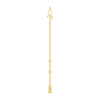
Altar Tusk
Categories
Altar & Shrine Objects
Institution Location
100 Queens Park, Toronto, ON M5S 2C6, Canada

Iconographies

7 annotations

Ubanu'hi / Obanu'hi
Ubanu'hi
Inifinity Symbol

The Ubanu'hi (infinity symbol) is a kind of guilloche or interlaced strapwork motif that can be angular or rounded. It was used by Edo artists in the decoration of many Emwin Arhe (royal treasures) and is ubiquitous in Benin royal arts. Ubanu'hi is a shortened form of “uba no Ọba ya de agbon ke ehimwin yi”, which means “the rope with which the Ọba ties the heaven and earth together” (pers. comm. Chief John Igbineweka Inneh n’Igbesawman, 2022). Similarly, Paula Ben-Amos Girshick described this as “Ọba n’iri agbon”, or the “rope of the world” pattern.

According to Ọbabanmu Ineh, the use of this motif indicates that objects were carved by members of the Igbesanmwan. However, the motif is found on all types of Emwin Arhe (royal treasures), not only those made of ivory or wood. On the flanges of the Ama-Ẹrọnmwọn (relief plaques) alone, Kathryn Gunsch identified three different versions of the Ubanu'hi and, through her analysis of over 850 plaques, found that these different Ubanu'hi forms align with other characteristics, such as dimensions, the prevalence of ornamental motifs, and stylistic qualities. Together, these provide evidence, she argues, of different production groups among the plaque makers.

Kate Ezra went on to argue that the use of these motifs indicates that certain objects were used in a “royal context” and were associated with “royal patronage”.

Ubanu’hi can also be spelt Obanu'hi, indicating different intonations in the pronunciation of the words.

1 annotation
Ubanu'hi
Spears
Asoro
Spears

Asoro (spears) were used as weapons in battle and for hunting. According to Osadolor, there were two types: long and short. Figures holding Asoro are often depicted on Ama-Ẹrọnmwọn (bronze relief plaques), sometimes in battle scenes and at ceremonies and festivals.

1 annotation
Asoro
Iconography image
Ẹbẹn
Ceremonial Sword

Ẹbẹn are a type of ceremonial sword of significant importance in the Benin Kingdom. During ceremonies, titled chiefs would hold them or toss them during dances, thereby paying homage to the Ọba at these public events, particularly when a chief receives a certain status. It is forbidden for Ẹbẹn to touch the ground, so the chief must take extra precautions to avoid dropping the Ẹbẹn during the dance. Therefore, the Okae-Odionmwan (head of executioners) dances with the Umozo (warfare or executioner’s sword) behind the dancing chief.

There are two central ceremonial swords used in the royal court of the Benin Kingdom, one of which is the Ẹbẹn, along with the Ada (ceremonial swords). They are distinguished by their blades: the Ẹbẹn blade reflects the shape of a leaf or an oar. Sometimes, it is decorated with openwork designs and/or brass inlays, most commonly shaped as small Ẹbẹn and Ẹkpẹn (leopards). The handle of the Ẹbẹn also has an unusual ring-shaped form, which further differentiates it from the Ada.

1 annotation
Ẹbẹn
Frog
Ẹkirẹ
Frog

Ẹkirẹ is the Edo term for frog. The Ẹkirẹ carries significant and often ambiguous symbolic importance, primarily linked to its liminal nature and association with spiritual and magical powers. As an amphibian that lives on the threshold between water and land, the Ẹkirẹ is seen as a messenger of Olokun. This connection reinforces the Ọba’s (king’s) ability to bridge the human and spiritual realms, a concept consistently present in Benin art.

While not as common as the mudfish, frogs appear on various Benin artworks, including Aken'ni Elao (carved tusks), pendant plaques, and Ẹrhẹ (royal stools). Their presence often relates to medicinal and occult practices. Frogs can be used in powerful curses, with a jumping frog signifying failure, and a frog, along with a coiled fish, used in rituals to release such curses. They are also associated with Osun, the deity of medicine, and scenes of snakes swallowing frogs can represent supernatural attacks or strong spiritual powers. For warriors, the Ẹkirẹ could even symbolise an aspect of their protective equipment and was used in palace rituals to encourage success in battle.

1 annotation
Ẹkirẹ
Ada Ceremonial Sword
Ada
Ceremonial sword

The Ada is a symbol of authority usually borne in the presence of the Ọba by a designated holder, the Omada, which translates as ‘Ada bearer’. The Ọba has almost exclusive rights to the use of the Ada, except when he permits titled chiefs, such as the Oliha, to possess one. During the Ogiso period, predating the current Ọba dynasty, the Ada is said to have been a symbol of ancestral power, with the ability to control the future. The Ada is ranked higher than the Ẹbẹn, another symbolically important ceremonial sword.

1 annotation
Ada
Fist/Hand
Obọ
Fist/Hand

The fist motif—particularly a clenched fist with an extended thumb—carries significant symbolic weight. It is central to the cult of the hand, a major aspect of Edo religion that focuses on an individual’s ability to achieve success through their own actions, skills, and enterprise. This cult is primarily observed by those who have already attained considerable wealth or status, including hunters, warriors, and craftsmen.

The fist symbolises physical prowess and strength, denoting the individual’s might and accomplishment. The hand is credited with enabling the accumulation of great riches and high status. This is sometimes linked to the idea that wealth results from both personal effort and the favour of Olokun, the god of wealth. On Ukhurhẹ (ancestral staffs), a clenched fist or hand grasping a mudfish signifies royal or chiefly authority. The image of a hand holding a coiled mudfish can also illustrate the Ọba’s formidable power to “cast and then release a curse” or to “set up obstacles and remove them”. The fist is sometimes accompanied by other motifs symbolising strength, chieftaincy, and longevity, such as tools like the hammer and pliers or feathers of the vulturine fish eagle. The fist motif is frequently depicted on Aken'ni Elao (carved tusks), on wooden Ikẹgobọ (altars to the hand), and on Ukhurhẹ.

1 annotation
Obọ
Colar Bead
Odigba
Coral beaded collar

Odigba (beaded collar) is a rigid neck collar made of beads, worn as part of ceremonial attire only by senior princes who have been made Enigie. Although Ibafe (2007, p. 43) argued that the Odigba was introduced during the Ogiso period (c. 900–c. 1170 AD) by Ogiso Ere, along with other symbolically important Emwin Arre, such as the Ada (ceremonial sword) and the Ebẹn (ceremonial sword). The Odigba was initially made of beads, while coral was incorporated only later, following its introduction through trade with Portuguese merchants in the late fifteenth century.

1 annotation
Odigba

Provenance

4 events
Production
1750 (year uncertain/approximate) to February 22, 1897 (day approximate)
Production of the Aken'ni Elao by the Igbesamwan guild in Benin City
Loot
February 19, 1897 (day approximate) to June 1899 (month approximate)
Looting of the Emwin Arre - Inalienable Cultural Artefacts - during the Invasion of the Benin Kingdom in February 1897 and until the end of overt military activity in June 1899
Inheritance
1957 to 1998
The object was inherited by John & Mrs. Braine from Henry Bevan Mansfield.
Gift
1998
The object was given as a gift by John & Mrs. Braine to the Royal Ontario Museum.

Institution data

Royal Ontario Museum
The data was transferred directly by the institution.
Last updated: 2021-08-03
Language: english
Institution fieldValue
Alternate Number
object id
Object Number
object id
998.122.1
ObjectID
object id
244168
Sort Number
object id
998 122 1
Title
designation
object type
Carved tusk
Description
description
Carved ivory tusk
Public Caption
description
Elephant tusks have been prominent objects on royal ancestral shrines since at least the 17th century. However, it was not until the late 18th century that elaborate carvings became a common characteristic of the tusks displayed on the shrines of Oba, Queen Mothers and high ranking chiefs. This tusk is likely from the ancestral altar of a high-ranking chief at the end of the 1800s. The carved elements on the tusk represent symbols and imagery from myths and legends that emphasize the temporal and spiritual power of the owner.
Material and Technique Display
material
Ivory
Dimensions
dimensions
(L) 93 cm x (W) 7 cm at base
Classification
object type
Religious & Ceremonial Objects
Object Name
object type
tusk
Begin Date
date made
1867
Date
date made
late 19th century
End Date
date made
1900
Maker Display
producer
Edo
Geography Display
production place
Benin Kingdom, Nigeria
Credit Line
prior source
Gift of Mr. & Mrs. John Braine and the Mansfield Family
Object History/Provenance
provenance
This object was gifted to the ROM in 1998 by Mr. & Mrs. John Braine, of Windsor, Ontario. According to Mr. Braine, his maternal grandfather was Capt. Henry Bevan Mansfield of the Royal Irish Rifles, who was a Commissioner in Nigeria in the late 19th century. The family emigrated from Ireland to Canada in 1957. 
Culture
ethnic attribution
Edo
Department
department and institution
Art & Culture: Global Africa
Accession Method
accession method
Gift - Tax Receipt
Exhibitions
exhibition history
Shreyas and Mina Ajmera Gallery of Africa, the Americas and Asia-Pacific, April 2008-present
Publications
bibliography
Object Status
legal status
Accessioned Object
Sensitive content

Sensitive Content Digital Benin includes colonial material that may contain inaccurate, derogatory or harmful language relating to African and African diasporic communities. Such language may appear in catalogue records, transcriptions, and book, exhibition or museum titles. We recognize that this material may cause distress. Sensitive-content warnings are being implemented across the collection, but this process is ongoing. The language does not reflect Digital Benin’s views; we take an anti-colonial and anti-racist position and are committed to centring the humanity of historically marginalised communities.

Read more about our approach