Loading...


Accession Number
2004.86
Institution
Chazen Museum of Art Edo designations

English designations
Categories
Institution Location
800 University Ave, Madison, WI 53706, United States
Accession Number
2004.86
Institution
Chazen Museum of Art Edo designations
English designations
Commemorative Head
Categories
Altar & Shrine Objects
Institution Location
800 University Ave, Madison, WI 53706, United States
Iconographies
5
annotations

Odigba
Coral beaded collar
1 annotation

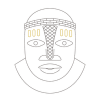
Ikharo
Forehead markings
1 annotation


Igan
Feather
1 annotation

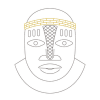
Udahae
Beaded forehead band
1 annotation


Ubanu'hi
Inifinity Symbol
1 annotation

Institution data
Chazen Museum of Art
The data was transferred directly by the institution.
Last updated: 2023-08-23
Language: english
| Institution field | Value |
|---|---|
Accession Number object id | 2004.86 |
Artist - Sort Name producer ethnic attribution | Unknown, Nigerian, Edo People |
Title object type edo designation | Commemorative Head of a Chief (uhunmwun-elao) |
Artist Life Dates producer | (Nigerian, Edo People) |
Display Date date made | late 19th century |
Creation Date Range date made | 1850-1897 |
Dimensions-overall dimensions | 25.63 in. x 11 in. x 9.75 in. (65.09 cm x 27.94 cm x 24.77 cm) |
Dimensions-Height dimensions | 25.63 in. (65.09 cm) |
Dimensions-Width dimensions | 11 in. (27.94 cm) |
Dimensions-Depth dimensions | 9.75 in. (24.77 cm) |
Media & Support material | Wood, brass, coconut shell inlay |
Didactic Text description | This commemorative head, or uhunmwun-elao, was carved from wood by an Edo craftsman in the Kingdom of Benin, located in the southwest part of present-day Nigeria. The head was carved in a cylindrical shape and overlaid with thin brass sheets. The figure wears Edo noble attire: a beaded crown with a feather adorning one side and a beaded collar. Scarification marks are seen around the figure’s eyes. Because the head is not made entirely of cast bronze or brass, it likely does not represent the king (called the Oba), but rather a chief. Commemorative heads like this one would have been placed on altars in Benin City, the kingdom’s capitol. In 1897, an army of men under the leadership of a British Vice Admiral attacked and looted Benin City; today, there is much debate about whether such objects belong in Western institutions. The Chazen continues to investigate the provenance of this particular object. |
Item Category object type | Sculpture |
Geography production place | Nigeria; Benin City |
Culture ethnic attribution | Edo |
Source prior owner | Sotheby's, New York |
Credit Line license | J. David and Laura Seefried Horsfall Endowment Fund purchase |
Provenance provenance | by 1973, in the collection of "R. S." (Berlin, Germany) [1]; by 1997, when included in a catalogue of the Bareiss Family Collection, in the ownership of Walter and Molly Bareiss (Greenwich, CT, USA) (inv. #346); 11 November 2004, sold by Walter and Molly Bareiss via Sotheby's New York "African, Oceanic and Pre-Columbian Art" auction [sale #8029, lot 72] to Elvehjem Museum of Art [now called Chazen Museum of Art] (Madison, WI, USA). [1] As published in Schaedler's "African Art in Private German Collections." [Last researched by Chazen staff 20 August 2021] |
Published reference bibliography | Schadler, Karl-Ferdinand. "African Art in Private German Collections." Munich: Munchner Buchgewebehaus, 1973. no. 279 |
Published reference bibliography | Roy, Christopher D. "Kilengi: African Art from the Bareiss Family Collection." Seattle: University of Washington Press, 1997. pp. 45, 301, 406; no. 199 |
Published reference bibliography | Sotheby's, New York. "African, Oceanic, and Pre-Columbian Art," Nov. 11, 2004. lot 72 |
Published reference bibliography | Chazen Museum of Art. "Bulletin 2003-2007." Madison: Chazen Museum of Art, 2010. p. 55 |
Published reference bibliography | Rarey, Matthew Francis and Henry John Drewal. "Never at Rest: African Art at the University of Wisconsin." African Arts, vol 53, no. 4 (2020): 68-85. fig. 6 |
Exhibition History exhibition history | Kilengi: African Art from the Bareiss Family Collection; organized by Kestner Gesellschaft, Hannover, Germany; exhibited: Kestner Gesellschaft, 30 August 1997 - 19 October 1997; MAK Austrian Museum of Applied Arts, 12 November 1997 - 18 January 1998; Stadtische Galerie Im Lenbachhaus, 8 April 1998 - 5 July 1998; University of Iowa Museum of Art, 27 March 1999 - 23 May 1999; State University of New York, 26 September 1999 - 10 January 2000 |
Exhibition History exhibition history | Perspectives: African Art from the Bareiss Family Collection, organized by the Elvehjem Museum of Art (now called Chazen Museum of Art), 16 April 2004-15 May 2005 |
Exhibition History exhibition history | re:mancipation, organized by the Chazen Museum of Art, 6 February 2023 - 25 June 2023 |
Sections
About
Other
Sensitive content
Sensitive Content Digital Benin includes colonial material that may contain inaccurate, derogatory or harmful language relating to African and African diasporic communities. Such language may appear in catalogue records, transcriptions, and book, exhibition or museum titles. We recognize that this material may cause distress. Sensitive-content warnings are being implemented across the collection, but this process is ongoing. The language does not reflect Digital Benin’s views; we take an anti-colonial and anti-racist position and are committed to centring the humanity of historically marginalised communities.