Loading...
ObjectID
198929
Edo designations
English designations
Categories
Institution Location
37 Quai Branly, 75007 Paris, France
ObjectID
198929
Edo designations
English designations
Commemorative Head
Categories
Altar & Shrine Objects
Heads
Institution Location
37 Quai Branly, 75007 Paris, France

Iconographies

4 annotations

Iconography image
Udahae
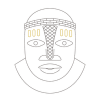
Beaded forehead band

The Udahae is a forehead band made from coral beads and worn by chiefs. Sometimes a white Igan (feather) from the Oɛɣohɔ (vulturine fish eagle) is tucked into the left side of the Udahae. According to Benin oral tradition, the Udahae was introduced by Ọba Ezoti, the first son of Ọba Ewuare I. During his coronation, Ezoti was shot in the forehead with a poisoned arrow. To stop the bleeding, a band of red beads was wrapped around his forehead while he made public appearances. Fourteen days later, he died from his wound. Since then, Benin chiefs have worn the red-beaded Udahae around their foreheads to commemorate the cap used by Ezoti to stop the bleeding (Egharevba 1968, p. 21).

1 annotation
Udahae
Forehead markings
Ikharo
Forehead markings

Ikharo are linear keloid markings depicted on the forehead of Uhunmwu-Elao (commemorative heads) in groups of three or four above each eye. The exact meaning of Ikharo is debated; some have argued that they relate to the gender or tribal identification of the person on whom they are depicted. For example, Gabriel Ọbazee has argued that they were worn only by men; however, their use in depictions is not consistent with this, and the Iy’Ọba are also shown wearing them. Flora Kaplan argued that they are instead a stylistic feature employed by artists that varied over time.

The naming of these markings differs between publications. For example, Ekhaguosa Aisien and Joseph Nevadomsky describe these markings as “agbaguda n'ehae”, which they write translates literally as “blades of the forehead”. However, Aisien later went on to call these “ikharo”, as used here. Kate Ezra referred to these forehead markings as ikharo, meaning “tribal mark [of eye]”.

1 annotation
Ikharo
Colar Bead
Odigba
Coral beaded collar

Odigba (beaded collar) is a rigid neck collar made of beads, worn as part of ceremonial attire only by senior princes who have been made Enigie. Although Ibafe (2007, p. 43) argued that the Odigba was introduced during the Ogiso period (c. 900–c. 1170 AD) by Ogiso Ere, along with other symbolically important Emwin Arre, such as the Ada (ceremonial sword) and the Ebẹn (ceremonial sword). The Odigba was initially made of beads, while coral was incorporated only later, following its introduction through trade with Portuguese merchants in the late fifteenth century.

1 annotation
Odigba
Feather
Igan
Feather

Igan (feathers) are commonly depicted tucked into the headdresses and hats of chiefs represented on Emwin Arre (royal treasures). These feathers are from the Oɛɣohɔ (vulturine fish eagle) and symbolise respected old age and proper chieftaincy.

1 annotation
Igan

Provenance

5 events
Production
unknown to February 22, 1897 (day approximate)
Production of Uhunmwu-Elao by the Igbesamwan guild
Loot
February 19, 1897 (day approximate) to June 1899 (month approximate)
Looting of the Emwin Arre - Inalienable Cultural Artefacts - during the Invasion of the Benin Kingdom in February 1897 and until the end of overt military activity in June 1899
Exhibition
1900
Ivory Coast Pavillon at the Universal Exhibition of 1900
Donation
1900
Donated to the Trocadéro Museum by the Comité de la Côte d'Ivoire
Rehousing
2003 to 2006
Establishment of the musée du quai Branly - Jacques Chirac

Related archival documents

1 documents
See all
Image not provided by the institution.
Accession Record
musée du quai Branly - Jacques Chirac
73.1964.5 (La Reine Margot)
Date
December 6, 1963

Institution data

musée du quai Branly - Jacques Chirac
The data was transferred directly by the institution.
Last updated: 2022-09-27
Language: french
Institution fieldValue
Numéro d'objet
object id
71.1900.44.1
ObjectID
object id
198929
Tri titres
designation
Tête anthropomorphe
Description
description
Tête de chef en bois. Hachures représentant une coiffure en perles. De chaque côte de la tête, deux anses, sculptées en chevrons. Au-dessus de l'oreille gauche, figuration d'une plume. Marques es et pupilles en bois noir incrusté. Ouverture derrière la tête et au sommet de l'occiput.
Matériaux et techniques
material
production technique
Bois
Dimensions
dimensions
40 x 16,5 x 19 cm, 2766 g
Date
date made
avant 1900
Toponyme
production place
Afrique > Afrique occidentale > Nigéria
Unité patrimoniale
production place
Afrique
Provenance historique
provenance
Autres numéros : 50591 M.E : Sans renseignement, 50591 : MET - Inventaire, 00.44.1 : MH - Inventaire, 00.45.1 : MH - Inventaire (numéro erroné).
Culture
ethnic attribution
Ethnonyme
ethnic attribution
Edo
Date d'entrée dans les collections nationales
accession date
1900-12-03 00:00:00
Mode d'entrée
accession method
Don manuel
Statut de l'objet
display status
Inscription à l'inventaire
Bibliographie
bibliography
Références publiées
bibliography
Crédits photographiques
license
musée du quai Branly - Jacques Chirac
Donateur
prior owner
Comité de la Côte d'Ivoire, Exposition universelle de 1900
Usage
Tête en bois pour le culte aux ancêtres placée sur un autel cheffal
Sensitive content

Sensitive Content Digital Benin includes colonial material that may contain inaccurate, derogatory or harmful language relating to African and African diasporic communities. Such language may appear in catalogue records, transcriptions, and book, exhibition or museum titles. We recognize that this material may cause distress. Sensitive-content warnings are being implemented across the collection, but this process is ongoing. The language does not reflect Digital Benin’s views; we take an anti-colonial and anti-racist position and are committed to centring the humanity of historically marginalised communities.

Read more about our approach