Loading...
Relief Plaque
Relief Plaque
Object Number
1979.206.97
Edo designations
English designations
Categories
Institution Location
1000 5th Ave, New York, NY 10028, United States
Object Number
1979.206.97
Edo designations
English designations
Relief Plaque
Categories
Palace Architecture & Ornamentation
Institution Location
1000 5th Ave, New York, NY 10028, United States

Iconographies

10 annotations

Fish
Ehẹn
Fish

Ehẹn is a general term used to describe various types of fish. Although mudfish are one of the most common motifs in Benin art, other kinds of fish are also represented. According to Blackmun, a greater variety of fish are represented on the Aken'ni Elao (carved tusks) than on other types of royal artefacts. According to Kathy Curnow, fish appear on 70 Ama-Ẹrọnmwọn (bronze relief plaques), making them the most commonly represented animal. Despite their prevalence, the precise species of fish are not easy to identify due to their “generic renderings”, possibly indicating that artists did not always distinguish between specific varieties. Fish are represented on the Ama-Ẹrọnmwọn both in profile and from above.

1 annotation
Ehẹn
Bell
Ẹroro
Bell

Ẹroro (bells) frequently appear as ornaments worn by figures depicted on the Emwin Arre, particularly on Ama-Ẹrọnmwọn (bronze relief plaques) and Aken’ni Elao (carved tusks). These Ẹroro are most commonly quadrangular in form or, less commonly, cylindrical with rounded tops. Quadrangular Ẹroro worn around the neck are often part of the attire that indicates that figures can be interpreted as warriors, alongside the Akọn Ẹkpẹn (leopard tooth neck ornament) and the Ohian Ẹkpẹn (leopard tunics).

1 annotation
Ẹroro
Water fern
Ebe Amẹ
Water Fern

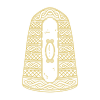
Ebe Amẹ refers to a wide variety of plants, particularly the leaves of the water fern or river leaf, found in riverine areas of southern Nigeria. Artists from the Igun-Ẹrọnmwọn used these as a decorative motif in the background of most Ama-Ẹrọnmwọn (bronze relief plaques). The petals of the Ebe Amẹ, like the points of the ἀghàdàgháda (crossroads), represent the four cardinal directions: north, east, south, and west. The number four plays a foundational role in the Edo calendar, which is structured around four market days.

1 annotation
Ebe Amẹ
leopard teeth
Akọn Ẹkpen
Leopard Teeth Neck Ornament

Akọn Ẹkpẹn are necklaces or neck ornaments made of strung leopard’s teeth. They are worn by figures to signify their high rank and military prowess, as well as by their leaders, the Ezọmọ or Iyasẹ. They are often worn alongside quadrangular Ẹroro (bells) and Ohian Ẹkpẹn (leopard tunics).

The Akọn Ẹkpẹn is clearly and profoundly related to the symbolism of the Ẹkpẹn (leopard) and its association with the Ọba (king), who is metaphorically referred to as ‘ẹkpẹn ne owa’, the ‘leopard of the home’. On the other hand, the Ẹkpẹn is often referred to as the ‘king of the bush’, embodying ferocity, aggression, strength, and leadership—qualities attributed to the Ọba. This intricate link between the leopard, the monarch, and his military leaders reinforces the complex hierarchy and spiritual authority central to Benin’s courtly art.

1 annotation
Akọn Ẹkpen
Headwear
Ẹrhu
Headwear

Many different kinds of Ẹrhu (headwear) are worn by the various figures depicted in the imagery of Benin royal artefacts. Through comparisons with ceremonial regalia still worn by chiefs and members of the royal court, including the Ọba himself, some Ẹrhu have been used to identify the different figures depicted. For example, the conical hat worn by high-ranking town chiefs as part of the pangolin regalia, still worn at ceremonies, is also visible on figures on some Ama-Ẹrọnmwọn (bronze relief plaques). Other examples include the distinctive bell-shaped helmet associated with the Iyasẹ. Figures who wear a shallow-brimmed hat and a cross have been identified as Ewua or Ohensa priests.

Different kinds of helmets and headwear were worn by warriors, reflecting the many different ranks and roles in the army at any given time, as well as developing trends that were in turn represented on Emwin Arhe created at different points in time. Warrior figures wearing helmets covered in cowrie shells were carved on the Aken'ni Elao (carved tusks) (Blackmun 1984, p. 330), yet on the brass Ama, warriors are sometimes depicted wearing helmets made from crocodile hide or horsehair with a front plate (Osadolor in Plankensteiner 2007, cat. no. 238, p. 457). Helmets made from horsehair with a front plate are one of the more common types represented on the Ama-Ẹrọnmwọn, and the demand for black horse tails was noted by both Portuguese and British traders during the late 17th and 18th centuries (Osadolor in Plankensteiner 2007, cat. no. 238, p. 457). Other warriors depicted on Ama-Ẹrọnmwọn wear helmets with a rounded top, chinstrap, and sometimes also a feather tucked into the left side. These types of headwear are known as Ẹrhu Iyokuo.

Attire worn for battle also differed from that worn for ceremonial occasions, such as the pointed headwear worn in combination with an ornate leopard-head tunic by war chiefs. Depictions of figures wearing this attire on brass Ama-Ẹrọnmwọn (bronze relief plaques) have been interpreted as representing the war chiefs’ participation in the war-ritual Isiokuo festival (Osadolor in Plankensteiner 2007, cat. no. 238, p. 457).

Another distinctive form of headwear is that worn by figures identified as leopard hunters on the brass Ama-Ẹrọnmwọn (relief plaques). These large helmets cover almost all of the leopard hunters’ faces except for their noses, eyes, and upper lips, and are made of an unusual material that remains unidentifiable (Plankensteiner 2007, cat. nos. 68–69, p. 322).

European figures are also portrayed with distinctive hats, such as Portuguese three-cornered hats. These depictions reflect the artists’ keen observation and highlight the impact of European trade and military assistance (Ezra 1992).

1 annotation
Ẹrhu
Shield
Asa
Shield

Asa (shields) are a crucial attribute of warriors and warrior chiefs, forming part of their ceremonial and battle attire as represented on the Emwin Arre (royal treasures). Asa were usually made from elephant or crocodile skin and used by warriors for protection during hand-to-hand combat. Interestingly, the form of Asa depicted on historic royal artefacts differs from those found in museum collections today, reflecting changes in shield shapes and designs over time.

1 annotation
Asa
Leopard tunic
Ohian Ẹkpẹn
Leopard tunic

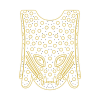
The Ohian Ẹkpẹn is a significant ceremonial garment in Benin royal court art, primarily associated with warriors and military officials, underscoring their delegated authority and ferocious skill as warriors.

The leopard tunic is typically made from leather and cloth decorated to imitate leopard skin, usually with the face of a leopard emblazoned on the chest using appliqué. An Akọn Ẹkpẹn (leopard tooth neck ornament) and quadrangular Ẹroro (bells) are often worn on top of the Ohian Ẹkpẹn. This tunic would be worn by the Ọba’s military chiefs.

In historical Benin, the Ọba held the exclusive right to distribute leopard skins to those officials to whom he delegated the power to take human life. This made the leopard tunic a potent symbol of delegated authority over life and death. Osarhieme Benson Osadolor recalled an Edo proverb: “It is the head of the leopard that accomplishes things for the leopard,” which is particularly significant for warrior chiefs, as this proverb indicates that the Ọba, known as the “Leopard of the Home,” relied on them to carry out his military campaigns.

1 annotation
Ohian Ẹkpẹn
Uhanbọ & Ifẹnmwẹ
Uhanbọ & Ifẹnmwẹ
Bow & Arrow

Uhanbọ (bows) and Ifẹnmwẹ (arrows) were produced by members of the Iwifenmwen (guild of archers and manufacturers of poisoned arrows). Arrows, particularly poisoned arrows, were used in warfare. When depicted on Emwin Arre (royal treasures), Uhanbọ and Ifẹnmwẹ are believed to represent Ake, the deity of archery. According to Aisien, Ake was an expert marksman who lived during the reign of Ọba Ẹwuare (c. 1440–1473 AD) and is credited with inventing the poisoned arrow used in hunting and warfare.

2 annotations
Uhanbọ & Ifẹnmwẹ
Uhanbọ & Ifẹnmwẹ
Warrior
Ọkhọn Okuo
Warrior

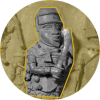
The frequency with which Ọkhọn Okuo (Benin warriors) are depicted in Emwin Arre (royal treasures) reflects the importance of the army and military to the Kingdom, as well as the role of royal art as an archive in which artists from the palace guilds recorded important people, events, and institutions. The army was organised into a number of regiments, with soldiers grouped according to the weapons they used, including archers, swordsmen, crossbowmen, and spearmen.

Warrior figures are frequently shown carrying weapons such as Asa (shields), Asoro (spears), warfare swords such as the Umozo or Ọhọ (executioners’ or warfare swords), Uhanbọ (bows), Ẹkpẹde (crossbows), and Ifẹnmwẹ (arrows), which were sometimes poisoned, as well as Osisi (firearms). Their dress also provides important indications of their military role. On both the Aken'ni Elao (carved tusks) and Ama-Ẹrọnmwọn (bronze relief plaques), warriors are depicted in a relatively standardised form, typically wearing an Ohian Ẹkpẹn (leopard tunic), Akọn Ẹkpen (leopard’s tooth neck ornament), an Ẹroro pendant around the neck, and the Uko ugbo-ohamwen (fortified chest band).

Differences are particularly apparent in the warriors’ headwear, both between individual figures and between representations on Aken'ni Elao and Ama-Ẹrọnmwọn. On the Ama - Eronmwon, the most common forms of headwear are crocodile-hide helmets and horsetail helmets with a front plate. On the Aken'ni Elao, some warriors wear double-horned helmets, while others wear simple rounded hats or helmets. The most frequently represented warrior type on the tusks, however, wears a helmet with cowries sewn onto a front panel.

1 annotation
Ọkhọn Okuo

Provenance

7 events
Production
1504 (approximate) to 1550 (approximate)
Production of the Ama-Ẹrọnmwọn by the Igun-Ẹrọnmwọn guild in Benin City
Loot
February 19, 1897 (day approximate) to June 1899 (month approximate)
Looting of the Emwin Arre - Inalienable Cultural Artefacts - during the Invasion of the Benin Kingdom in February 1897 and until the end of overt military activity in June 1899
Unknown
1920s to 1949
The object is known to have come into contact with Josef von Sternberg.
Purchase
1949
The object was purchased by Julius Carlebach from Josef von Sternberg.
Purchase
1949
The object was purchased by Nelson Aldrich Rockefeller from Julius Carlebach and Julius Carlebach Gallery.
Loan
1958 to 1978
The object was loaned by Nelson Aldrich Rockefeller to New York Museum of Primitive Arts.
Bequest
1979
N. A. Rockefeller bequest to the Metropolitan Museum of Art, 1979

Institution data

Metropolitan Museum of Art
The data was transferred directly by the institution.
Last updated: 2021-07-30
Language: english
Institution fieldValue
Object Number
object id
1979.206.97
Object Sort Number
object id
1979 206 97
Primary Rendition No
object id
1979.206.97
Title
designation
object type
Plaque: Warrior and Fish
Medium
material
Brass
Dimensions
dimensions
H. 18 x W. 12 x D. 2 1/4 in. (45.8 x 30.5 x 5.7 cm)
Classification
object type
Metal-Sculpture
Date
date made
16th–17th century
Geo: City
production place
Court of Benin
Geo: Country
production place
Nigeria
Credit Line
prior source
The Michael C. Rockefeller Memorial Collection, Bequest of Nelson A. Rockefeller, 1979
Provenance
provenance
Joseph von Sternberg (1894–1969), Vienna, New York, Hollywood, until 1949; [Julius Carlebach Gallery, New York, until 1949]; Nelson A. Rockefeller, New York, 1949, on permanent loan to The Museum of Art, New York, August 1958–1978Court of Benin Objects in the Michael C. Rockefeller Wing, Metropolitan Museum of Art
Dynasty
reign associated name
Oranmiyan
Culture
ethnic attribution
Edo peoples
ExhibitionHistory
exhibition history
Benin Bronzes Museum of Art, May 20, 1959–September 6,1959 Africa: Images and Realities St. Paul Gallery, MN, June 12, 1962–September 2,1962 Art from Africa, Oceania, and the Americas Lent by theMPA The Society of the Four Arts, March 7, 1964–March 29,1964 Humble Treasures University of St. Thomas, Houston, October 14, 1965–December 5,1965 The World of Art Museum of Art, July 12, 1966–September 11,1966 Benin Museum of Fine Arts, Houston, September 21, 1968–November 24,1968 New Orleans Museum of Art, December 15, 1968–January 15,1969 Art of Oceania, Africa and the Americas from The Museum of Art The Metropolitan Museum of Art, May 10, 1969–August 17,1969 Sculpture of : Nigeria &Cameroon The Metropolitan Museum of Art, June 23, 1971–March 19,1972 African Art from the Museum of Art Museum of Art, Rhode Island School of Design, October 12,1972–November 19, 1972 The Art of Nigeria and Cameroon South Huntington Public Library, New York, February 5, 1973–March30, 1973
Bibliography
bibliography
The Metropolitan Museum of Art. Art of Oceania, Africa, and the Americas from the Museum of Art. New York: The Metropolitan Museum of Art, 1969, no. 366.
Published References
bibliography
Sensitive content

Sensitive Content Digital Benin includes colonial material that may contain inaccurate, derogatory or harmful language relating to African and African diasporic communities. Such language may appear in catalogue records, transcriptions, and book, exhibition or museum titles. We recognize that this material may cause distress. Sensitive-content warnings are being implemented across the collection, but this process is ongoing. The language does not reflect Digital Benin’s views; we take an anti-colonial and anti-racist position and are committed to centring the humanity of historically marginalised communities.

Read more about our approach