Loading...
Relief Plaque
Relief Plaque
Object ID
1958.58
Edo designations
English designations
Categories
Institution Location
10 Art Museum Dr, Baltimore, MD 21218, United States
Object ID
1958.58
Edo designations
English designations
Relief Plaque
Categories
Palace Architecture & Ornamentation
Institution Location
10 Art Museum Dr, Baltimore, MD 21218, United States

Iconographies

2 annotations
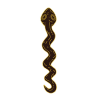
snake
Ẹyẹn
Snake

Ẹyẹn (snakes) are among the most common animals depicted by Edo artists on the Emwin Arre (royal treasures). The varied depictions of these reptiles suggest different snake species, including the Ikpin (python), Arhunmoto (puff adder), and Olose (red-black striped snake); therefore, here we use the generic term for snake: Ẹyẹn.

The identification of snake motifs and depictions as Ikpin, as well as the importance accorded to this species, is a subject of scholarly debate. Paula Ben-Amos argued that the Edo admired the “stature, colouration and crushing power” of the python, which was in turn associated with Olokun. She went on to identify the brass figures of snakes that formerly adorned the roof of the palace, as well as several other snakes, as pythons. Joseph Nevadomsky argued instead that the importance of the Ikpin had been overstated.

Some of these snake representations may in fact be the Arhunmwoto (puff adder). The first to suggest this was the German curator Felix von Luschan in his early research into the Benin royal treasures. Nevadomsky suggested that the large head, narrow neck, and rough scales are indicative of either the puff adder, a symbol of “material wealth, tribute, and gifts,” or the Gaboon viper.

Another kind of snake that may be depicted is the Olose (red-black striped snake). It has the praise name “king of the snakes” in Edo. Olose is also closely connected to the deity Olokun, both because of its attractiveness and because it inhabits wet environments such as forest streams, which in turn flow into rivers and the sea, where Olokun lives. Although the exact meanings of these different snakes vary, they share the characteristic of being spiritually powerful creatures.

1 annotation
Ẹyẹn
Water fern
Ebe Amẹ
Water Fern

Ebe Amẹ refers to a wide variety of plants, particularly the leaves of the water fern or river leaf, found in riverine areas of southern Nigeria. Artists from the Igun-Ẹrọnmwọn used these as a decorative motif in the background of most Ama-Ẹrọnmwọn (bronze relief plaques). The petals of the Ebe Amẹ, like the points of the ἀghàdàgháda (crossroads), represent the four cardinal directions: north, east, south, and west. The number four plays a foundational role in the Edo calendar, which is structured around four market days.

1 annotation
Ebe Amẹ

Provenance

5 events
Production
1504 (approximate) to 1550 (approximate)
Production of the Ama-Ẹrọnmwọn by the Igun-Ẹrọnmwọn guild in Benin City
Loot
February 19, 1897 (day approximate) to June 1899 (month approximate)
Looting of the Emwin Arre - Inalienable Cultural Artefacts - during the Invasion of the Benin Kingdom in February 1897 and until the end of overt military activity in June 1899
Unknown
February 22, 1897 (day approximate) to 1900
The object is known to have come into contact with Augustus Henry Pitt-Rivers (Lane Fox) and Farnham Pitt-Rivers Museum.
Unknown
1950 (approximate) to 1958
The object is known to have come into contact with John J. Klejman.
Purchase
1958
The object was purchased by the Baltimore Museum of Art from John J. Klejman and J. J. Klejman Gallery through Alan Wurtzburger.

Institution data

Baltimore Museum of Art
The data was transferred directly by the institution.
Last updated: 2021-03-04
Language: english
Institution fieldValue
Object ID
object id
1958.58
Object Name
designation
object type
Plaque with Snake
Description
description
Medium
material
Copper alloy
Dimensions
dimensions
15 9/16 x 7 11/16 x 1 1/4 in. (39.5 x 19.5 x 3.2 cm.)
Century
date made
16th century
Date
date made
16th century
Origin
production place
Kingdom of Benin, Nigeria
Credit Line
prior source
Purchase with exchange funds from Gift of Alan Wurtzburger
Provenance
provenance
The Baltimore Museum of Art, by purchase, 1958-present; Ex. JJ Klejman Gallery, by purchase (?), ?? - 1958, Ex. Pitt Rivers Museum (inv. no. 6442 or 6449)
Collection Area
place collected
AFRICAN
Reign
reign associated name
Esigie (r. 1517-1550s) and Orhogbua (r. 1550s-1570s)
Culture
ethnic attribution
Edo
Department
department and institution
Africa, the Americas, Asia, and the Pacific Islands
Notes
notes
Publication History
bibliography
Sensitive content

Sensitive Content Digital Benin includes colonial material that may contain inaccurate, derogatory or harmful language relating to African and African diasporic communities. Such language may appear in catalogue records, transcriptions, and book, exhibition or museum titles. We recognize that this material may cause distress. Sensitive-content warnings are being implemented across the collection, but this process is ongoing. The language does not reflect Digital Benin’s views; we take an anti-colonial and anti-racist position and are committed to centring the humanity of historically marginalised communities.

Read more about our approach