Loading...


idno
1950.266 B
Institution
Omo n'Oba n'Edo Uku Akpolokpolo, Ọba of Benin & National Commission for Museums and Monuments, Nigeria Restituted
Previously owned by Museum of Archaeology and Anthropology, University of Cambridge
Edo designations

English designations
Categories
Institution Location
1 Adesogbe (Plymouth) Road, P.M.B. 1115, Benin City , Edo State
idno
1950.266 B
Institution
Omo n'Oba n'Edo Uku Akpolokpolo, Ọba of Benin & National Commission for Museums and Monuments, Nigeria Restituted
Previously owned by Museum of Archaeology and Anthropology, University of Cambridge
Edo designations
English designations
Udo-Style Head
Categories
Altar & Shrine Objects
Heads
Institution Location
1 Adesogbe (Plymouth) Road, P.M.B. 1115, Benin City , Edo State
Iconographies
2
annotations
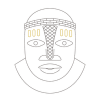
Ikharo
Forehead markings
1 annotation


Odigba
Coral beaded collar
1 annotation

Provenance
6
events
Institution data
Museum of Archaeology and Anthropology, University of Cambridge
The data was transferred directly by the institution.
Last updated: 2022-07-18
Language: english
| Institution field | Value |
|---|---|
idno object id | 1950.266 B |
local edo designation | |
Physical description/0 description | Catalogue card for 1950.266 A-B notes 'Two female heads, apparently tusk-holders, with many-stringed necklaces, of bronze.' |
Physical description/1 description | |
Physical description/2 description | |
Physical description/3 description | |
Physical description/4 description | |
d_Description Name description | Bronze female head, used as a tusk holder, cast in the Udo style |
height dimensions | 212 mm |
length dimensions | 166 mm |
width dimensions | 150 mm |
weight weight | 4.8 kg |
Inscription inscriptions | |
Labels - Markings/0 inscriptions | |
Labels - Markings/1 inscriptions | |
Labels - Markings/2 inscriptions | |
Labels - Markings/3 inscriptions | |
Labels - Markings/4 inscriptions | |
Labels - Markings/5 inscriptions | |
period date made | 15th - 16th century |
maker producer | ?Igun Eronmwon (royal guild of brass casters) |
d_Place production place | Africa; West Africa; Nigeria; [Kingdom of Benin]; Edo State; Benin City; Oba’s Palace |
Other owners prior source | |
source prior source | Green, Frederick William [donor]; ?Benin Expedition [?collector] |
Collection or Excavation Year date collected | 1897 |
culture group ethnic attribution | Edo |
source date accession date | 1950 |
Amendments - updates/0 notes | Bequeathed by Frederick William Green (1869-1949), Honorary Keeper of Antiquities at the Fitzwilliam Museum, Cambridge from 1908 to 1949. There is no documentation on Green's acquisition but it is typical of the ‘bronzes’ looted as part of the Benin Expedition , 1897. Some objects retain the white sale numbers which can be connected to the sales of dealer William Webster. Webster has therefore been added to the source field where known with queries to indicate the lack of available data for a definite provenance |
Amendments - updates/1 notes | |
Amendments - updates/2 notes | |
Amendments - updates/3 notes | |
Amendments - updates/4 notes | |
Exhibition/0 exhibition history | |
Exhibition/1 exhibition history | |
Reference Numbers bibliography | 1950.266 B |
References/0 bibliography | Catalogue to the exhibition: Ebin, V. and Swallow, D. A. (1984) The Proper Study of Mankind: Great Anthropological Collections in Cambridge. Cambridge University Museum of Archaeology and Anthropology |
References/0 2 bibliography | |
References/1 bibliography | |
Related Documents/0 bibliography | Catalogue card reads, in blue ink: "50.266 A/B | Africa | Nigeria / Two female heads, apparently tusk-holders, with many-stringed necklaces, of bronze / A. 9 ins high. / B. 8 [ins high]. / Benin. / F.W. Green bequest." In second hand, blue ink: [below "Benin"] "Note: W.B. Fagg says that these are a local style, from UDO, + may not be female." In third hand, black ink: [beside measurements for A] "[Exchanged with British Museum]" In fourth hand, black ink at bottom of card: "-Centenary Exhibition" Two circular red stickers, on top right and bottom left of card. |
Related Documents/1 bibliography | |
Related Documents/2 bibliography | |
Related Documents/3 bibliography | |
Related Documents/4 bibliography | |
Related Documents/5 bibliography | |
Related Documents/6 bibliography | |
Acquisition Details/0 provenance | |
Acquisition Details/1 provenance | |
Acquisition Details/2 provenance | |
Analysis/0 | In January 2017, Prof. Marcos Martinon-Torres and Agnese Benzonelli, UCL Institute of Archaeology, tested this idno using a portable XRF as part of a programme of base metal analysis of Benin material. This object was tested twice and the results are as follows: 1) Cu: 88.83%; Zn: 3.82%; Sn: 3.49%; Pb: 2.36%. 2) Cu: 88.42%; Zn: 3.72%; Sn: 3.50%; Pb: 2.81%. It was noted as Dark 6, Willett 3 but a low Zn reading and a high Sn reading may be Willett 2. According to Willett this would date to 15th-16th century but according to Riederer this would probably date to the end of the 16th century. |
Analysis/1 | |
Archaeology | |
Auction - Sale/0 provenance | |
Auction - Sale/1 provenance | |
CMS Context/0 | |
CMS Description description | |
Catalogue | |
Display/0 exhibition history | Part of MAA's Centenary Exhibition, held in the Adeane gallery, at the Fitzwilliam Museum, 12 March- 6 May 1984, and the Sainsbury Centre for the Visual Arts, Norwich, 2 July- 16 September 1984. |
Display/1 exhibition history | Exhibited in the Benin case, Andrews Gallery, 20 March 2017- present. |
Display/2 exhibition history | |
Display/3 exhibition history | |
Field_collection/0 provenance | |
Field_collection/1 provenance | |
Found_together - assemblage | |
Freezing | |
Online Only | |
Other/0 | |
Other/1 | |
Production - use | Catalogue card for 1950.266 A-B notes "W.B. Fagg says that these are a local style, from UDO, and may not be female". |
Remedial/0 | |
Remedial/1 | |
Surface Clean | |
unknown |
Sections
About
Other
Sensitive content
Sensitive Content Digital Benin includes colonial material that may contain inaccurate, derogatory or harmful language relating to African and African diasporic communities. Such language may appear in catalogue records, transcriptions, and book, exhibition or museum titles. We recognize that this material may cause distress. Sensitive-content warnings are being implemented across the collection, but this process is ongoing. The language does not reflect Digital Benin’s views; we take an anti-colonial and anti-racist position and are committed to centring the humanity of historically marginalised communities.