Loading...
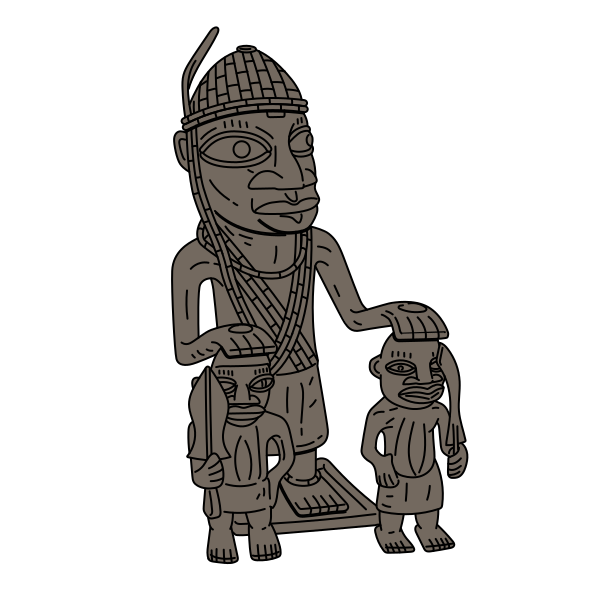
Male Figure
Male Figure
OBJEKTE_ID
1712982
Edo designations
English designations
Categories
Institution Location
Johannispl. 5-11, 04103 Leipzig, Germany
OBJEKTE_ID
1712982
Edo designations
English designations
Male Figure
Categories
Figures
Institution Location
Johannispl. 5-11, 04103 Leipzig, Germany

Iconographies

6 annotations

Headwear
Ẹrhu
Headwear

Many different kinds of Ẹrhu (headwear) are worn by the various figures depicted in the imagery of Benin royal artefacts. Through comparisons with ceremonial regalia still worn by chiefs and members of the royal court, including the Ọba himself, some Ẹrhu have been used to identify the different figures depicted. For example, the conical hat worn by high-ranking town chiefs as part of the pangolin regalia, still worn at ceremonies, is also visible on figures on some Ama-Ẹrọnmwọn (bronze relief plaques). Other examples include the distinctive bell-shaped helmet associated with the Iyasẹ. Figures who wear a shallow-brimmed hat and a cross have been identified as Ewua or Ohensa priests.

Different kinds of helmets and headwear were worn by warriors, reflecting the many different ranks and roles in the army at any given time, as well as developing trends that were in turn represented on Emwin Arhe created at different points in time. Warrior figures wearing helmets covered in cowrie shells were carved on the Aken'ni Elao (carved tusks) (Blackmun 1984, p. 330), yet on the brass Ama, warriors are sometimes depicted wearing helmets made from crocodile hide or horsehair with a front plate (Osadolor in Plankensteiner 2007, cat. no. 238, p. 457). Helmets made from horsehair with a front plate are one of the more common types represented on the Ama-Ẹrọnmwọn, and the demand for black horse tails was noted by both Portuguese and British traders during the late 17th and 18th centuries (Osadolor in Plankensteiner 2007, cat. no. 238, p. 457). Other warriors depicted on Ama-Ẹrọnmwọn wear helmets with a rounded top, chinstrap, and sometimes also a feather tucked into the left side. These types of headwear are known as Ẹrhu Iyokuo.

Attire worn for battle also differed from that worn for ceremonial occasions, such as the pointed headwear worn in combination with an ornate leopard-head tunic by war chiefs. Depictions of figures wearing this attire on brass Ama-Ẹrọnmwọn (bronze relief plaques) have been interpreted as representing the war chiefs’ participation in the war-ritual Isiokuo festival (Osadolor in Plankensteiner 2007, cat. no. 238, p. 457).

Another distinctive form of headwear is that worn by figures identified as leopard hunters on the brass Ama-Ẹrọnmwọn (relief plaques). These large helmets cover almost all of the leopard hunters’ faces except for their noses, eyes, and upper lips, and are made of an unusual material that remains unidentifiable (Plankensteiner 2007, cat. nos. 68–69, p. 322).

European figures are also portrayed with distinctive hats, such as Portuguese three-cornered hats. These depictions reflect the artists’ keen observation and highlight the impact of European trade and military assistance (Ezra 1992).

1 annotation
Ẹrhu
Colar Bead
Odigba
Coral beaded collar

Odigba (beaded collar) is a rigid neck collar made of beads, worn as part of ceremonial attire only by senior princes who have been made Enigie. Although Ibafe (2007, p. 43) argued that the Odigba was introduced during the Ogiso period (c. 900–c. 1170 AD) by Ogiso Ere, along with other symbolically important Emwin Arre, such as the Ada (ceremonial sword) and the Ebẹn (ceremonial sword). The Odigba was initially made of beads, while coral was incorporated only later, following its introduction through trade with Portuguese merchants in the late fifteenth century.

1 annotation
Odigba
Round Neck Bead
Ikele
Coral bead circlet

Ikele is a single stiff string or circlet of coral beads. It is worn by chiefs, such as senior chiefs who have been made Enigie (Inneh 2007, p.107), and is a sign of nobility and rank. The Ikele may only be worn once the Ọba has conferred a person with the right to wear the beads, and the Ikele must always be worn when appearing before the Ọba. According to Ekhaguosa Aisien when a chief is wearing the Ikele, they may not eat nor drink in public, and they “constitute an embassy of the Benin Palace wherever he might be.”

1 annotation
Ikele
Container
Uko
Container

Uko are flask-shaped containers with globular bodies and narrow openings, which could be made from calabash or cast in brass. The Uko depicted on Emwin Arhre (royal treasures) are usually worn around the neck or waist of figures, particularly those identified as ritual specialists or warriors, suggesting that they may have contained protective or ritual substances. Figures on Ama-Ẹrọnmwọn (bronze relief plaques) are sometimes shown holding or pouring from larger Uko, likely referencing the presentation of offerings during ceremonies and festivals. Uko motifs also decorate the flanges of Ikẹgobọ (altars to the hand), where they may similarly reference vessels used to contain liquid offerings.

1 annotation
Uko
Iconography image
Ẹbẹn
Ceremonial Sword

Ẹbẹn are a type of ceremonial sword of significant importance in the Benin Kingdom. During ceremonies, titled chiefs would hold them or toss them during dances, thereby paying homage to the Ọba at these public events, particularly when a chief receives a certain status. It is forbidden for Ẹbẹn to touch the ground, so the chief must take extra precautions to avoid dropping the Ẹbẹn during the dance. Therefore, the Okae-Odionmwan (head of executioners) dances with the Umozo (warfare or executioner’s sword) behind the dancing chief.

There are two central ceremonial swords used in the royal court of the Benin Kingdom, one of which is the Ẹbẹn, along with the Ada (ceremonial swords). They are distinguished by their blades: the Ẹbẹn blade reflects the shape of a leaf or an oar. Sometimes, it is decorated with openwork designs and/or brass inlays, most commonly shaped as small Ẹbẹn and Ẹkpẹn (leopards). The handle of the Ẹbẹn also has an unusual ring-shaped form, which further differentiates it from the Ada.

1 annotation
Ẹbẹn
Bell
Ẹroro
Bell

Ẹroro (bells) frequently appear as ornaments worn by figures depicted on the Emwin Arre, particularly on Ama-Ẹrọnmwọn (bronze relief plaques) and Aken’ni Elao (carved tusks). These Ẹroro are most commonly quadrangular in form or, less commonly, cylindrical with rounded tops. Quadrangular Ẹroro worn around the neck are often part of the attire that indicates that figures can be interpreted as warriors, alongside the Akọn Ẹkpẹn (leopard tooth neck ornament) and the Ohian Ẹkpẹn (leopard tunics).

1 annotation
Ẹroro

Provenance

4 events
Production
unknown to 1989
The object was produced by Unknown member(s) of the Igun-Ẹrọnmwọn guild.
Purchase
unknown to 1989
The object was purchased by Mr. & Mrs. Esche.
Unknown
1989 (approximate)
The object is known to have come into contact with Mr. & Mrs. Esche and later with the Linden-Museum Stuttgart, Staatliches Museum für Völkerkunde.
Donation
December 19, 1991
The object was donated by the Linden-Museum Stuttgart, Staatliches Museum für Völkerkunde to the Staatliche Ethnographische Sammlungen Sachsen und Staatliche Kunstsammlungen Dresden.

Institution data

Staatliche Ethnographische Sammlungen Sachsen und Staatliche Kunstsammlungen Dresden
The data was transferred directly by the institution.
Last updated: 2021-09-28
Language: german
Institution fieldValue
INV_NR
object id
70910
OBJEKTE_ID
object id
1712982
KURZTITEL
designation
Figur mit Zeremonialschwert
Object-name-and-materials
designation
material
tanzender Oba mit Zeremonialschwert Gelbguss
TITEL
designation
Figur mit Zeremonialschwert
INTERNETKOMMENTAR
description
notes
Dargestellt ist ein tanzender Oba, der das Zeremonialschwert eben schwingt. Es könnte sich um eine Figur für eine Altargruppe handeln. Nicht alle kommen nach dem Guss zum Einsatz und werden dann verkauft. Die Erwerbungsgeschichte im 20. Jh. deutet auf eine Entstehung nach der historischen Zeit des Benin-Reiches hin. Es fällt mit großer Wahrscheinlichkeit in die Zeit nach der Wiederaufnahme des Bronzegusses in der Igun-Street nach 1914, der sich dem Kunstmarkt zu öffnen begann. (MVD, S. D.)
KATALOGTEXT
description
MATERIAL
material
Metall
MASSEBEMERKUNG
dimensions
39,5 x 10,5 x 8,5 cm|H: 40 cm (lt. Karteikarte)
MASSETABANGABE
dimensions
gesamt
MASSETABBEMERKUNG
dimensions
MASSETABBREITE
dimensions
10,5
MASSETABDURCHMESSER
dimensions
MASSETABEINHEITLAENGE
dimensions
cm
MASSETABEINHEITLAENGE_IDS
dimensions
1
MASSETABHOEHE
dimensions
39,5
MASSETABTIEFE
dimensions
8,5
Dimensions_weight
weight
H: 39,5 cm W: 10,5 cm X: 8,5 cm
MASSETABEINHEITGEWICHT
weight
MASSETABEINHEITGEWICHT_ID
weight
MASSETABGEWICHT
weight
OBJEKTBEZ
object type
Plastik
KONVOLUT
provenance
object count
SES Benin-Objekte
ORT_DATUM_BIS
date made
1989;1989
ORT_DATUM_KONKRET
date made
';'
ORT_DATUM_VON
date made
1914;
MATTECHBEMERKUNG
production technique
Gelbguss
TECHNIK
production technique
gegossen
ORTE
production place
Benin City;Benin City
ORTZEITBEMERKUNG
production place
Nigeria, Benin City, 20. Jh. (wohl 1914-1989)
Ort_Zeit-Bemerkung
production place
Nigeria, Benin City, 20. Jh. (wohl 1914-1989)
REGIONEN
production place
Benin
Collector/Previous-owner
prior source
Purchased by Mr. & Ms. Esche, Filderstadt near Stuttgart before 1989
ERWERBUNG
prior source
Schenkung 19.12.1991 vom Linden-Museum Stuttgart
PERSON
prior source
unbekannt;Linden-Museum Stuttgart
Acquisition-Details
provenance
Donated by Linden-Museum Stuttgart on 19 December 1991
EIGENTUEMER
provenance
SES/Freistaat Sachsen
PROVENIENZ
provenance
Ehepaar Esche, Filderstadt bei Stuttgart (erworben vor 1989); Linden-Museum Stuttgart (bis 1991)
PROVENIENZSTATUS
provenance
SKD-Eigentum
EREIGNISSE
event
Herstellung;Provenienz
ETHNIEN
ethnic attribution
Institution
department and institution
Staatliche Ethnographische Sammlungen Sachsen - Museum für Völkerkunde Dresden
MUSEUM
department and institution
MVD
Institutional-acquisition-date
accession date
1991
Comments
notes
PRAESENZ
display status
nicht ausgestellt
BIBLIOGRAPHIE
bibliography
ERWAEHNTIN
bibliography
LITERATUR
bibliography
LIT_LITERATUR
bibliography
BILDUNTERSCHRIFT
images
Übernahme Altdaten|Region original: Großregion => Westafrika; Land => Nigeria; Gebiet => Benin-Stadt, Edo|Ethnie original: kein Eintrag|Region bei Datenübergabe: Afrika>Westafrika>Nigeria>Benin
ALTINVENTARE
AUTHENTIZITAETSZUSATZ
;
AUTHZUSAETZE_IDS
;
Additional-IDs
object id
Dokumentname
70910_1; 70910_3
EREIGNISSE_IDS
12;15
ETHNIEN_IDS
ETH_AUTHZUSAETZE
ETH_AUTHZUSAETZE_IDS
ETH_EREIGNISSE
ETH_EREIGNIS_IDS
FERTIG
1
FLAG
EXP
FOTOFELD
FUNKTION
Hersteller;Vorbesitzer
GEAENDERT_AM
17.05.2021
GLEICHRANGIG
GND_ID_OBEZ
22955
GND_ID_SCHLAGWORT
8866;18315;22955;262747;94811
GRUNDDATEN
1
INTERNETFREIGABE
1
INVENTURDATUM
INVNR_MERKMALE_IDS
KONVOLUTE_IDS
959
KOORDINATEN
(6,33504 5,62749);(6,33504 5,62749)
LEIHVERKEHR
exhibition history
LIT_ABBILDUNG
LIT_BAND_SEITE
LIT_BEMERKUNG
LIT_LITERATUR_IDS
LIT_NUMMERE
LIT_STA_INETFREIGABE
MAND_ID
1
MATERIALIEN_IDS
1233
MERKMAL
MUSEEN_ID
35
ORTE_IDS
2347283;2347283
ORT_AUTHZUSAETZE
;
ORT_AUTHZUSAETZE_IDS
;
ORT_BEZUG
;
ORT_EREIGNISSE
Herstellung;Erwerbung
ORT_EREIGNISSE_IDS
12;9
PND_BEZUG
;
PND_FUNKTIONEN_IDS
-2;127
PND_INETFREIGABE
1;0
PND_PERSONEN_IDS
12797488;12821988
PRAESENZEN_WERT_ID
-67
PROVSTATUS_WERT_ID
-43
REGIONEN_IDS
612
REG_EREIGNISSE
Erwerbung
REG_EREIGNIS_IDS
9
SAMMLUNG
Afrika
SAMMLUNGEN_ID
535
SCHLAGWORT
Altar;König;Plastik;Schwert <Motiv>;Waffe <Motiv>
TECHNIKEN_IDS
75
UNTERGEORDNET
VORLAGEN
WEITERE_NUMMERN
object id
WISSENSCHAFT
1
XRAY
###
Sensitive content

Sensitive Content Digital Benin includes colonial material that may contain inaccurate, derogatory or harmful language relating to African and African diasporic communities. Such language may appear in catalogue records, transcriptions, and book, exhibition or museum titles. We recognize that this material may cause distress. Sensitive-content warnings are being implemented across the collection, but this process is ongoing. The language does not reflect Digital Benin’s views; we take an anti-colonial and anti-racist position and are committed to centring the humanity of historically marginalised communities.

Read more about our approach