Loading...


ObjectID
155384
Institution
Brooklyn Museum Edo designations

English designations
Categories
Institution Location
200 Eastern Pkwy, Brooklyn, NY 11238, United States
ObjectID
155384
Institution
Brooklyn Museum Edo designations
English designations
Pendant Mask
Categories
Ceremonial Regalia
Institution Location
200 Eastern Pkwy, Brooklyn, NY 11238, United States
Iconographies
3
annotations

Udahae
Beaded forehead band
1 annotation


Ititi ako
Star beads
1 annotation

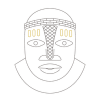
Ikharo
Forehead markings
1 annotation

Provenance
6
events
Institution data
Brooklyn Museum
The data was transferred directly by the institution.
Last updated: 2021-06-30
Language: english
| Institution field | Value |
|---|---|
ObjectID object id | 155384 |
Title designation object type | Hip Ornament with Human Face (Uhunmwun-ekue) |
Description description | Human face with ornate adornments. Semi-circular "crown" extends above forehead with lattice-like area and three 5-lobed decorations at center. Small, globular forms around edge. At forehead, five strands of "beads." Above each eye, three vertical incised lines. Band of incised lines from center of brow to tip of nose. Seven strands of beads represented around lower edge of face. Extending from beaded strands, series of conical projections, resembling ruffled collar; loops attached to each flaring element. Five small, figure-eight shaped wires attached to loops. |
Medium material | Copper alloy, iron |
Dimensions dimensions | 6 13/16 × 4 5/16 × 2 1/4 in. (17.3 × 11 × 5.7 cm) |
Inscriptions inscriptions | faint evidence of a number in white along the PR side of the base, possibly "B60(?).8.513" |
Alpha Sort 2 date made | 18th century (possibly) |
Begin Date date made | 1701 |
Geography production place | Place made: Benin City, Royal Court of Benin, Edo State, Nigeria, Africa |
Credit Line prior source | Gift of Beatrice Riese |
Provenance provenance | Prior to 1965, provenance not yet documented; by 1965, reportedly John Hewitt, London; by 1965, acquired by Merton D. Simpson Gallery, New York; 1965, purchased and traded for by Beatrice Riese, New York; 1994, gift of Beatrice Riese to the Brooklyn Museum. |
Alpha Sort ethnic attribution | Edo |
Maker ethnic attribution | Edo |
Exhibition History exhibition history | Brooklyn Museum, "African Innovations," Long-term Installation, August 12, 2011 - September 28, 2014. Brooklyn Museum, “Arts of Africa,” Long-term Installation, May 24, 2001 - June 26, 2011. |
Published References bibliography | |
Object Number object id | 1994.143 |
Sort Number | 1994 143 |
Sections
About
Other
Sensitive content
Sensitive Content Digital Benin includes colonial material that may contain inaccurate, derogatory or harmful language relating to African and African diasporic communities. Such language may appear in catalogue records, transcriptions, and book, exhibition or museum titles. We recognize that this material may cause distress. Sensitive-content warnings are being implemented across the collection, but this process is ongoing. The language does not reflect Digital Benin’s views; we take an anti-colonial and anti-racist position and are committed to centring the humanity of historically marginalised communities.