Loading...


ObjectID
154352
Institution
Brooklyn Museum Edo designations

English designations
Categories
Institution Location
200 Eastern Pkwy, Brooklyn, NY 11238, United States
ObjectID
154352
Institution
Brooklyn Museum Edo designations
English designations
Pendant Mask
Categories
Ceremonial Regalia
Institution Location
200 Eastern Pkwy, Brooklyn, NY 11238, United States
Iconographies
3
annotations

Udahae
Beaded forehead band
1 annotation


Ititi ako
Star beads
1 annotation

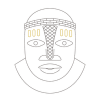
Ikharo
Forehead markings
1 annotation

Provenance
8
events
Institution data
Brooklyn Museum
The data was transferred directly by the institution.
Last updated: 2021-06-30
Language: english
| Institution field | Value |
|---|---|
ObjectID object id | 154352 |
Title designation object type | Pendant Mask (Uhunmwun-ekue) |
Description description | Human face of copper alloy, semi-circular portion above forehead lattice-like, hollow designs bordered by a wide solid band. Ears at edge of each side at forehead level. Six tear drop shaped elements across forehead. Eyes oval-shaped with slightly protruding pupils at center. Eyes rimmed with slightly raised ridge, with lightly incised horizontal lines. Nose long with pronounced nostrils. Heart shaped mouth with clearly delineated upper and lower lips. Rounded chin. Bottom of head from eye level to chin rimmed with a wide decorative band. Two loops on upper and lower inside rim. Reverse unornamented. |
Medium material | Copper alloy, iron |
Dimensions dimensions | 7 3/4 × 4 5/16 × 1 3/4 in. (19.7 × 11 × 4.5 cm) |
Inscriptions inscriptions | |
Alpha Sort 2 date made | 19th century |
Begin Date date made | 1801 |
Geography production place | Place made: Benin City, Royal Court of Benin, Edo State, Nigeria, Africa |
Credit Line prior source | Gift of Dorothy Robbins |
Provenance provenance | Prior to 1987, provenance not yet documented; by 1939, reportedly acquired by Harry Beasley; before 1987, reportedly acquired by John Wise, New York; June 29, 1987, Sotheby's, London, lot 184; May 10, 1988, Sotheby's, New York, lot 141; before 1993, Dorothy Robbins, New York; 1993, gift of Dorothy Robbins to the Brooklyn Museum. |
Alpha Sort ethnic attribution | Edo |
Maker ethnic attribution | Edo |
Exhibition History exhibition history | Dayton Art Institute, Dayton, OH, January 18, 2003 - January 18, 2006. Dayton Art Institute, Dayton, OH, "Looking Forward, Looking Black," July 13 - September 8, 2002. "Tradition and Transition: African Art from the Brooklyn Museum of Art." Williams College of Art, Williamstown MA. XX - Jan. 2000. |
Published References bibliography | |
Object Number object id | 1993.180.15 |
Sort Number | 1993 180 15 |
Sections
About
Other
Sensitive content
Sensitive Content Digital Benin includes colonial material that may contain inaccurate, derogatory or harmful language relating to African and African diasporic communities. Such language may appear in catalogue records, transcriptions, and book, exhibition or museum titles. We recognize that this material may cause distress. Sensitive-content warnings are being implemented across the collection, but this process is ongoing. The language does not reflect Digital Benin’s views; we take an anti-colonial and anti-racist position and are committed to centring the humanity of historically marginalised communities.