Loading...
irn
106842
Institution
National Gallery of Australia Edo designations

English designations
Categories
Institution Location
Parkes Pl E, Parkes ACT 2600, Australia
irn
106842
Institution
National Gallery of Australia Edo designations
English designations
Udo-Style Head
Categories
Altar & Shrine Objects
Heads
Institution Location
Parkes Pl E, Parkes ACT 2600, Australia
Iconographies
1
annotations

Odigba
Coral beaded collar
1 annotation

Provenance
5
events
Institution data
National Gallery of Australia
The data was transferred directly by the institution.
Last updated: 2021-10-26
Language: english
| Institution field | Value |
|---|---|
irn object id | 106842 |
Main Title designation object type | Head in the Udo style |
Materials and Technique material | cast brass with iron (?) inlay |
Dimensions dimensions | 23.8 x 16.0 x 16.0 x cm |
Date Created date made | late 16th century |
Creators producer | Bini people |
Place Of Creation production place | Nigeria |
Provenance provenance | collection of Jacob Epstein (1880–1959); collection of A. Schwarz, Amsterdam; at auction, Sotheby's London, 8 July 1980; when bought by the Australian National Gallery, Canberra, July 1980 The collecting history of this work of art is partial. Its location and ownership are unknown between its creation and entering Epstein's collection. The National Gallery of Australia welcomes further information regarding its history of ownership prior to 1980. |
Credit Line accession date | Purchased 1980 |
Exhibited exhibition history | Arts Council of Great Britain, London 1967; Zurich 1970; In Our Own Image: Figurative Sculpture from the National Gallery of Australia [NGA Travelling Exhibition], 27 April 1994–23 June 1995; National Gallery of Australia, Canberra, December |
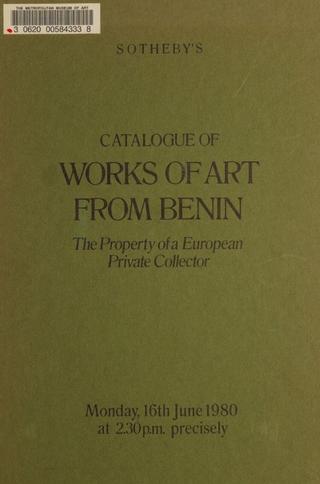
Literature bibliography | Felix von Luschan, Die Altertümer von Benin, Berlin and Leipzig: De Gruyter 1919 (reprinted New York: Hacker Art Books 1968), vol.3, rf pl.57, illus. b&w as ‘koepfe von kindren’; Akitola Akpata, ‘Benin: notes on altars and bronze heads’ and ‘Bronze head and ring: A suggestion,’ Ethnologia Cramoresis #1, 1937; Elsy Leuzinger, The Art of Black Africa , London: Studio Vista 1972, K29, pp.168–69, illus. b&w, as ‘collection: A Schwartz, Amsterdam’; Eliot Elisofun and William Fagg, The Sculpture of Africa, New York: Hacker Art Books 1958 (reprinted 1978), cat.158–59, illus. b&w p.127 as ‘Memorial head’ and p.255 as ‘J J Klejman Gallery, New York’; Works of Art from Benin, Sotheby’s, London, 16 June 1980, lot 9, pp.24–25, illus.; Ekpo Eyo and Frank Willett, Treasures of ancient Nigeria, New York: Knopf 1980 |
Accession Number object id | 803674 |
Sections
About
Other
Sensitive content
Sensitive Content Digital Benin includes colonial material that may contain inaccurate, derogatory or harmful language relating to African and African diasporic communities. Such language may appear in catalogue records, transcriptions, and book, exhibition or museum titles. We recognize that this material may cause distress. Sensitive-content warnings are being implemented across the collection, but this process is ongoing. The language does not reflect Digital Benin’s views; we take an anti-colonial and anti-racist position and are committed to centring the humanity of historically marginalised communities.