Loading...
Accession Number: (Registration Details)/Accession Details/Accession Number/Accession No.: (Accession Details)
0.3998.a-f
Institution
Manchester Museum Edo designations

English designations
Categories
Institution Location
Oxford Rd, Manchester M13 9PL, UK
Accession Number: (Registration Details)/Accession Details/Accession Number/Accession No.: (Accession Details)
0.3998.a-f
Institution
Manchester Museum Edo designations
English designations
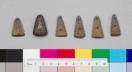
Charm
Categories
Personal Adornment
Institution Location
Oxford Rd, Manchester M13 9PL, UK
Iconographies
1
annotations

Ubanu'hi
Inifinity Symbol
1 annotation

Provenance
4
events
Institution data
Manchester Museum
The data was transferred directly by the institution.
Last updated: 2022-06-24
Language: english
| Institution field | Value |
|---|---|
Accession Number: (Registration Details)/Accession Details/Accession Number/Accession No.: (Accession Details) object id | 0.3998.a-f |
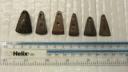
Physical Description designation description | Six charms: Each is a wedge shaped piece of bronze. Charm a to d are flat with incised designs, and e is more rounded with a plaited strap work design. |
Object Name/Object Name: (Classification) object type | Charm |
Place: (Production Details) production place | Africa, Nigeria, Yergum Africa, Benin |
Accession Lot: (Collection Details)/Accession Lot: (Accession Details) prior source | [0.3998] Darbishire, Robert Dukinfield - Whitworth Trust (1926) |
Origin provenance | Nigeria, Benin. Donated by Robert Dukinfield Darbishire on behalf of the Whitworth Trust in 1926. Nigeria, Benin. Note on KEEMU states that an ‘old card’ contained the following: ‘UMANANGOA: Worn by people taking part in the AGUE Festival.’ |
Current Location/Current Location: (Current Location) display status | [CP1/B56/102/D/Box] Manchester Museum - Coupland 1 - Basement - B.56 - Ethnology Store - Cupboard 102 - Shelf D - In Box |
Copyright license | © The Manchester Museum, The University of Manchester Images (.tiff): © The Manchester Museum, The University of Manchester, photography by Michael Pollard |
Correspondence Transcripts |
Sections
About
Other
Sensitive content
Sensitive Content Digital Benin includes colonial material that may contain inaccurate, derogatory or harmful language relating to African and African diasporic communities. Such language may appear in catalogue records, transcriptions, and book, exhibition or museum titles. We recognize that this material may cause distress. Sensitive-content warnings are being implemented across the collection, but this process is ongoing. The language does not reflect Digital Benin’s views; we take an anti-colonial and anti-racist position and are committed to centring the humanity of historically marginalised communities.