Loading PDF
Correspondence
Unit
Sjögren, ÅkeInstitution
Statens museer för världskultur Date
February 13, 1898
Locations
Bicester, GB
Actors
Source actors
Webster, William Downing
Target actors
Stolpe, Hjalmar
Correspondence
Unit
Sjögren, ÅkeInstitution
Statens museer för världskultur Date
February 13, 1898
Locations
Bicester, GB
Actors
Source actors
Webster, William Downing
Target actors
Stolpe, Hjalmar
Previous document
Next document
Institution data
| Institution field | Value |
|---|---|
Arkivdokument | Webster to Stolpe_1898-02-13 |
Alternativ identitet | EM-Ö1-006 |
Samlingsnummer - Beskriver | 1900.01 |
Sakord | brev ; letter |
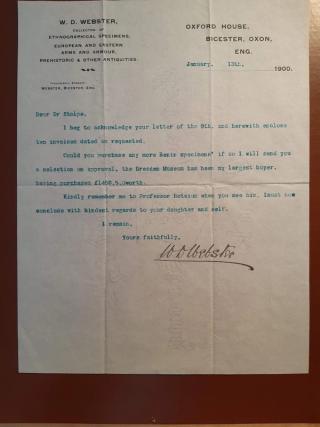
Beskrivning - engelska | Letter from W.D. Webster to H. Stolpe describing the nature of his trade with "Benin specimens", their high value and great interest from museums to buy. "Last week I purchased two specimens for £60. Every time they come into the market, the [sic] go up in price, but I buy it all, as I have many museums wanting to buy." Webster also refers to an earlier, previously unknown, sending of Benin objects to Stockholm and he asks Stolpe to make a decision on taking up the option of purchase before the end of the year. References to General Pitt Rivers buying a lot of Benin objects (£1,300 worth) and the museum in Berlin competing with Pitt Rivers for the largest collection after the British Museum. Finally, Webster advises Stolpe to persuade business man Åke Sjögren to acquire "one of the large tusks. They cost from £50 to £100 each. I have sold three at £80 each, it will be impossible to get one at [any?] price soon. |
Namn - tillverkare | Webster, William Downing (1868-05-11 - 1913-02-14), konsthandlare, samlare |
Sökord | Benin City |
FILE | Webster+to+Stolpe_1898-02-13_01.jpg |
URL | https://collections.smvk.se/carlotta-em/web/object/25899167 |
Tidpunkt - tillverkning, tidigast | 1898-02-13 |
Namn - mottagare | Stolpe, Hjalmar (1841 - 1905), arkeolog, etnograf, intendent |
Sections
About
Other
Sensitive content
Sensitive Content Digital Benin includes colonial material that may contain inaccurate, derogatory or harmful language relating to African and African diasporic communities. Such language may appear in catalogue records, transcriptions, and book, exhibition or museum titles. We recognize that this material may cause distress. Sensitive-content warnings are being implemented across the collection, but this process is ongoing. The language does not reflect Digital Benin’s views; we take an anti-colonial and anti-racist position and are committed to centring the humanity of historically marginalised communities.