Loading PDF
Correspondence
Unit
Sjögren, ÅkeInstitution
Statens museer för världskultur Date
May 7, 1900
Locations
Bicester, GB
Actors
Source actors
Webster, William Downing
Target actors
Stolpe, Hjalmar
Correspondence
Unit
Sjögren, ÅkeInstitution
Statens museer för världskultur Date
May 7, 1900
Locations
Bicester, GB
Actors
Source actors
Webster, William Downing
Target actors
Stolpe, Hjalmar
Previous document
Next document
Institution data
| Institution field | Value |
|---|---|
Arkivdokument | Webster to Stolpe_1900-05-07 |
Alternativ identitet | EM-Ö1-006 |
Samlingsnummer - Beskriver | 1900.01 |
Sakord | brev ; letter |
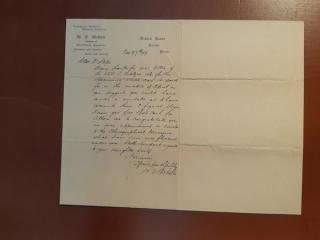
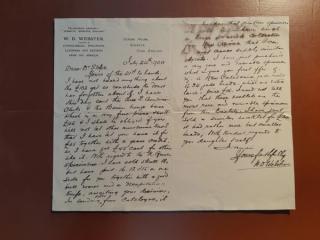
Beskrivning - engelska | Letter from Webster to Stolpe where he asks Stolpe to kindly settle his account for the purchase of Benin objects, "as I have been buying very heavily of late..." Webster also announces that he soon will be visiting Sweden as well as St Petersburg on business, and that he hopes to be able to visit one of Stolpe‘s excavations. |
Namn - tillverkare | Webster, William Downing (1868-05-11 - 1913-02-14), konsthandlare, samlare |
Sökord | Benin City |
FILE | Webster+to+Stolpe_1900-05-07_01.jpg |
URL | https://collections.smvk.se/carlotta-em/web/object/25901162 |
Tidpunkt - tillverkning, tidigast | 1900-05-07 |
Namn - mottagare | Stolpe, Hjalmar (1841 - 1905), arkeolog, etnograf, intendent |
Sections
About
Other
Sensitive content
Sensitive Content Digital Benin includes colonial material that may contain inaccurate, derogatory or harmful language relating to African and African diasporic communities. Such language may appear in catalogue records, transcriptions, and book, exhibition or museum titles. We recognize that this material may cause distress. Sensitive-content warnings are being implemented across the collection, but this process is ongoing. The language does not reflect Digital Benin’s views; we take an anti-colonial and anti-racist position and are committed to centring the humanity of historically marginalised communities.