OBJEKTE_ID
1711062
Edo designations
English designations
Relief Plaque
Categories
Palace Architecture & Ornamentation
Location
Johannispl. 5-11, 04103 Leipzig, Germany
Loading...

Iconographies

6 annotations
Oko/Akohẹn
Horn/Flute

Akohẹn, or ivory horns, are played by members of the Ikpakoen (guild of ivory hornblowers), while Oko, or flutes, are played by members of the Ikpeziken (guild of royal flute players). Among the Emwin Arhe (royal treasures), Oko and Akohẹn are usually depicted being played by brass-cast figures representing members of these guilds, and also appear on Ama-Ẹrọnmwọn (bronze relief plaques), Aken'ni Elao (carved altar tusks), and Urhotọ (altar tableau).

Today in Benin City, when a public procession leaves the palace, a court official may sound side-blown horns made from ivory. Historically, these instruments were also used during warfare, where they were played alongside Ema (drums) and Ẹroro (bells), producing a “cacophony of sound” whose “[t]he psychological effect of the barrage of noise magnified the size of Benin’s forces” ( ).

Some Oko/Akohẹn were also cast in brass by members of the Igun-Ẹrọnmwọn. However, these brass examples are understood not to have been functional instruments and could not have been blown like their ivory counterparts ( ).

1 annotation
Oko/Akohẹn
Ẹrhu
Headwear

Many different kinds of Ẹrhu (headwear) are worn by the various figures depicted in the imagery of Benin royal artefacts. Through comparisons with ceremonial regalia still worn by chiefs and members of the royal court, including the Ọba himself, some Ẹrhu have been used to identify the different figures depicted. For example, the conical hat worn by high-ranking town chiefs as part of the pangolin regalia, still worn at ceremonies, is also visible on figures on some Ama-Ẹrọnmwọn (bronze relief plaques) ( ). Other examples include the distinctive bell-shaped helmet associated with the Iyasẹ ( ). Figures who wear a shallow-brimmed hat and a cross have been identified as Ewua or Ohensa priests ( ).

Different kinds of helmets and headwear were worn by warriors, reflecting the many different ranks and roles in the army at any given time, as well as developing trends that were in turn represented on Emwin Arhe created at different points in time. Warrior figures wearing helmets covered in cowrie shells were carved on the Aken'ni Elao (carved tusks) (Blackmun 1984, p. 330), yet on the brass Ama, warriors are sometimes depicted wearing helmets made from crocodile hide or horsehair with a front plate (Osadolor in Plankensteiner 2007, cat. no. 238, p. 457). Helmets made from horsehair with a front plate are one of the more common types represented on the Ama-Ẹrọnmwọn, and the demand for black horse tails was noted by both Portuguese and British traders during the late 17th and 18th centuries (Osadolor in Plankensteiner 2007, cat. no. 238, p. 457). Other warriors depicted on Ama-Ẹrọnmwọn wear helmets with a rounded top, chinstrap, and sometimes also a feather tucked into the left side. These types of headwear are known as Ẹrhu Iyokuo.

Attire worn for battle also differed from that worn for ceremonial occasions, such as the pointed headwear worn in combination with an ornate leopard-head tunic by war chiefs. Depictions of figures wearing this attire on brass Ama-Ẹrọnmwọn (bronze relief plaques) have been interpreted as representing the war chiefs’ participation in the war-ritual Isiokuo festival (Osadolor in Plankensteiner 2007, cat. no. 238, p. 457).

Another distinctive form of headwear is that worn by figures identified as leopard hunters on the brass Ama-Ẹrọnmwọn (relief plaques). These large helmets cover almost all of the leopard hunters’ faces except for their noses, eyes, and upper lips, and are made of an unusual material that remains unidentifiable (Plankensteiner 2007, cat. nos. 68–69, p. 322).

European figures are also portrayed with distinctive hats, such as Portuguese three-cornered hats. These depictions reflect the artists’ keen observation and highlight the impact of European trade and military assistance (Ezra 1992).

1 annotation
Ẹrhu
Ukpọn
Wrapper

Ukpọn is the Edo term for cloth (Aigbe 1985, p. 55; Ọbazee 2025, p. 542) and is used here to refer to the wrappers or kilts worn by many of the figures depicted on the Emwin Arre (royal treasures). The cloth worn around the waist may be plain, but it is more commonly richly decorated with motifs associated with the monarchy, power, and wealth, such as the Ọba'nui (infinity symbol) and Uhunme Ikpotoki (Portuguese heads).

The Benin Kingdom was renowned for its textile production, both for local use and for trade ( ). Within the royal court, members of the Owina n’Ido produced ukhuen cloth for the Ọba and other members of the court, who wore it as wrappers during festivals and ceremonies ( ).

Alongside locally produced textiles, imported cloth was also an important commodity in the Benin Kingdom’s trade networks. Textiles were exchanged with neighbouring production centres, particularly Ijebu ( ), while European traders brought silks, woollens, linens, and cotton from Europe and Asia from the 15th century onwards ( ).

1 annotation
Ukpọn
Aghadaghada
Crossroads

According to , this motif is known as Aghadaghada, a “play on the word ada,” meaning “crossroads.” The design appears as a background motif on a small number of Ama-Ẹrọnmwọn (bronze relief plaques) and is associated with Olokun and the period of close contact between the Benin Kingdom and the Portuguese Empire during the reigns of Ọba Ọzọlua, Ọba Ẹsigie, and Ọba Orhogbua ( ). At the time of Ben-Amos’s research, the same symbol was drawn in chalk at the centre of Olokun shrine courtyards in Benin City. described the design more literally as a “circled cross” and suggested that the Ama-Eronmwon bearing this background motif may have been cast by a particular ‘master’ or member of the Igun-Ẹrọnmwọn.

More broadly, the cross, with its four points, references the number four, which has significance in Edo belief: the Edo week consists of four days, and each day is divided into four parts ( ). Other cross forms are treated as distinct motifs and are discussed separately under Uman-Ague (equal-armed cross).

1 annotation
Aghadaghada
Ikoro
Armcuff

Ikoro (armcuffs) are made from different materials using different techniques, including brass sheet, cast bronze, and ivory. They were crafted by different guilds depending on the material used: artists of the Igun-Ẹrọnmwọn cast them in brass or hammered and incised them from brass sheet, whereas artists of the Igbesamwan carved ivory Ikoro. Ikoro were made in different qualities, from rather simple examples with abstract geometric decoration to finely carved ivory examples with brass or copper inlays. Ikoro are worn in pairs on both forearms by chiefs and the Ọba during ceremonies and festivals. Figures depicted on the Emwin Arhe (royal treasures) are often shown wearing such pairs.

1 annotation
Ikoro
tribal marks
Iwu
Facial and Body Markings

Iwu are facial and body markings (scarifications) that were historically worn by Edo men and women. However, since the 1960s, the practice has been nearly extinct (Aisien 2011). In the past, Iwu were used as a way of proving that one was an Edo citizen, and the ceremony of having Iwu completed was an important rite of passage for men and women. The Osiwu, who also practised circumcision and other surgical procedures, would carry out the procedure of adding Iwu. There are different types of Iwu: ‘blades’ worn on the torso (Iwu-eko), and those worn on the face, such as Ikharo (three or four markings above the eyebrows), Irho (two narrow ‘blades’ worn on each cheek), Ovbihue (nasal ‘blades’), Ovbi-agbanmwen (chin ‘blade’), and Igho-okpa/Ukpgho (three forehead ‘blades’) (Aisien 2011, p. 22).

The number of Iwu also varied depending on the identity of the person wearing them. For example, royal men would wear six ‘blades’ on their torso, whilst men who were not royal would wear seven ‘blades’. Meanwhile, the Ọba’s female children would wear fifteen ‘blades’, and all other women would wear sixteen (Aisien 2011).

1 annotation
Iwu

Provenance

5 events
Production
1504 (approximate) to 1550 (approximate)
The object was produced by Unknown member(s) of the Igun-Ẹrọnmwọn guild in Benin City.
Looted
February 22, 1897 (day approximate) to June 1899 (year approximate)
The object was looted by Unknown member of the British colonial military campaign on Benin - February 1897 from Benin Kingdom.
Unknown
February 22, 1897 (day approximate) to 1899
The object is known to have come into contact with William Downing Webster, later in Bicester.
Purchase
1899
The object was purchased by Arthur Baessler from William Downing Webster from Bicester to Berlin.
Donation
1899
The object was donated by Arthur Baessler to the Staatliche Ethnographische Sammlungen Sachsen und Staatliche Kunstsammlungen Dresden from Berlin to Dresden.

Related archival documents

4 documents
See all
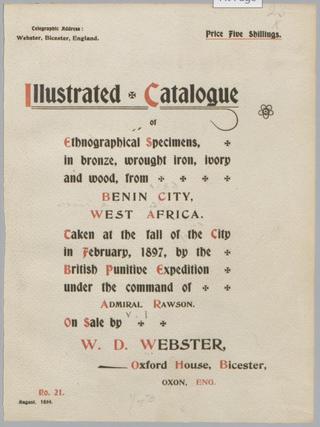
An archival document representing a Sales Catalog of 32 page(s)
Sales Catalogue
Metropolitan Museum of Art
Thomas J. Watson Library sales and auction catalogues
Date
August 1, 1899 to August 31, 1899
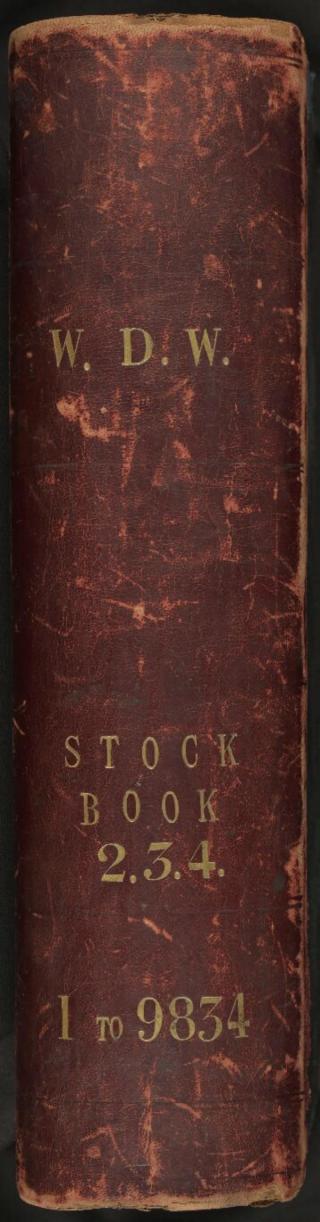
An archival document representing a Inventories of 404 page(s)
Inventory
Museum of New Zealand Te Papa Tongarewa
Stock books
Date
January 18, 1897 to March 26, 1900
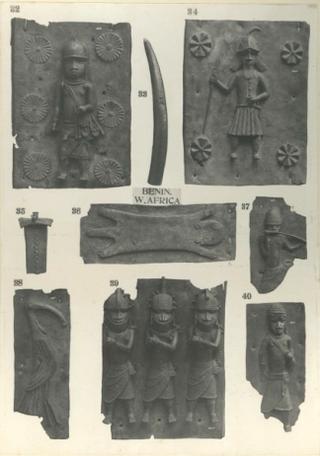
An archival document representing a Photograph Album of 2 page(s)
Photograph Album
British Museum
W. D. Webster photograph album
Date
January 1, 1898 to December 31, 1899

Institution data

Staatliche Ethnographische Sammlungen Sachsen und Staatliche Kunstsammlungen Dresden
The data was transferred directly by the institution.
Last updated: 2021-09-28
Language: german
Institution fieldValue
INV_NR
object id
16090
OBJEKTE_ID
object id
1711062
KURZTITEL
designation
Reliefplatte mit Hornbläser
Object-name-and-materials
designation
material
Reliefplatte mit königlichem Hornbläser Gelbguss
TITEL
designation
Reliefplatte mit königlichem Hornbläser;Bronzeplatte mit 1 Krieger
INTERNETKOMMENTAR
description
notes
Der königliche Hornbläser am Hof des Benin-Königs signalisiert mit dem Rufton aus einer Elfenbein- oder Metalltrompete die Ankunft und Anwesenheit des Königs. (MVD, S. D.)
KATALOGTEXT
description
MATERIAL
material
Metall;Bronze
MASSEBEMERKUNG
dimensions
30 x 17,5 x 4 cm, 1557 g
MASSETABANGABE
dimensions
Gesamt
MASSETABBEMERKUNG
dimensions
MASSETABBREITE
dimensions
17
MASSETABDURCHMESSER
dimensions
MASSETABEINHEITLAENGE
dimensions
cm
MASSETABEINHEITLAENGE_IDS
dimensions
1
MASSETABHOEHE
dimensions
30
MASSETABTIEFE
dimensions
4
Dimensions_weight
weight
H: 30 cm W: 17,5 cm X: 4 cm M: 1557 g
MASSETABEINHEITGEWICHT
weight
g
MASSETABEINHEITGEWICHT_ID
weight
8
MASSETABGEWICHT
weight
1557
OBJEKTBEZ
object type
Plastik
KONVOLUT
provenance
object count
Sammlung Arthur Baessler; SES Benin-Objekte; William D. Webster, London; SES Dossier Benin-Objekte, Überlieferung an die Kontaktstelle für Sammlungsgut aus kolonialen Kontexten
ORT_DATUM_BIS
date made
1897;1899
ORT_DATUM_KONKRET
date made
';'
ORT_DATUM_VON
date made
;
MATTECHBEMERKUNG
production technique
Gelbguss
TECHNIK
production technique
gegossen
ORTE
production place
Federal Republic of Nigeria;Benin City
ORTZEITBEMERKUNG
production place
Königreich Benin, vor 1897
Ort_Zeit-Bemerkung
production place
Königreich Benin, vor 1897
REGIONEN
production place
Benin
Collector/Previous-owner
prior source
Arthur Baessler, Berlin, purchased from William D. Webster, London, in 1899
ERWERBUNG
prior source
Schenkung 1899 von Arthur Baessler, Berlin
PERSON
prior source
unbekannt;Baessler, Arthur;Webster, William Downing
Acquisition-Details
provenance
Donated by Arthur Baessler, Berlin
EIGENTUEMER
provenance
SES/Freistaat Sachsen
PROVENIENZ
provenance
William D. Webster, London (bis 1899); Arthur Baessler, Berlin (erworben 1899 von William D. Webster, bis 1899)
PROVENIENZSTATUS
provenance
SKD-Eigentum
EREIGNISSE
event
Herstellung;Provenienz;Provenienz
ETHNIEN
ethnic attribution
Edo
Institution
department and institution
Staatliche Ethnographische Sammlungen Sachsen - Museum für Völkerkunde Dresden
MUSEUM
department and institution
MVD
Institutional-acquisition-date
accession date
1899
Comments
notes
Arthur Baessler, 1857-1907, German Ethnologist and Athropologist; William Downing Webster, 1868-1913, English Dealer and Collector of Ethnographica
PRAESENZ
display status
verliehen
BIBLIOGRAPHIE
bibliography
'- Dolz, Silvia: Ernst Ludwig Kirchners Begegnung mit dem Fremden in Dresden um 1910. in: Hrsg.: Haldemann/Henze/Nommsen: Kirchner Neu Denken [Tagungsband 28.Juni-1.Juli 2018], S. 139-147|- Silvia Dolz: Schätze aus Afrika: Benin. Die Schenkung Baessler [Au
ERWAEHNTIN
bibliography
Dolz, 2018, Abb. 18|MVD, 2006, S. 23 u. Abb. 38|Luschan, 1919, S. 192 u. Anm. 2 Nr. 1 (?)|Wolf, 1965, Tafel 3 + 4
LITERATUR
bibliography
Gunsch, K.W.: The Benin Plaques: A Singular Monument. in: Art. N° 88 Summer 2018. S. 98-113|
LIT_LITERATUR
bibliography
Deimel 2006 [Schätze aus Afrika, ...];Bodrogi 1967;Wolf 1965;Wolf 1965;Gunsch 2018;Luschan 1919;Wysocki Gunsch 2018;Kirchner [2018]
BILDUNTERSCHRIFT
images
Übernahme Altdaten|Region original: Großregion => Westafrika; Land => Nigeria; Gebiet => Benin|Ethnie original: kein Eintrag|Region bei Datenübergabe: Afrika>Westafrika>Nigeria>Benin
ALTINVENTARE
AUTHENTIZITAETSZUSATZ
;;
AUTHZUSAETZE_IDS
;;
Additional-IDs
6932 (original number)
Dokumentname
16090_1
EREIGNISSE_IDS
12;15;15
ETHNIEN_IDS
2796
ETH_AUTHZUSAETZE
ETH_AUTHZUSAETZE_IDS
ETH_EREIGNISSE
Sammelereignis
ETH_EREIGNIS_IDS
17
FERTIG
1
FLAG
EXP
FOTOFELD
ja|Neg.Tasche Nr. 326/39,40
FUNKTION
Hersteller;Schenker;Händler
GEAENDERT_AM
14.06.2021
GLEICHRANGIG
GND_ID_OBEZ
22955
GND_ID_SCHLAGWORT
116012;118242;21285;22165;22955;22976;24148;35264
GRUNDDATEN
1
INTERNETFREIGABE
1
INVENTURDATUM
INVNR_MERKMALE_IDS
581
KONVOLUTE_IDS
582;959;1409;1191
KOORDINATEN
(10 8);(6,33504 5,62749)
LEIHVERKEHR
LIT_ABBILDUNG
38;98;3;4 (Rückansicht);;;Fig. 6.66 3B;18
LIT_BAND_SEITE
Seite 43;S. 121;Bd. 24 / Taf.;Bd. 24 / Taf.;S. 98-113;S. 192;S. 176;S. 154
LIT_BEMERKUNG
farbig;s/w;schwwarz-weiss;schwarz-weiss;;;s/w;farbig
LIT_LITERATUR_IDS
821;1372;1968;1968;2783;703;3121;3741
LIT_NUMMERE
;;;;;;;
LIT_STA_INETFREIGABE
1;1;1;1;1;1;1;1
MAND_ID
1
MATERIALIEN_IDS
1233;1116
MERKMAL
Originalnummer
MUSEEN_ID
35
ORTE_IDS
2328926;2347283
ORT_AUTHZUSAETZE
;
ORT_AUTHZUSAETZE_IDS
;
ORT_BEZUG
;
ORT_EREIGNISSE
Herstellung;Erwerbung
ORT_EREIGNISSE_IDS
12;9
PND_BEZUG
;;
PND_FUNKTIONEN_IDS
-2;133;645
PND_INETFREIGABE
1;0;1
PND_PERSONEN_IDS
12797488;12106249;12821279
PRAESENZEN_WERT_ID
-39
PROVSTATUS_WERT_ID
-43
REGIONEN_IDS
612
REG_EREIGNISSE
Erwerbung
REG_EREIGNIS_IDS
9
SAMMLUNG
Afrika
SAMMLUNGEN_ID
535
SCHLAGWORT
Hofstaat;Krieger;Musikinstrument;Ornament;Plastik;Platte;Relief;Symbol
TECHNIKEN_IDS
75
UNTERGEORDNET
VORLAGEN
WEITERE_NUMMERN
6932
WISSENSCHAFT
1
XRAY
###
Sensitive Content

Digital Benin collates digital material from institutions, and some of this material is inherently colonial and contains words, terms and phrases that are inaccurate, derogatory and harmful towards African and African diasporic communities. Catalogue transcriptions, book titles, exhibition titles and museum titles may contain harmful terms. We recognise the potential for the material to cause physical and mental distress as well as evoke strong emotions. Owing to the scale of the collection’s data, a process to implement sensitive-content warnings in the displayed data is still incomplete. The material within the catalogue does not represent Digital Benin’s views. Digital Benin maintains a strong anti-colonial, anti-racist position and affirms its support for centring the humanity of historically marginalised and disenfranchised communities. Read more about the background of this statement here